Manufacturing company Illinois Tool Works (NYSE: ITW) missed Wall Street’s revenue expectations in Q3 2026 as revenue rose 4.4% year on year to $4.24 billion. Its GAAP profit of $3 per share was 0.9% above analysts’ consensus estimates.
For more on Illinois Tool Works, read our free full research report.
Illinois Tool Works (ITW) Q3 2026 highlights:
- Revenue $4.24 billion vs S&P analysts’ consensus estimates of $4.26 billion (4.4% year-on-year growth, 0.5% miss)
- EPS (GAAP) $3 vs analysts’ consensus estimates of $2.97 (0.9% beat)
- GAAP EPS guidance $11.50 at the midpoint for the full year, roughly in line with what analysts were expecting
- Operating margin 27.8%, in line with the same quarter last year
- Free cash flow margin 20.1%, down from 22.3% in the same quarter last year
- Organic revenue rose 3.8% year on year (miss)
- Market capitalization $78.67 billion
“Our top-line results reflect accelerating demand in our capex-related segments, Welding and Test & Measurement and Electronics, continued strength in Polymers & Fluids segment, and a meaningful increase in the contribution to revenue growth from our Customer-Back Innovation efforts. We entered the fourth quarter with strong operational momentum and are raising our EPS guidance for the year. As we continue to advance our enterprise strategy priorities, including our goal of 3 percent-plus Customer-Back Innovation yield, we are positioning ITW to deliver consistent, above-market organic growth while further expanding profitability and margins,” O’Herlihy concluded.
Revenue growth
A company’s long-term revenue performance is one signal of its overall quality. Any business can experience short-term success, but top-performing ones sustain growth for years. Over the last five years, Illinois Tool Works grew its revenue at a sluggish 3.2% compounded annual growth rate, falling short of the industrials sector benchmark.
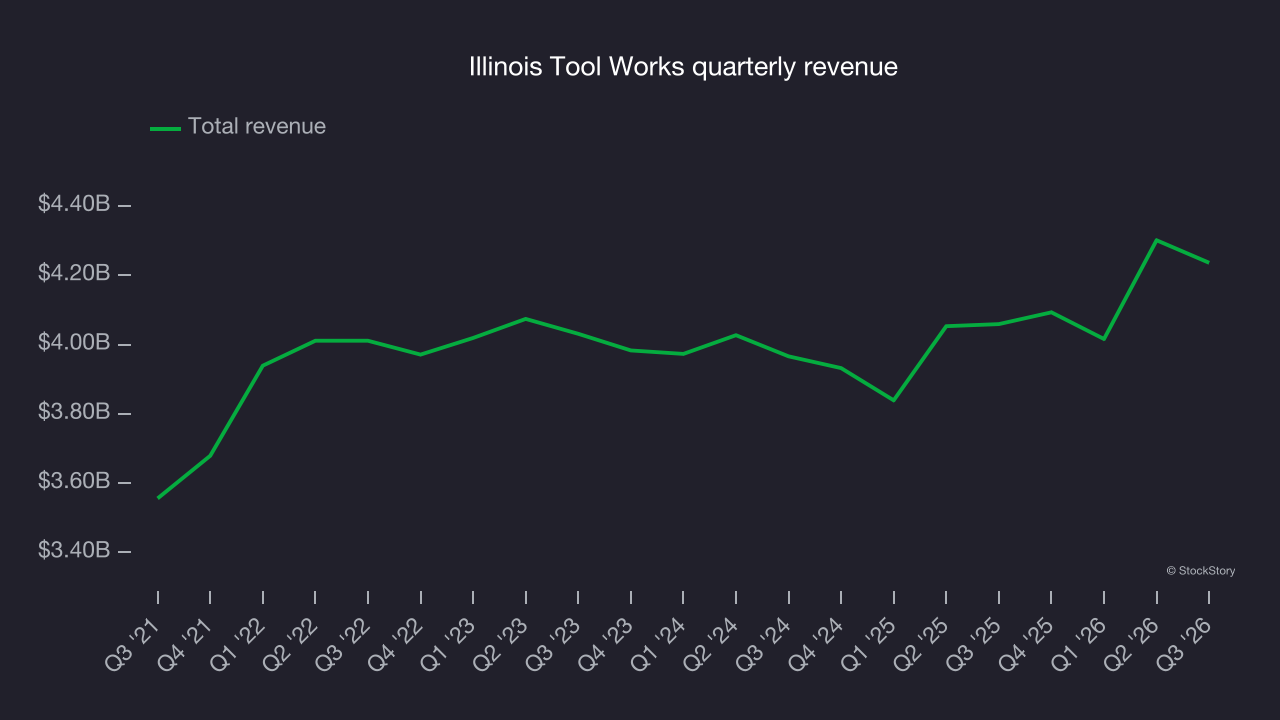
Long-term growth matters most, but within industrials, a half-decade historical view may miss cycles, industry trends or a company capitalizing on catalysts such as a new contract win or a successful product line. Illinois Tool Works’s annualized revenue growth of 2.2% over the last two years aligns with its five-year trend, suggesting its demand was consistently weak. 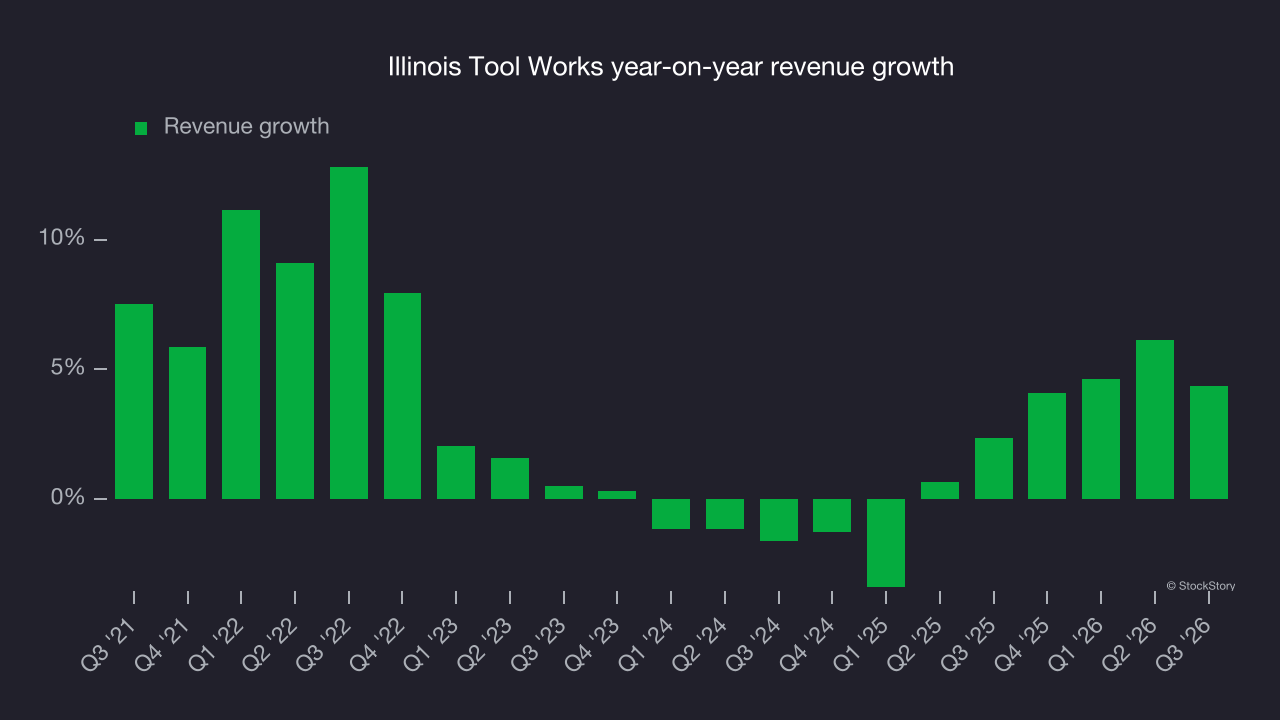
Illinois Tool Works also reports organic revenue, which strips out one-time events like acquisitions and currency fluctuations that don’t accurately reflect its fundamentals. Over the last two years, Illinois Tool Works’s organic revenue averaged 1.2% year-on-year growth. This was in line with its two-year revenue growth, indicating that core operations, not acquisitions and divestitures, drove most of its results. 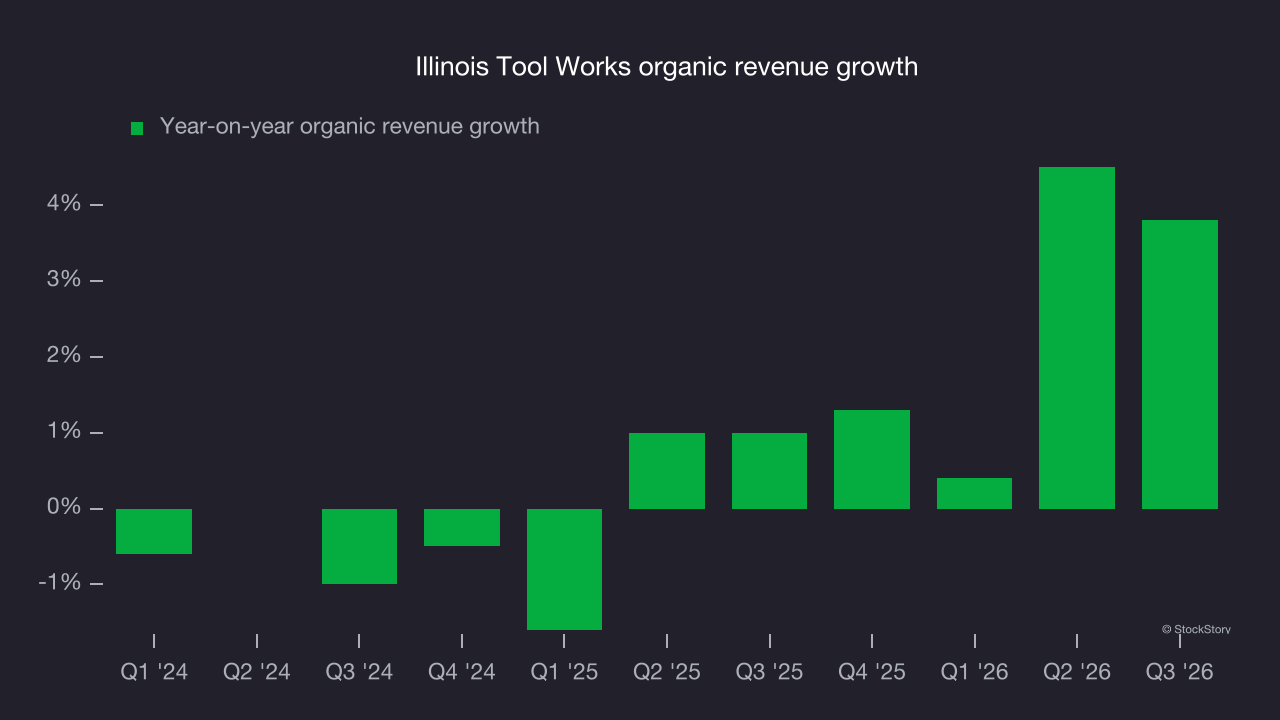
This quarter, Illinois Tool Works’s revenue grew by 4.4% year on year to $4.24 billion, falling short of Wall Street’s consensus estimates.
Looking ahead, sell-side analysts expect revenue to grow 3.8% over the next 12 months, according to S&P. Although this projection implies its newer products and services will fuel better top-line performance, it is still below average for the sector.
Operating margin
Operating margin is a key measure of profitability. Think of it as net income – the bottom line – excluding the impact of taxes and interest on debt, which are less connected to business fundamentals.
Illinois Tool Works has performed well over the last five years. It demonstrated strong profitability for an industrials business, with an average operating margin of 25.5%. This result is unsurprising given its favorable gross margin baseline.
Looking at the trend in its profitability, Illinois Tool Works’s operating margin rose by 3.3 percentage points over the last five years, as its revenue growth gave it operating leverage.
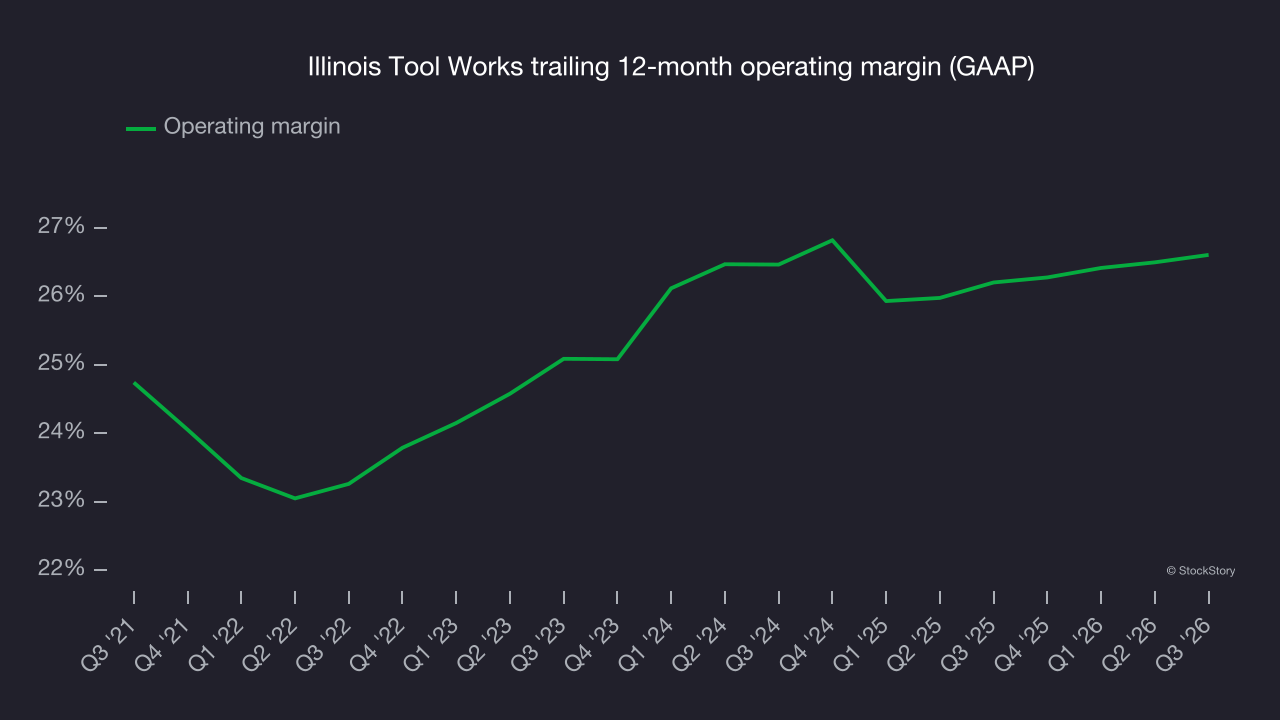
In Q3, Illinois Tool Works generated an operating margin of 27.8%, in line with the same quarter last year. This indicates the company’s cost structure has recently been stable.
Earnings per share
Revenue trends explain a company’s historical growth, but the long-term change in earnings per share (EPS) points to the profitability of that growth. For example, a company could inflate its revenue through excessive spending on advertising and promotions.
Illinois Tool Works’s EPS grew at a 5.5% compounded annual growth rate over the last five years. On the positive side, this outpaced its 3.2% annualized revenue growth, indicating the company became more profitable on a per-share basis as it expanded.
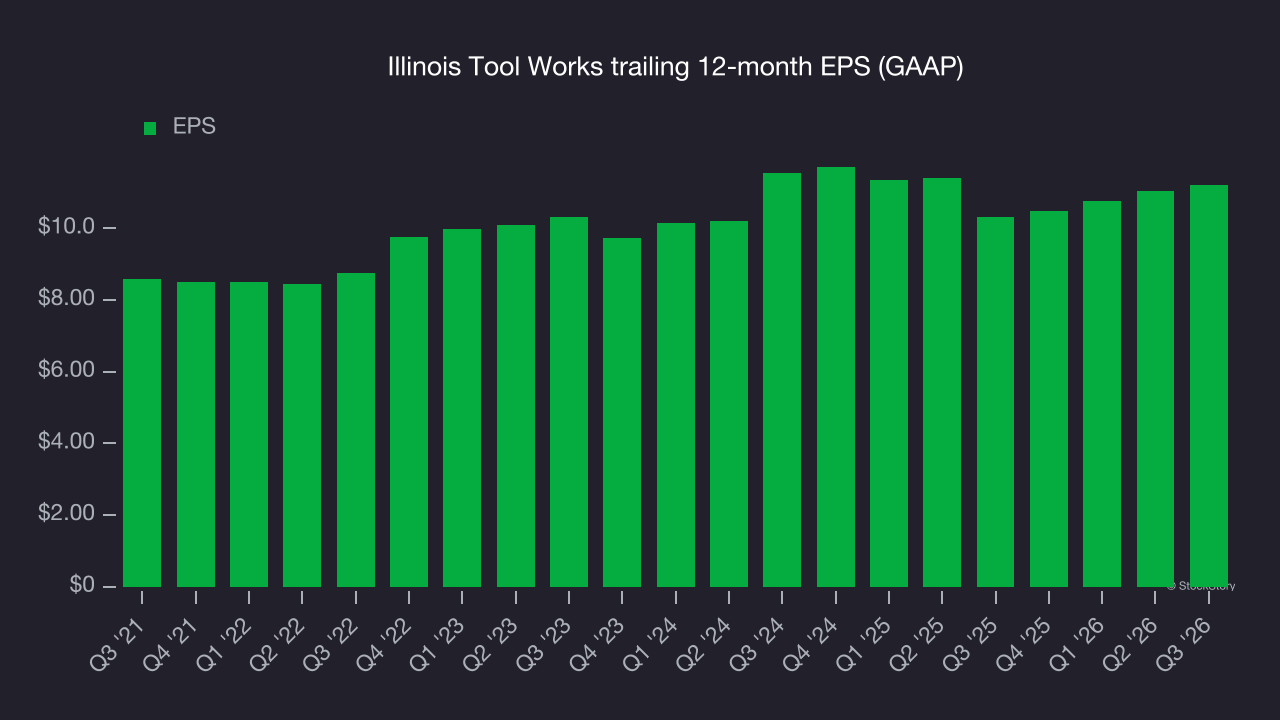
A closer look at Illinois Tool Works’s earnings helps explain its performance. As mentioned earlier, Illinois Tool Works’s operating margin was flat this quarter but expanded by 3.3 percentage points over the last five years. In addition, its share count shrank by 9.7%. These are positive signs for shareholders because improving profitability and share buybacks boost EPS growth relative to revenue growth. 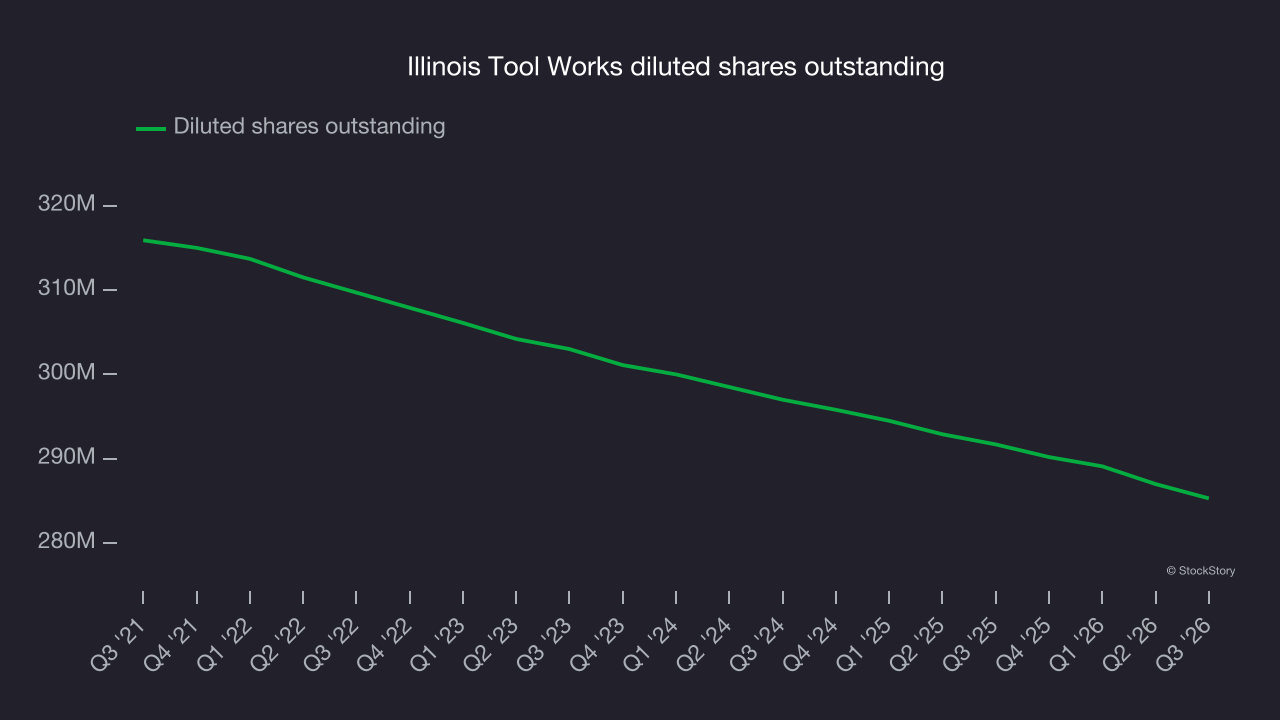
As with revenue, a shorter-term view of EPS can reveal changes in the business.
For Illinois Tool Works, its two-year annual EPS declines of 1.5% show it’s continued to underperform. These results were poor regardless of the time frame.
In Q3, Illinois Tool Works reported EPS of $3, up from $2.81 in the same quarter last year. This result was close to analysts’ consensus estimates. Over the next 12 months, Wall Street expects Illinois Tool Works’s full-year EPS to grow 7% from $11.22 to $12.00, according to S&P.
Key takeaways from Illinois Tool Works’s Q3 results
Illinois Tool Works delivered a weaker quarter, with organic revenue slightly missing expectations and revenue falling slightly short of Wall Street’s consensus estimates. Its full-year EPS guidance offered a positive, coming in slightly above analysts’ consensus estimates. Shares fell 3% to $267.84 immediately after the report.
Illinois Tool Works’s earnings report left more to be desired. Assessing whether this quarter has created a buying opportunity requires considering its valuation, business quality and latest quarterly results. For more on Illinois Tool Works, read the full research report here (it’s free).