Travel technology company Sabre (NASDAQ: SABR) reported Q3 2026 results exceeding the market’s revenue expectations, with revenue up 3.2% year on year to $738.4 million. Its GAAP loss of $0.06 per share was $0.03 above analysts’ consensus estimates.
For more on Sabre, read our free full research report.
Sabre (SABR) Q3 2026 highlights:
- Revenue $738.4 million vs S&P analysts’ consensus estimates of $731.1 million (3.2% year-on-year growth, 1% beat)
- EPS (GAAP) -$0.06 vs analysts’ consensus estimates of -$0.09 ($0.03 beat)
- Adjusted EBITDA $163.7 million vs analysts’ consensus estimates of $154.2 million (22.2% margin, 6.2% beat)
- EBITDA guidance $610 million at the midpoint for the full year, above analysts’ consensus estimates of $588 million
- Operating margin 14.8%, up from 13.1% in the same quarter last year
- Free cash flow -$47.51 million, down from $13.42 million in the same quarter last year
- Total bookings in line with the same quarter last year
- Market capitalization $702.2 million
Revenue growth
A company’s long-term revenue performance is one signal of its overall quality. Any business can experience short-term success, but top-performing ones sustain growth for years. Over the last five years, Sabre grew its revenue at a 13.9% compounded annual growth rate. Though this growth is acceptable on an absolute basis, revenue growth alone is not enough for the consumer discretionary sector, which can display significant earnings volatility. The bar for the sector is particularly high, reflecting the nonessential and hit-driven nature of the products and services offered. Additionally, the five-year growth period starts around Covid, when revenue was depressed before rebounding.
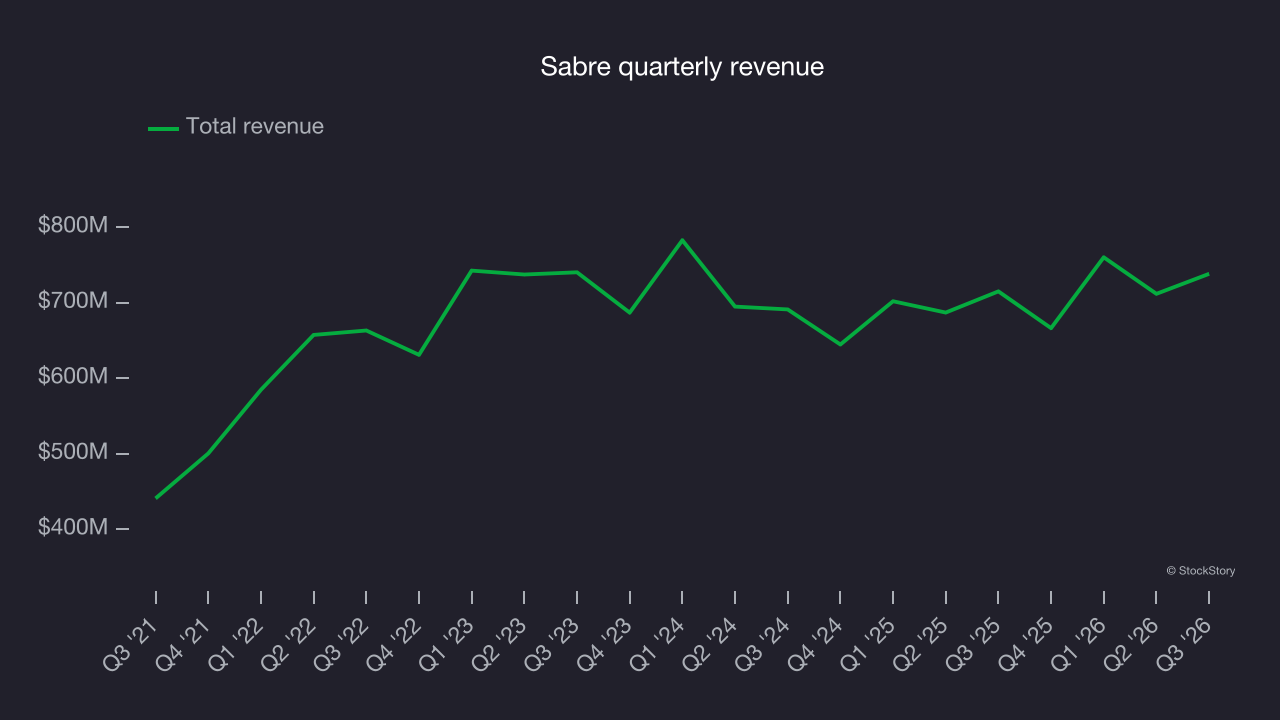
Long-term growth matters most, but within consumer discretionary, a longer historical view may miss a company riding a successful new property or trend. Sabre’s recent performance shows its demand has slowed as its revenue was flat over the last two years. 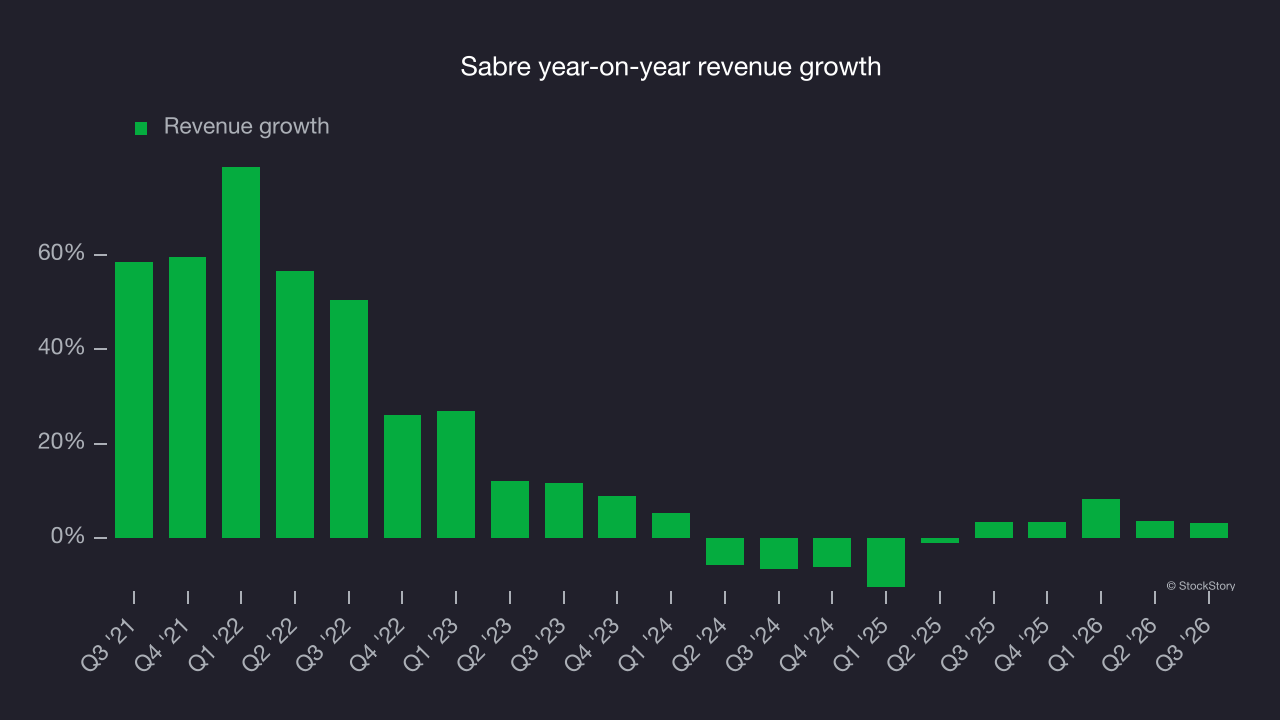
Total bookings, which reached 95.13 million in the latest quarter, offer a closer look at the company’s revenue dynamics. Over the last two years, Sabre’s total bookings averaged 8.5% year-on-year growth. Bookings growth outpaced revenue growth during the same period, indicating that the company’s monetization has fallen. 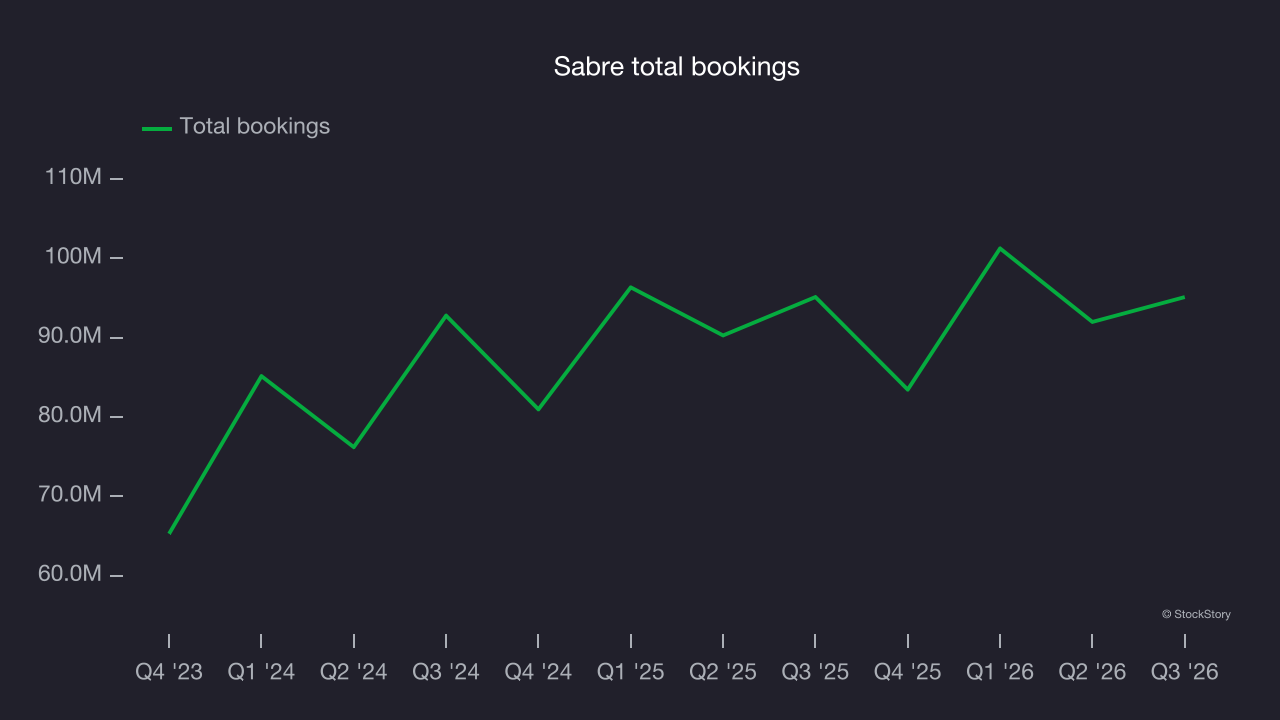
This quarter, Sabre reported modest year-on-year revenue growth of 3.2% but beat Wall Street’s consensus estimates by 1%.
Looking ahead, sell-side analysts expect revenue to grow 3.7% over the next 12 months, according to S&P. Although this projection implies its newer products and services will fuel better top-line performance, it is still below average for the sector.
Operating margin
Sabre’s operating margin has been largely unchanged over the last 12 months, and margin increases driven by economies of scale and cost efficiency are generally preferable over time.
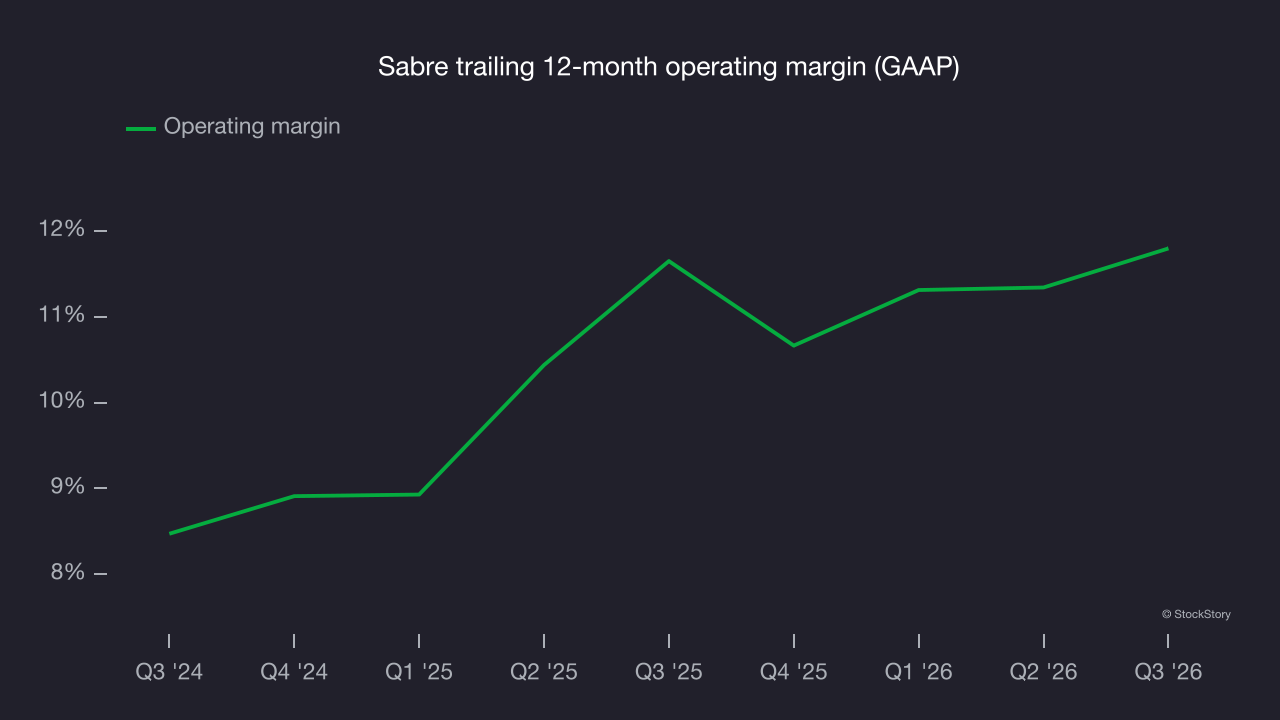
In Q3, Sabre generated an operating margin of 14.8%, up 1.7 percentage points year on year. The increase was a positive sign of improved efficiency.
Earnings per share
Revenue trends explain a company’s historical growth, but the long-term change in earnings per share (EPS) points to the profitability of that growth – for example, a company could inflate its revenue through excessive spending on advertising and promotions.
Although Sabre’s full-year earnings are still negative, it reduced its losses and improved its EPS by 35.1% annually over the last five years. The next few quarters will be critical for assessing its long-term profitability.
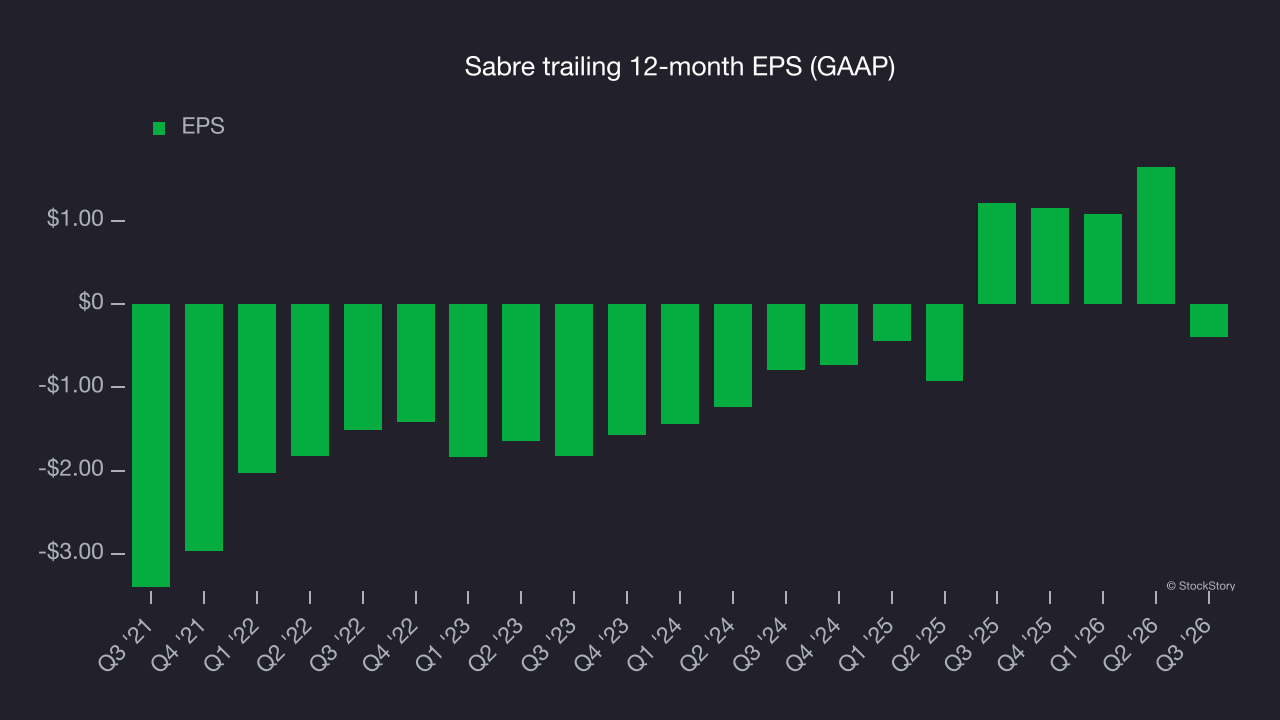
In Q3, Sabre reported EPS of negative $0.06, down from $1.98 in the same quarter last year. Despite falling year on year, the result came in well above analysts’ consensus estimates. Over the next 12 months, Wall Street expects Sabre to narrow its losses. Analysts forecast its full-year EPS will improve from negative $0.39 to negative $0.07, according to S&P.
Key takeaways from Sabre’s Q3 results
Sabre delivered a solid quarter, with EPS topping analysts’ consensus estimates and full-year EBITDA guidance coming in above Wall Street’s consensus. Those were the key positives in the report. Shares surged 5.7% to $1.84 immediately after the release.
Sabre had a solid quarterly earnings result, but is the stock a good investment? The latest quarter matters, but not nearly as much as longer-term fundamentals and valuation when deciding if the stock is a buy. Read the full research report here (it’s free).