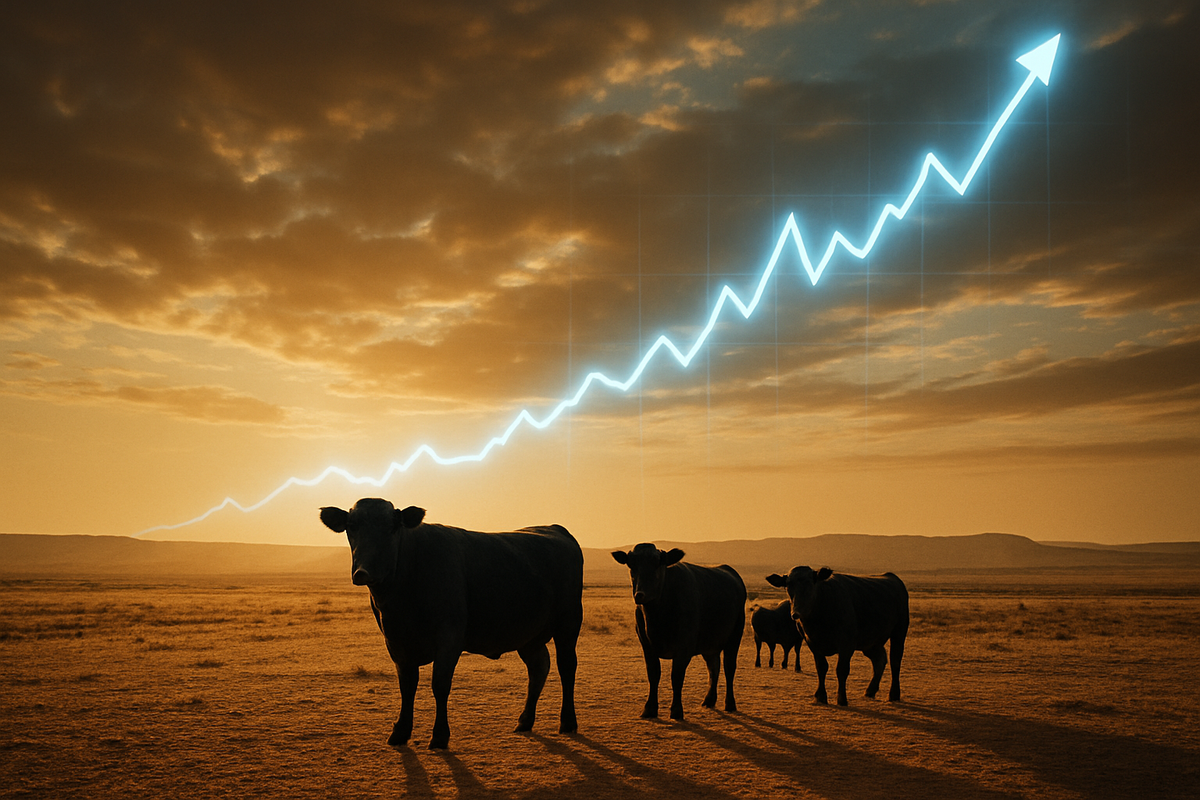
As of March 20, 2026, the American cattle industry is grappling with a structural supply crisis that has pushed livestock prices into uncharted territory. With the national cattle inventory plummeting to its lowest level since 1951, the "perfect storm" of biological constraints, geopolitical trade disruptions, and a decade-long contraction cycle has sent shockwaves through the global food supply chain. For consumers, this translates to record-breaking retail prices, while for the massive processing giants that dominate the market, the era of "cheap beef" appears to be a relic of the past.
The immediate implications are stark: the average retail price for all-fresh beef has surged toward a staggering $10.00 per pound, forcing a significant shift in consumer behavior and corporate strategy. While ranchers are receiving record nominal prices for their calves, the broader industry—from meatpackers to fast-food chains—is navigating a high-stakes environment where procurement costs are eating into margins and testing the limits of consumer price elasticity.
A Decades-Long Low: The Mechanics of the Scarcity
The current crisis is the culmination of a multi-year contraction in the U.S. cattle herd. According to the USDA’s January 2026 inventory report, the total number of cattle and calves in the United States stands at a meager 86.2 million head. This figure represents the smallest national herd in 75 years, a depth of scarcity not seen since the Truman administration. More critically, the beef cow herd—the primary engine of future supply—has dwindled to 27.6 million head, its lowest point since 1961. This contraction is the result of "Year 13" of the current cattle cycle and "Year 8" of a persistent contraction phase driven by severe drought in the Southern Plains and high interest rates that historically disincentivized herd expansion.
The timeline leading to this moment was accelerated by a series of exogenous shocks in late 2024 and throughout 2025. A significant turning point occurred when the U.S. border was closed to Mexican cattle imports to prevent the spread of the New World screwworm. This closure effectively removed a vital "safety valve" of approximately 1.5 million feeder cattle that typically bolster U.S. feedlots annually. Furthermore, the 2025 calf crop was the smallest on record at 32.9 million head, ensuring that the supply of market-ready cattle will remain extremely tight through at least 2027.
Industry reaction has been one of defensive posturing. Feedlots have attempted to mitigate the lack of "head count" by keeping cattle on feed longer, resulting in record-high slaughter weights averaging over 1,460 pounds. However, these heavier carcasses have failed to offset the double-digit percentage drops in total animal numbers. In the livestock pits, negotiated prices for fed steers have reached record peaks, with five-area average forecasts for 2026 hovering between $224 and $240 per hundredweight (cwt).
Corporate Winners and Losers
The impact of this supply crunch is bifurcated across the corporate landscape. Among the "Big Four" meatpackers, Tyson Foods (NYSE: TSN) has faced the most significant headwinds. With a heavy reliance on domestic U.S. beef, Tyson's beef segment is projected to see an operating loss of between $250 million and $500 million for fiscal 2026. To counter this, the company has leaned heavily into its "diversified protein" model, using record profits from its chicken and prepared foods segments to subsidize the losses in its beef division.
In contrast, JBS S.A. (OTC: JBSAY), the world’s largest meat processor, has found a relative advantage through geographic diversification. While its North American beef margins are under pressure, JBS has benefited from booming production in its Australian and Brazilian segments, where cattle cycles are currently in an expansionary phase. Similarly, Marfrig (OTC: MRRTY), which controls National Beef in the U.S., has seen its domestic margins thin to near-zero but remains bolstered by its recent merger with poultry giant BRF S.A., providing a critical hedge against high cattle costs.
In the restaurant sector, the results are equally varied. Texas Roadhouse (NASDAQ: TXRH) has shown remarkable resilience; despite beef making up half of its cost of goods sold, its status as a "value leader" in the steakhouse category has driven a 13% increase in same-store sales as consumers "trade down" from high-end independent steakhouses. Conversely, McDonald’s (NYSE: MCD) has been forced to pivot to a "Value First" doctrine. To protect its margins against $8.00/lb ground beef, the fast-food giant has aggressively expanded its chicken-based menu and launched a permanent "McValue Platform" to retain price-sensitive customers who are increasingly viewing a Quarter Pounder as a luxury item.
The Wider Significance: A Structural Shift
This event is more than a temporary market spike; it represents a structural shift in how protein is produced and consumed in North America. The current crisis fits into a broader trend of "protein volatility," where climate-related drought and aging producer demographics are making the traditional 10-year cattle cycle more unpredictable. Historically, a price peak of this magnitude would trigger rapid herd rebuilding, but in 2026, the "biological lag" is more pronounced. It takes nearly three years from the moment a rancher decides to keep a heifer for breeding until her calf reaches the dinner table, meaning the current scarcity is effectively "baked in" for the next several years.
There are also significant regulatory and policy implications. The Mexico border closure has highlighted the vulnerability of the U.S. supply chain to transboundary animal diseases, leading to calls for increased biosecurity funding and more robust domestic "passport" systems for livestock. Furthermore, the high price of beef is providing a secondary tailwind for competitors in the alternative protein and poultry sectors. Companies like Pilgrim’s Pride (NASDAQ: PPC) are seeing increased demand as grocery retailers like Walmart (NYSE: WMT) and Kroger (NYSE: KR) report a massive "trade-out" where shoppers replace beef roasts with chicken and pork to stay within their monthly budgets.
The Outlook: The Expansion Pivot
Looking ahead to the remainder of 2026 and into 2027, the market is watching for the "Expansion Pivot." For the U.S. cattle herd to recover, ranchers must eventually stop selling young females (heifers) for slaughter and instead keep them for breeding. Paradoxically, this act of rebuilding will temporarily tighten the beef supply even further, as those animals are removed from the immediate food chain. This suggests that while prices may plateau in late 2026, the physical availability of beef will likely reach its absolute nadir in 2027.
Short-term opportunities may emerge for technology companies specializing in precision livestock farming and animal health, such as Zoetis (NYSE: ZTS), as producers look to maximize the productivity and health of every single high-value calf. However, the challenge for the industry remains the "demand cliff." If prices stay at these historic highs for too long, there is a risk of a permanent shift in consumer habits, where beef becomes a "celebratory" protein rather than a dietary staple.
Summary and Investor Watchlist
The 2026 beef market is defined by a historic supply-demand imbalance that has rewritten the playbook for the protein industry. With the U.S. herd at its lowest level in three-quarters of a century, the power has shifted—temporarily—to the producers, while the processing and retail sectors face a grueling period of margin compression and strategic adaptation.
Key Takeaways for Investors:
- The Herd Bottom: 2026 likely marks the cyclical bottom for cattle numbers, but the supply recovery will be slow and may not normalize until 2028-2029.
- Margin Squeeze: Watch for continued earnings volatility in beef-heavy processors like Tyson Foods (NYSE: TSN). Diversified players like JBS (OTC: JBSAY) are better positioned to weather the domestic storm.
- The Chicken Hedge: As beef prices remain elevated, poultry demand is expected to remain robust, benefiting producers like Pilgrim’s Pride (NASDAQ: PPC).
- Retail Resilience: Watch how retailers like Walmart (NYSE: WMT) manage their meat cases; a shift toward private-label "value packs" and beef/pork blends will be a key indicator of consumer stress.
As the industry moves into the second half of 2026, the critical metric to watch will be heifer retention rates. Until those numbers begin to climb, the era of the $10 pound of beef is here to stay.
This content is intended for informational purposes only and is not financial advice.