Shopify (SHOP) reported Q1 2026 results on Tuesday morning before the markets opened. While it beat top and bottom-line estimates for the quarter, its shares fell by nearly 16% on the day due to concerns about slowing growth. The single-day drop doubled its year-to-date losses to 34.5%.
As a Canadian, I’m delighted to see its success. Homegrown tech success stories don’t happen very often in Canada, and when they do, the good news doesn’t usually last. Think Nortel and BlackBerry (BB).
There is no question that Shopify has plenty of supporters and detractors. It comes with disrupting an industry. CEO Tobi Lütke is acutely aware of this.
“A good friend who plays tennis and has fans tells me, ‘No matter what you do, you're going to have haters.’ We were so in the background [as a business-to-business provider], so few people asked what we were doing, we ended up with fans and not haters. They came all at once,” Lütke said in a November 2017 Globe and Mail interview about the tumultuous year.
It’s worked out pretty well in the eight years since. Its market cap at the end of 2017 was $967 million; today, it’s $137 billion.
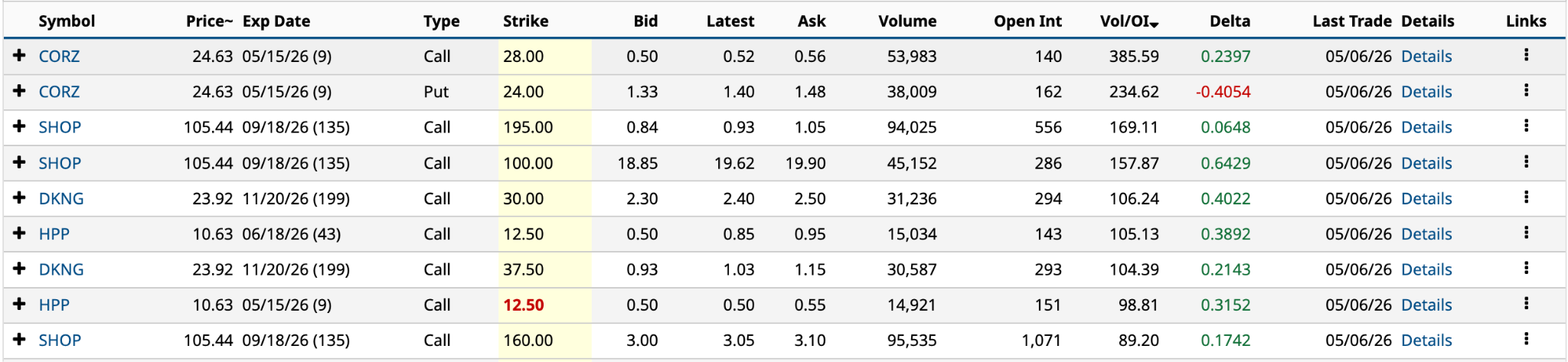
In Wednesday’s unusual options activity, Shopify had three of the top 10 Vol/OI (volume-to-open interest) ratios at 169.11, 157.87, and 89.20. All three were calls; two ITM (in-the-money) and one deep OTM (out-of-money).
In today’s newsletter, I’ll consider some of the options (no pun intended) available to investors, bullish or bearish.
The SHOP Calls in Question
As I said, there were three SHOP calls in the top 10 in yesterday’s unusual options activity -- I define this as options with at least 500 contracts traded and expiring in seven days or more -- all of them expiring on Sept. 18, 134 days or 19 weeks from now.
Not quite LEAPS (Long-Term Equity Anticipation Securities), in today’s market, anything beyond 10 days is relatively rare. For example, in yesterday’s trading, 66% of the contracts traded had DTEs (days to expiration) of 10 days or less. Only 7% were greater than 120 days. The three SHOP calls accounted for 5% of the 120+ DTE volume on the day.
As for Shopify’s options volume yesterday, it was 364,910, about 5.1 times its 30-day average, but 25,410 less than the previous day’s volume, the highest in the past three months.
Clearly, the company’s guidance for approximately 28% Q2 2026 revenue growth -- the percentage growth has been over 30% for four consecutive quarters -- and possibly slightly softer margins, has investors in a betting mood.
The Most Obvious Play
The options flow data from yesterday shows that the three calls had the highest volume of strikes expiring on Sept. 18. In fact, of all the trades of 10 contracts or higher, only five were for strike prices other than $195, $160 or $100.
As you see below, the three unusually active call options in the top 10 all had purchases by big fish. The 92,000 contracts traded for the $160 call accounted for 96.2% of the volume. The 92,000 contracts traded for the $195 call accounted for 97.8% of the volume, while the 45,000 contracts traded for the $100 call accounted for 99.7%.
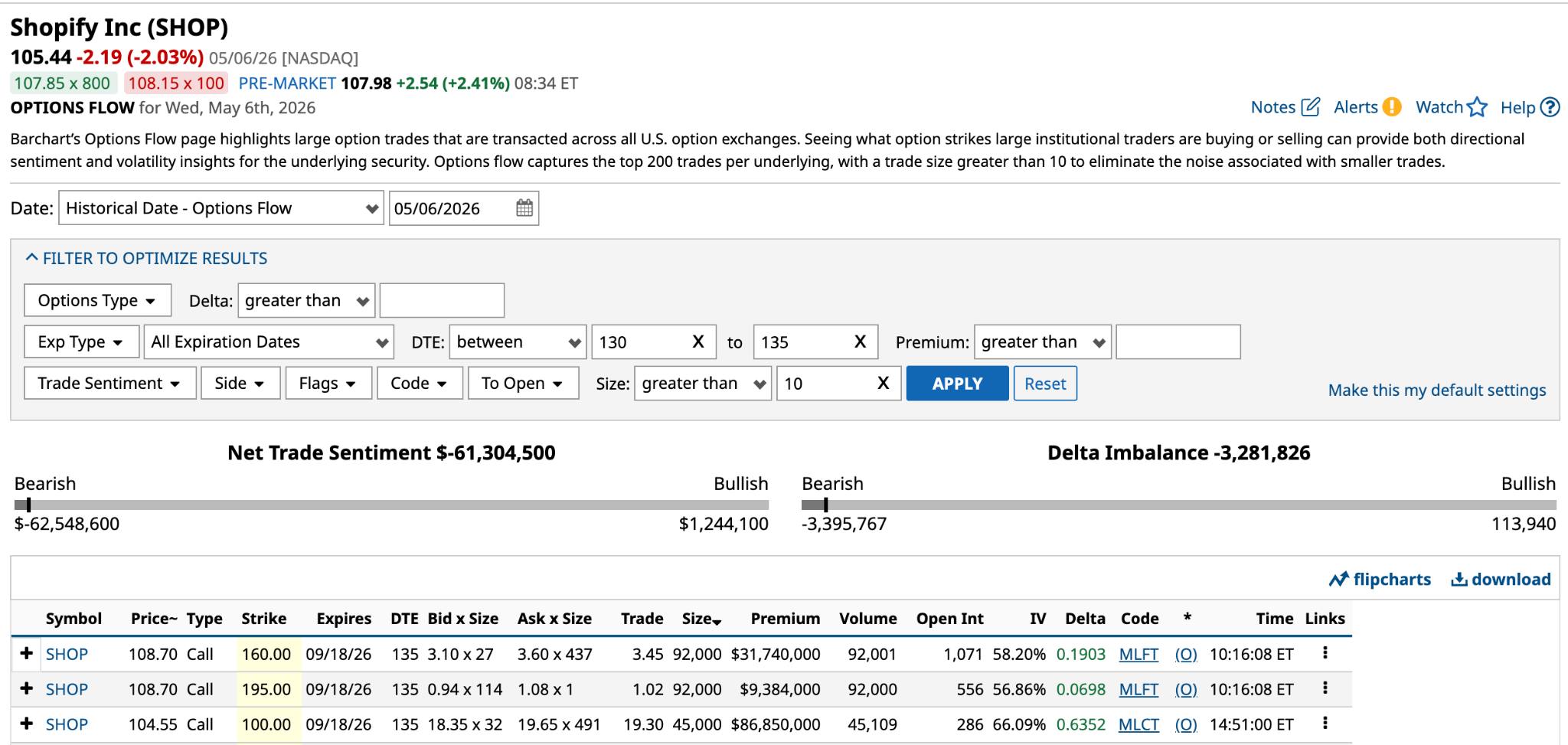
As you can see, the 92,000 contracts for the $195 and $160 calls both happened at 10:16:08 ET. That tells us the big fish was doing a Bull Call Spread, a bet that the shares will rise over the next 4-5 months.
In this bull call spread, the investor bought 92,000 long $160 calls expiring on Sept. 18 and simultaneously sold 92,000 short $195 calls.
So, they could have just paid $31.74 million for the 92,000 long $160 calls, but to lower their cost, they sold 92,000 short $195 calls for $9.38 million in premium, lowering the overall net debit to $22.36 million.
Here’s how the trade looks as I write this at Thursday’s open.

You might be wondering why someone would bet millions (the cost based on the above would be $20.79 million) on a trade that has a 12.5% chance of breaking even at expiration in September.
Simple.
It’s for the large payoff. While risking $20.79 million, the maximum profit would be $301.21 million [$195 call - $160 call - $2.26 net debit * 100 * 92,000] or 1,448.67%. You’re risking 7 cents to generate a $1 of profit.
Let’s assume that the institution behind this trade has $2 billion set aside for options and futures trading. The $20.79 million accounts for 1% of the portfolio. It’s not insignificant, but in the scheme of things, it’s relatively tiny.
But if the maximum profit hits, that $301.21 million profit would add approximately 40.7 percentage points [$301.21 / $2 billion * 365 / 135 DTE] to the overall portfolio’s annual return. That too is not insignificant.
Don’t Forget the $100 Call
The multi-leg trade for 45,000 Sept. 18 $100 calls ITM (in-the-money) could be one of many different options strategies. These include a traditional long call, a bull call spread, a Fiduciary Call, a Poor Man’s Covered Call, and an institutional hedge.
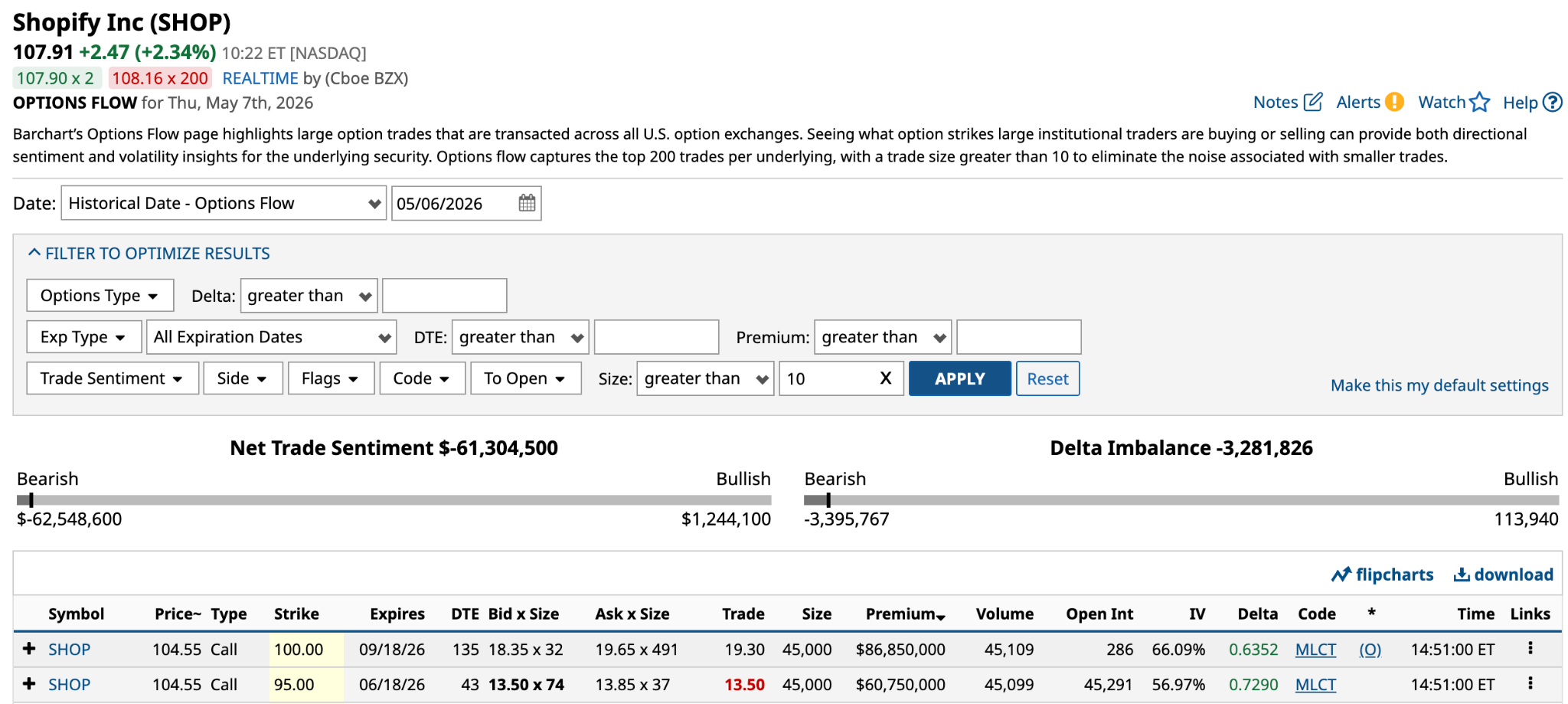
Before deciding on which of these strategies likely played out yesterday, I need to find a corresponding trade for 45,000 contracts that happened at the same time as the $100 call. It was the June 18 $95 call shown below.
Three weeks ago, I discussed how a big fish was rolling Covered Calls on Shopify stock. Wouldn’t you know it, the number of contracts traded on April 15 was 45,000, just like yesterday. The same big fish could be back.
In the example in April, the trader bought 40,000 long May 15 $85 contracts to close the covered call and sold 45,000 short June 18 $95 calls to open a new one. In that trade, they rolled their position up $10 (I mistakenly wrote $5 in my article) and out one month.
Yesterday’s 45,000 trades suggest they repeated the up-and-out move, only this time they moved up $5 and out three months, buying 45,000 June 18 $95 calls to close the position, and selling 45,000 Sept. 18 $100 calls to open a new position.
Very theoretically, let’s assume this institution bought 4.5 million shares of Shopify on Oct. 10, 2022, at its five-year low of $23.63. They’re currently sitting on an unrealized gain of $80.92 per share, based on the share price at 2:51:00 ET when the trades occurred. While that’s an excellent return, SHOP stock hit an all-time high of $182.19 on Oct. 27, 2025.
It’s possible the institution feels the shares have bottomed here and is looking to generate some income as the next leg up gets underway.
On April 15, they generated $153.45 million in premium income for selling the 45,000 short $95 calls. Yesterday, they turned around and bought those calls for $60.75 million to close the position and sold 45,000 short $100 calls for $86.85 million in premium income. That gives it a net gain of $179.55 million, and it extends the expiration date by three months.
It’s a great way to generate income when the share price is retreating, but you’re bullish over the long haul.
On the date of publication, Will Ashworth did not have (either directly or indirectly) positions in any of the securities mentioned in this article. All information and data in this article is solely for informational purposes. For more information please view the Barchart Disclosure Policy here.
More news from Barchart
- Don’t Trust This Top-Heavy Stock Market, Hedge It. Here’s Your Roadmap.
- Unusual Shopify Stock Options Activity Signals a Unique Trade for Income and Upside
- HOOD Stock Bullish Diagonal Trade Targets a Price of $85 by June 18th
- Ahead of Airbnb Earnings, Here Is What Barchart Options Data Shows for ABNB Stock