A step-up transformer raises AC voltage. A step-down transformer does the opposite by bringing high voltage down to a safer, lower level. Both are essential for getting electricity from power plants to your home or business safely. The term step up and down transformer can refer to one unit that handles both jobs, or it can describe the whole category of voltage-changing transformers.
Their main job is to change voltage using the principle of electromagnetic induction. This process makes sure power travels correctly from where it is made to where it is used.
This guide explains both the step up transformer and step down transformer in detail and puts them side by side for easy comparison. We will also look at design choices, reverse feeding, and how to pick the right transformer for your needs.
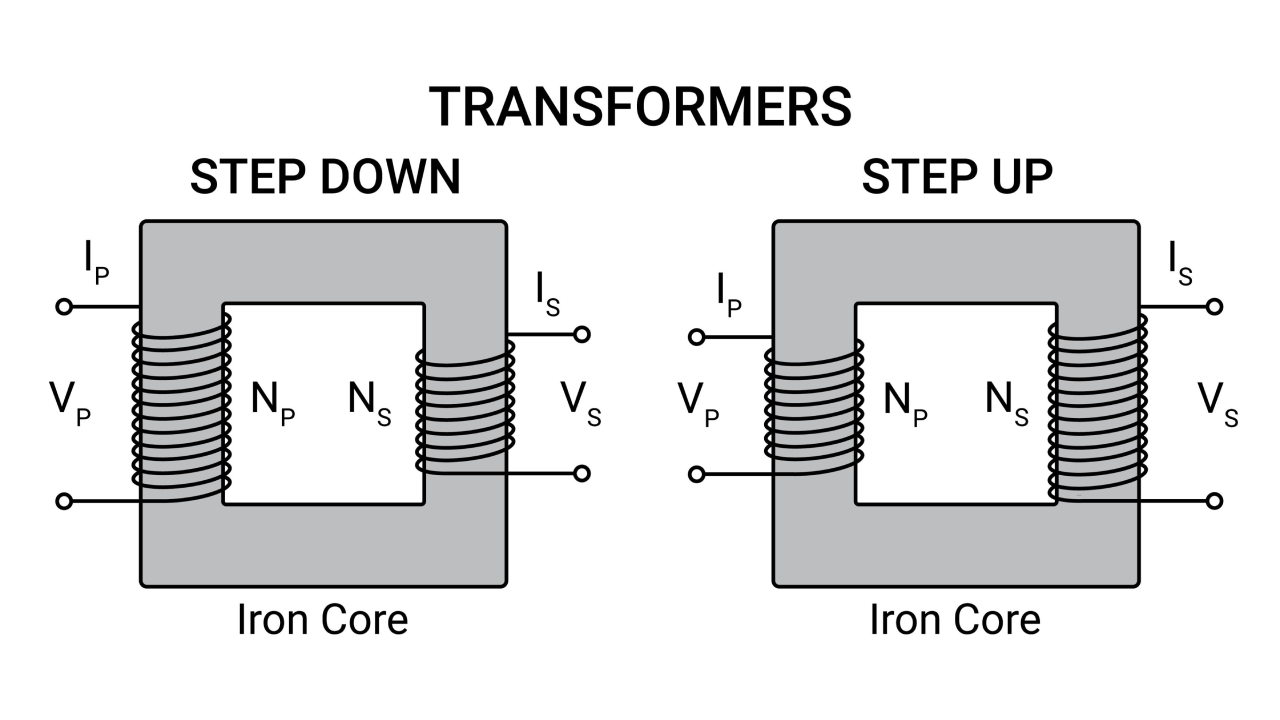
The Step-Up Transformer
Definition and Function
A step up transformer has more turns in its secondary winding than in its primary winding (Ns > Np).
Its job is to raise voltage from a low level to a higher one. When voltage goes up, current goes down, following the rule P = V × I. This reduces power loss over long distances, since less current means less energy wasted as heat in the wires (I²R losses).
Key Applications
Step-up transformers play a key role at power generation stations. They raise the voltage from turbines, for example from 11kV, up to very high levels like 220,000 volts (220kV) or more, so power can travel efficiently over long distances.
They are also used in wind and solar farms to boost voltage before it enters the main power grid. Some industrial machines need a step up transformer because they require higher voltage than the building’s power supply can provide.
The Step-Down Transformer
Definition and Function
A step down transformer has fewer turns in its secondary winding than in its primary winding (Ns < Np).
Its job is to bring high, unsafe voltage down to a lower level that people and devices can safely use. As voltage drops, available current increases, which makes the power suitable for everyday equipment.
Key Applications
Large step-down transformers at distribution substations reduce high transmission voltages to medium levels for neighborhoods.
Pole-mounted or pad-mounted transformers then handle the final voltage drop to household levels, such as 240V or 120V. Smaller step down transformers are also found inside power adapters for electronics and in low-voltage systems like residential doorbell circuits.
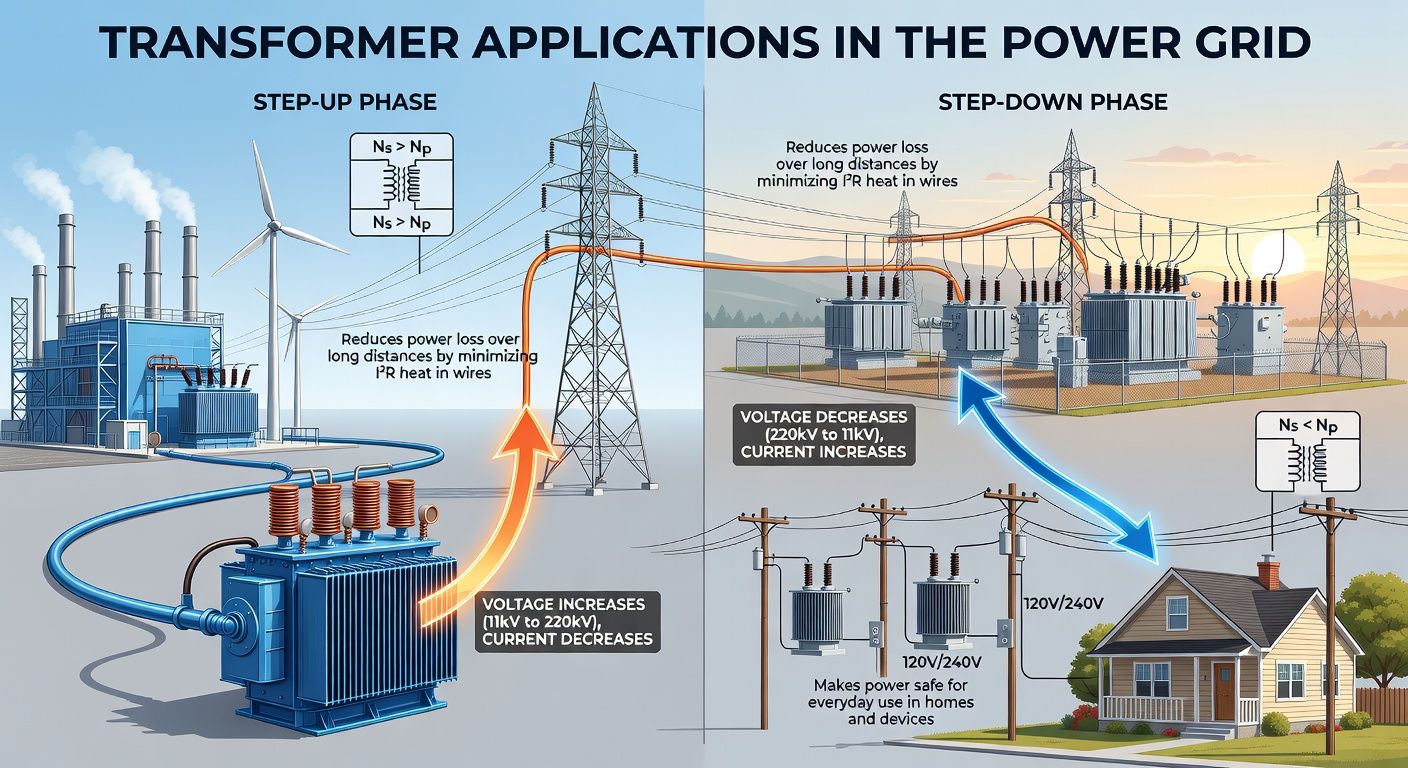
Step-up and Step-down Transformer Key Differences
The table below gives a clear, direct look at the key differences between step-up transformer and step-down transformer
| Feature | Step-Up Transformer | Step-Down Transformer |
|---|---|---|
| Primary Function | Increases output voltage ($V_{out} > V_{in}$) | Decreases output voltage ($V_{out} < V_{in}$) |
| Turns Ratio | Secondary turns ($N_s > N_p$) | Primary turns ($N_p > N_s$) |
| Current | Output current is lower than input current | Output current is higher than input current |
| Primary Winding | Low-voltage side, uses thicker wire | High-voltage side, uses thinner wire |
| Secondary Winding | High-voltage side, uses thinner wire | Low-voltage side, uses thicker wire |
CNC ELECTRICS9-M Series Fully Sealed Oil-Immersed Transformer
Features a fully oil-filled, sealed corrugated tank that naturally adapts to oil expansion. Engineered for high efficiency and low loss to significantly save power consumption and operating costs.
- Sealed corrugated tank for optimal heat dissipation
- High mechanical strength & strong short-circuit resistance
- Low no-load/load loss for maximum energy savings
- Compact, reliable, and 100% maintenance-free

Beyond the Basics
Insulation Requirements
Choosing a transformer means looking at more than just the voltage ratio. The high-voltage side needs much stronger insulation to stop electrical arcing and prevent failure. In a step up transformer, that high-voltage side is the secondary winding. In a step down transformer, it is the primary winding.
Winding Location and Taps
Designers often place voltage-adjustment taps on the primary winding. Because of this, the primary winding is usually the outer coil so workers can reach it easily, and this is one key design difference between dedicated step-up and step-down units.
Vector Grouping
For three-phase systems, winding connections are often set up differently depending on the transformer’s role. Step-up units may use a Wye-Wye setup, while step-down units often use Delta-Wye. These choices help control harmonics and grounding, which directly affects how stable and safe the whole system is.
The “Reverse Feeding” Shortcut
What is Reverse Feeding for Transformer?
Reverse feeding means using a standard step-down transformer as a step-up transformer. You do this by connecting your power source to the low-voltage secondary side and taking power out from the high-voltage primary side. It is a common workaround, but it is important to understand how to identify a transformer and what it was originally built to do before trying this.
Dangers and Complications
While this can work in theory, reverse feeding comes with real risks:
- Inrush Current: The startup current can be far higher than the transformer was designed for, which may trip circuit breakers.
- Voltage Regulation: The output voltage can become unstable under load because the adjustment taps are now on the wrong side of the circuit.
- Safety and Compliance: Codes like NEC 450.11(B) may allow this in some cases, but you must follow the manufacturer’s instructions exactly to stay safe and legal.
Making the Right Choice
Step-up transformers are built for moving power efficiently over long distances. Step-down transformers are built for delivering that power safely to homes, businesses, and devices.
The basic idea is simple, but choosing the right transformer still takes care. You need to match it to your voltage level, power needs, and specific design requirements.
Media Contact
Company Name: CNC ELECTRIC GROUP
Email: Send Email
Country: China
Website: https://www.cnc-power.com/