As the Q2 earnings season wraps, let’s dig into this quarter’s best and worst performers in the specialty retail industry, including Dick's (NYSE: DKS) and its peers.
Some retailers try to sell everything under the sun, while others—appropriately called Specialty Retailers—focus on selling a narrow category and aiming to be exceptional at it. Whether it’s eyeglasses, sporting goods, or beauty and cosmetics, these stores win with depth of product in their category as well as in-store expertise and guidance for shoppers who need it. E-commerce competition exists and waning retail foot traffic impacts these retailers, but the magnitude of the headwinds depends on what they sell and what extra value they provide in their stores.
The 7 specialty retail stocks we track reported a satisfactory Q2. As a group, revenues were in line with analysts’ consensus estimates.
While some specialty retail stocks have fared somewhat better than others, they have collectively declined. On average, share prices are down 4.5% since the latest earnings results.
Weakest Q2: Dick's (NYSE: DKS)
Started as a hunting supply store, Dick’s Sporting Goods (NYSE: DKS) is a retailer that sells merchandise for traditional sports as well as for fitness and outdoor activities.
Dick's reported revenues of $5.59 billion, up 53.2% year on year. This print fell short of analysts’ expectations by 0.9%. Overall, it was a softer quarter for the company with full-year EPS guidance missing analysts’ expectations significantly and full-year revenue guidance slightly missing analysts’ expectations.
"We're proud of our second quarter performance in the DICK'S Business, where we delivered comp sales growth of 4.9% and gained market share despite growing pressure across portions of the athletic footwear and apparel marketplace. Our Q2 results reflect the strength of our athlete-focused strategy, broad differentiated assortment, strong brand partnerships and continued focus on profitable growth opportunities such as House of Sport, GameChanger and DICK'S Media Network. We invested significantly around the FIFA World Cup, and our team delivered outstanding results. While we are taking a more cautious view of the balance of the year, we remain highly confident in the strength of the DICK'S Business and our long-term opportunity at Foot Locker."
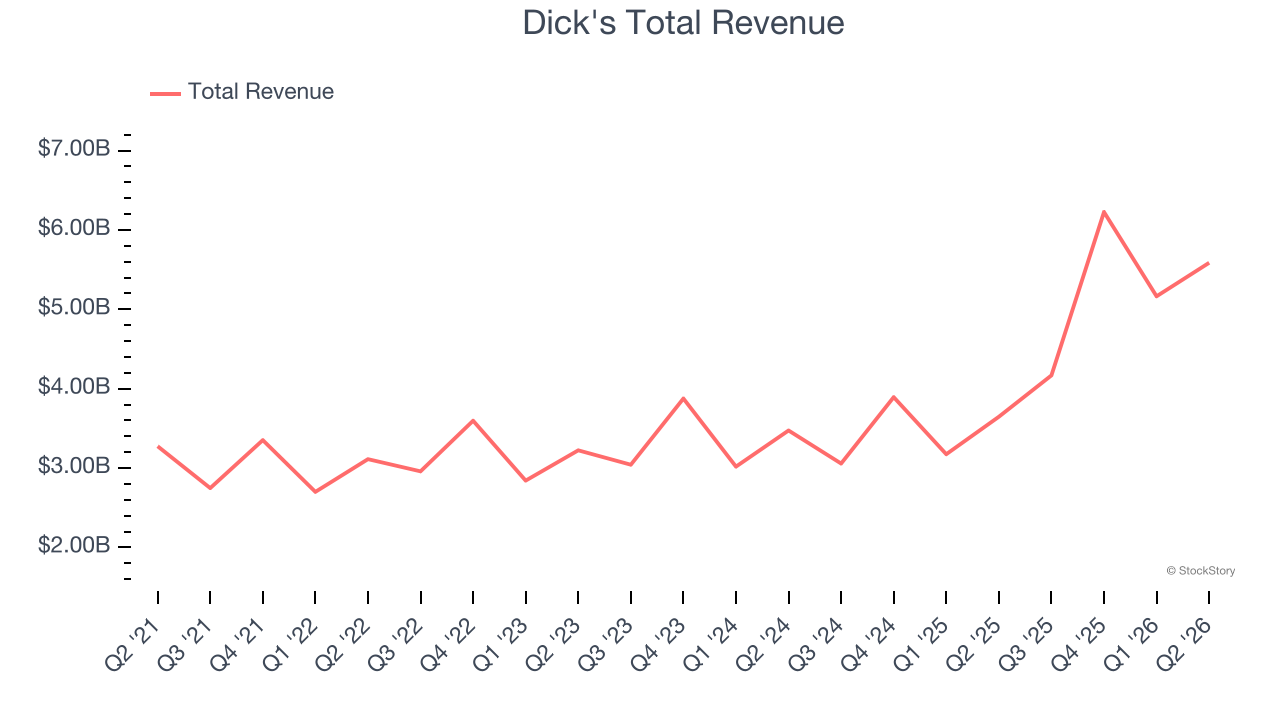
Dick's pulled off the fastest revenue growth but had the weakest full-year guidance update among its peers. Still, the market seems discontent with the results. The stock is down 25.1% since reporting and currently trades at $134.38.
Is now the time to buy Dick's? Access our full analysis of the earnings results here, it’s free.
Best Q2: Sportsman's Warehouse (NASDAQ: SPWH)
A go-to destination for individuals passionate about hunting, fishing, camping, hiking, shooting sports, and more, Sportsman's Warehouse (NASDAQ: SPWH) is an American specialty retailer offering a diverse range of active gear, equipment, and apparel.
Sportsman's Warehouse reported revenues of $295.6 million, flat year on year, in line with analysts’ expectations. The business had a very strong quarter with a solid beat of analysts’ EBITDA estimates and a beat of analysts’ EPS estimates.
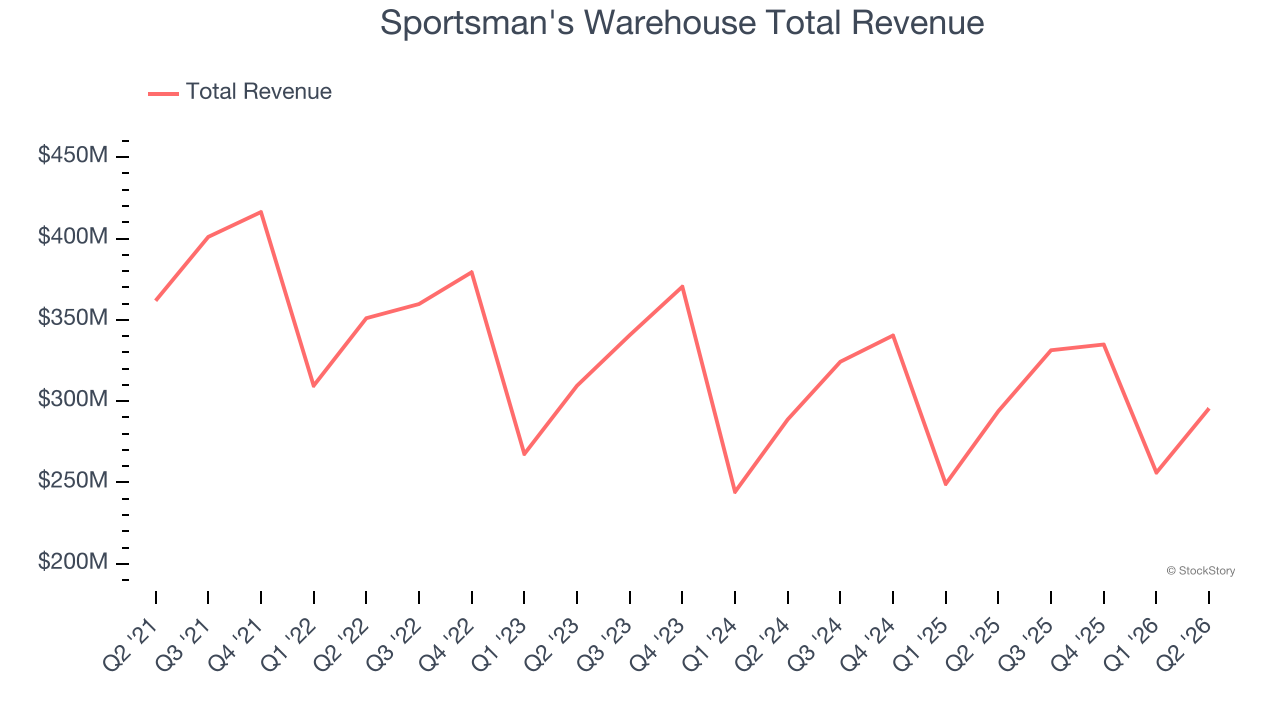
Although it had a fine quarter compared to its peers, the market seems unhappy with the results as the stock is down 2.9% since reporting. It currently trades at $1.17.
Is now the time to buy Sportsman's Warehouse? Access our full analysis of the earnings results here, it’s free.
Sally Beauty (NYSE: SBH)
Catering to both everyday consumers as well as salon professionals, Sally Beauty (NYSE: SBH) is a retailer that sells salon-quality beauty products such as makeup and haircare products.
Sally Beauty reported revenues of $935.5 million, flat year on year, in line with analysts’ expectations. It was a mixed quarter as it posted a decent beat of analysts’ EBITDA estimates but full-year revenue guidance meeting analysts’ expectations.
Interestingly, the stock is up 13.2% since the results and currently trades at $16.95.
Read our full analysis of Sally Beauty’s results here.
Bath and Body Works (NYSE: BBWI)
Spun off from L Brands in 2020, Bath & Body Works (NYSE: BBWI) is a personal care and home fragrance retailer where consumers can find specialty shower gels, scented candles for the home, and lotions.
Bath and Body Works reported revenues of $1.51 billion, down 2.3% year on year. This number topped analysts’ expectations by 1.2%. Aside from that, it was a satisfactory quarter as it also produced a beat of analysts’ EPS estimates but EPS guidance for next quarter missing analysts’ expectations significantly.
Bath and Body Works had the slowest revenue growth of the whole group. The stock is down 7.6% since reporting and currently trades at $16.25.
Read our full, actionable report on Bath and Body Works here, it’s free.
Warby Parker (NYSE: WRBY)
Founded in 2010, Warby Parker (NYSE: WRBY) designs, manufactures, and sells eyewear, including prescription glasses, sunglasses, and contact lenses, through its e-commerce platform and physical retail locations.
Warby Parker reported revenues of $235.5 million, up 9.8% year on year. This print came in 1% below analysts’ expectations. Zooming out, it was a satisfactory quarter as it also recorded a beat of analysts’ EPS estimates but a miss of analysts’ gross margin estimates.
Warby Parker had the weakest performance against analyst estimates among its peers. The company reported 2.71 million active customers, up 4.2% year on year. The stock is down 14.9% since reporting and currently trades at $24.90.
Read our full, actionable report on Warby Parker here, it’s free.
Market Update
Over the past year, investors have been forced to repeatedly answer the same question: what is the market’s biggest risk? The answer has changed several times, and each shift has reshaped market leadership.
Late in 2025 and early 2026, artificial intelligence became the market’s primary uncertainty. Investors questioned whether AI would erode software pricing power and weaken competitive moats as AI made it easier to replicate once-differentiated products.
By the spring, technology took a back seat to geopolitics. The U.S. conflict with Iran briefly became the market’s dominant narrative, raising concerns about oil prices, inflation, and global growth. But as energy markets remained orderly and fears of a prolonged supply disruption faded, investors quickly turned their focus back to fundamentals.
Want to invest in winners with rock-solid fundamentals? Check out our 9 Best Market-Beating Stocks and add them to your watchlist. These companies are poised for growth regardless of the political or macroeconomic climate.