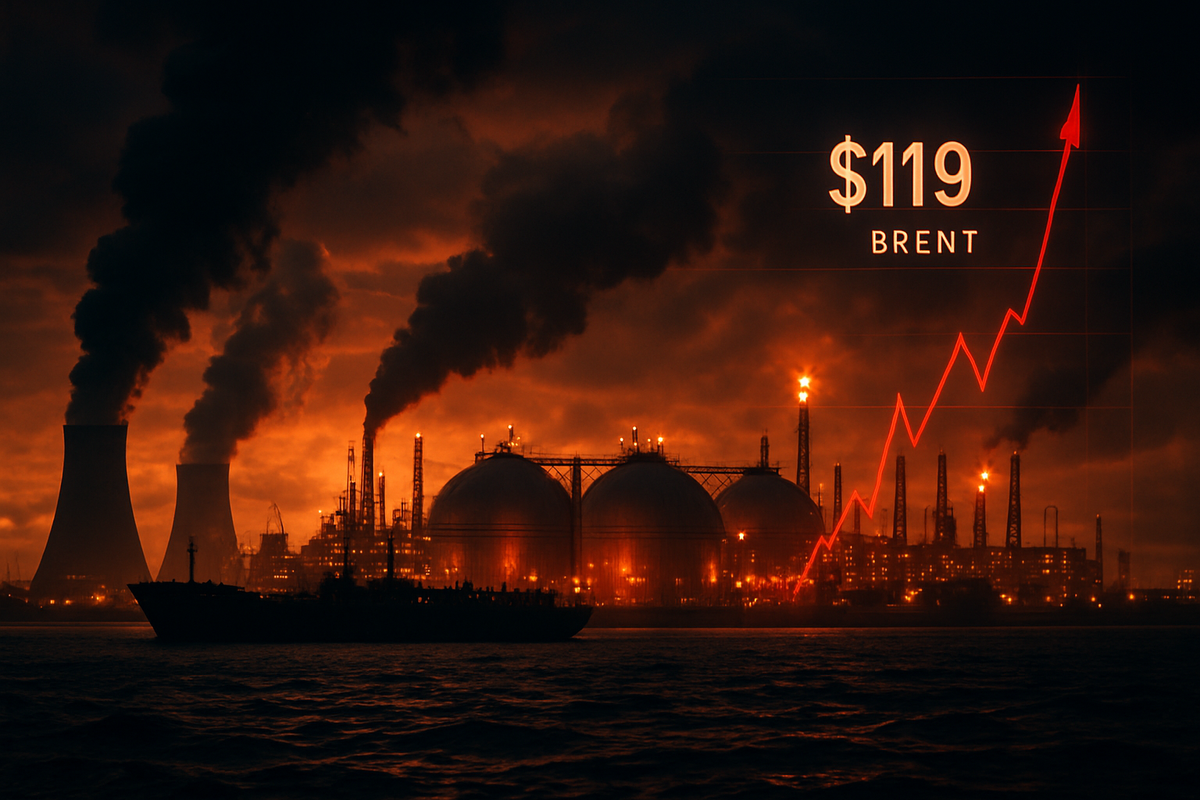
As of March 30, 2026, the global energy landscape is reeling from a series of unprecedented military escalations in the Persian Gulf, culminating in targeted strikes against the Ras Laffan Industrial City in Qatar. The attacks, attributed to Iranian-backed regional actors following a month of heightening tensions, have triggered a massive "geopolitical risk premium" across all energy benchmarks. Brent crude has peaked at $119.45 per barrel, while West Texas Intermediate (WTI) is hovering just under the $100 mark, reflecting deep-seated fears of a sustained disruption to nearly 20% of the world’s liquefied natural gas (LNG) supply and a significant portion of global oil transit.
The immediate implications are staggering: energy-intensive industries in Europe and Asia are already facing supply rationing, and the maritime insurance market for the Persian Gulf has effectively frozen. With the Strait of Hormuz increasingly contested and critical infrastructure at Ras Laffan sustaining structural damage, the "just-in-time" energy delivery model that has sustained the global economy for decades is being fundamentally re-evaluated. Analysts warn that if a diplomatic solution is not reached within weeks, the world could be facing an energy-induced recession unlike anything seen since the 1970s.
The Siege of Ras Laffan: A Timeline of Escalation
The current crisis traces its roots back to late February 2026, when maritime skirmishes between regional powers led to the effective closure of the Strait of Hormuz on February 28. However, the situation turned catastrophic on March 18 and 19, when a sophisticated swarm of drones and precision missiles struck the Ras Laffan complex, the world’s most vital hub for natural gas. The strikes specifically targeted LNG Trains 4 and 6, which are essential to Qatar’s massive export capacity. These hits have knocked out approximately 17% of Qatar’s total export capability—roughly 12.8 million tonnes per annum (MTPA)—forcing QatarEnergy to declare force majeure on several long-term contracts with major buyers in China, South Korea, and the European Union.
The players involved in this crisis span the globe. While Iran and its regional proxies are seen as the primary aggressors, the United States and its allies have scrambled to provide a security umbrella for the remaining infrastructure. The damage to the Pearl GTL (gas-to-liquids) facility, a crown jewel of global fuel technology, has further restricted the availability of high-quality jet fuel and diesel. Military analysts suggest the precision of the strikes indicates a level of technological sophistication that caught regional air defenses off-guard, raising questions about the long-term viability of centralized energy hubs in high-conflict zones.
Initial market reactions were swift and violent. In the 48 hours following the Ras Laffan strikes, European natural gas prices (Dutch TTF) surged by over 23%, as traders realized that the "safety valve" of Qatari LNG was being tightened. The equity markets followed suit, with energy-heavy indices decoupling from the broader market as oil and gas producers saw frantic buying, while transport and manufacturing stocks plummeted on the prospect of soaring input costs.
Corporate Fallout: Winners, Losers, and the Risk to Joint Ventures
The financial impact of the Ras Laffan attacks is being felt most acutely by the international oil companies (IOCs) that have deeply integrated partnerships with QatarEnergy. ExxonMobil (NYSE: XOM) holds a significant stake in the damaged trains and a 25% interest in the North Field East (NFE) expansion, which was slated to provide much of the world's new supply in the coming years. Similarly, Shell (NYSE: SHEL), which operates the Pearl GTL facility and holds nearly 10% of the North Field South (NFS) project, faces a dual blow of infrastructure damage and lost production revenue. For these giants, the crisis represents a multi-billion-dollar hit to their long-term asset valuations and a temporary halt to expected dividend growth from their LNG portfolios.
TotalEnergies (NYSE: TTE) and ConocoPhillips (NYSE: COP) are also heavily exposed, having recently increased their commitments to the North Field expansions. TotalEnergies, the first international partner in the NFS project, is now forced to recalibrate its 2026-2030 earnings projections as repairs at Ras Laffan are estimated to take between three to five years. Conversely, companies with significant domestic U.S. production and export capacity are emerging as the relative winners. Cheniere Energy (NYSE: LNG), the leading U.S. LNG exporter, has seen its stock price surge as global buyers pivot toward American "freedom gas" to fill the Qatari void. Other U.S. players like Chevron (NYSE: CVX) and EOG Resources (NYSE: EOG) are benefiting from the nearly $100 WTI price, though they face their own headwinds from rising service costs and potential export restrictions.
In the engineering and construction sector, Technip Energies (EPA: TE) finds itself in a precarious position. As the lead contractor for the North Field West and South expansions, the company must now manage the logistics of building in a high-risk combat zone. While the demand for repair work and new, more secure infrastructure will ultimately drive revenue, the immediate operational delays and insurance spikes are weighing heavily on their 2026 guidance.
Wider Significance: A Paradigm Shift in Energy Security
The events of March 2026 represent a definitive end to the era of cheap, reliable energy globalization. This crisis fits into a broader trend of "energy regionalization," where nations are prioritizing supply security over cost-efficiency. The vulnerability of Ras Laffan highlights a systemic risk: the over-concentration of global energy production in a few highly volatile geographical points. Historically, the 2019 attacks on Saudi Arabia’s Abqaiq-Khurais plants served as a warning, but the Ras Laffan strikes are more damaging because they affect the world's primary "transition fuel"—natural gas—just as many nations have retired their coal fleets.
The ripple effects are moving through every sector of the global economy. Competitors in the renewables space, such as NextEra Energy (NYSE: NEE), may see a renewed push for domestic solar and wind, but in the short term, the high price of gas is making the manufacturing of wind turbines and solar panels more expensive. Regulatory and policy implications are also mounting; the European Commission is reportedly discussing emergency measures to decouple electricity prices from gas prices, a move that could fundamentally alter the utility sector for decades.
Furthermore, this event is drawing comparisons to the 1973 oil embargo, but with a modern twist. In 1973, the world was dependent on oil; today, the dependency on a global LNG "super-highway" means that a disruption in Qatar has immediate effects on the power grids of Berlin, Tokyo, and Seoul. The historical precedent of using energy as a geopolitical weapon has returned, but with a level of technological precision that makes traditional naval blockades look primitive.
What Lies Ahead: Strategic Pivots and Scenarios
In the short term, the primary challenge will be the repair of the Ras Laffan trains. With specialized parts for mega-trains often having two-year lead times, the global LNG market will remain undersupplied through at least 2028. We may see a strategic pivot where European and Asian nations sign even more aggressive, long-term deals with U.S. and Australian producers, potentially leading to a "super-cycle" in American LNG infrastructure investment. However, these projects take years to come online, leaving a dangerous gap in the 2026–2027 window.
Market opportunities may emerge in the form of "floating storage and regasification units" (FSRUs) and increased investment in nuclear energy as a stable baseload alternative. Companies like NuScale Power (NYSE: SMR) could see accelerated regulatory approval as governments seek to diversify away from gas. However, the immediate challenge remains the "risk premium" in the oil market. If the Strait of Hormuz remains contested, we could see Brent crude test the $140–$150 range, a level that would almost certainly trigger a global economic contraction.
Summary and Investor Outlook
The March 2026 Middle East energy crisis has fundamentally rewritten the rules for energy investors. The attacks on Ras Laffan have removed a massive chunk of global supply at a time when demand was already near record highs. Key takeaways include the realization that the geopolitical risk premium is back with a vengeance, and that the energy transition will be significantly more volatile and expensive than previously forecasted.
Moving forward, the market will be hyper-sensitive to any news regarding the reopening of the Strait of Hormuz and the progress of repairs in Qatar. Investors should watch for the next round of earnings calls from major IOCs like ExxonMobil and Shell for clarity on the financial impact of the force majeure declarations. Additionally, the role of the U.S. Strategic Petroleum Reserve (SPR) and potential coordinated releases by the International Energy Agency (IEA) will be critical in stabilizing the WTI price near $100. In the coming months, the focus will shift from "growth" to "resilience," as the world learns to navigate a new era of energy insecurity.
This content is intended for informational purposes only and is not financial advice