On January 22, 2026, the consumer staples giant Procter & Gamble (NYSE: PG) delivered a fiscal second-quarter report that served as a stark barometer for the health of the global consumer. While the company managed to lean on its vast operational efficiencies to eke out an earnings beat—reporting a core earnings per share (EPS) of $1.87 against an expected $1.86—the victory was hollowed out by a notable miss on the top line. Revenue for the quarter ending December 31, 2025, fell short of Wall Street's expectations as shipment volumes dipped, signaling that the aggressive price hikes that sustained the company through years of inflation have finally met their match in a fatigued and cash-strapped public.
The immediate market reaction was one of trepidation. Shares of the Cincinnati-based powerhouse struggled in early trading, reflecting a growing consensus among investors that the "pricing power" narrative may have run its course. For years, P&G and its peers successfully passed on rising raw material costs to consumers, but the current quarter’s 1% decline in organic volume suggests a pivotal shift. As households face the double whammy of high interest rates and the expiration of pandemic-era social safety nets, the world’s largest consumer goods company is finding that its most loyal customers are beginning to trade down or opt out entirely.
A Precarious Balance: EPS Beats While Volumes Bleed
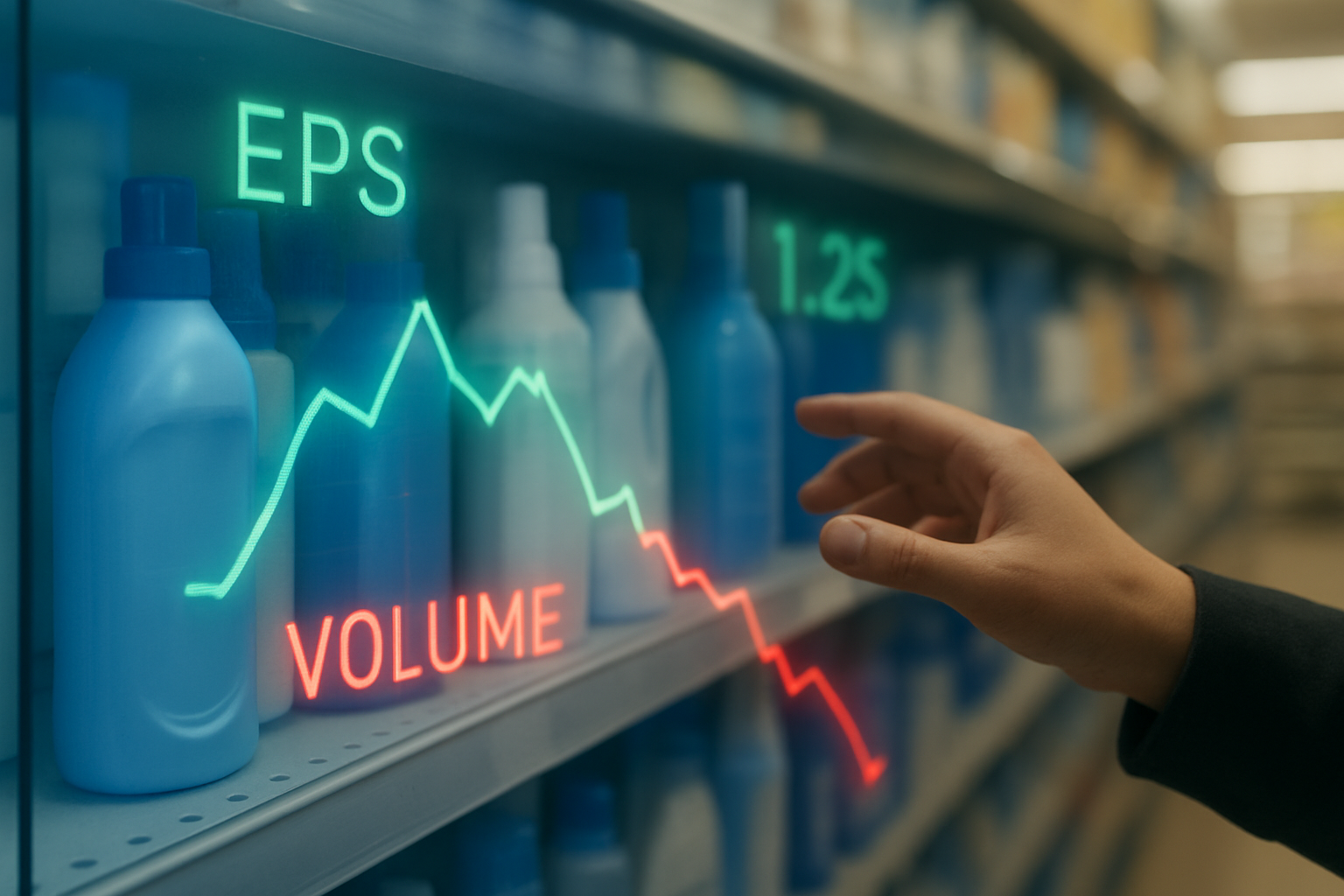
The fiscal second quarter was defined by a delicate tug-of-war between margin protection and market share. P&G's ability to deliver $1.87 in core EPS was largely credited to a robust productivity program and lower-than-anticipated commodity costs, which provided a much-needed tailwind to gross margins. However, total revenue of $22.21 billion failed to meet the $22.35 billion consensus, illustrating a stagnation in growth. The company’s organic sales growth remained flat, as a 1% increase in pricing was completely negated by a 1% drop in the volume of goods shipped to retailers.
The timeline leading to this moment has been marked by increasing macroeconomic friction. Management pointed to several "non-recurring" headwinds that soured the quarter, including a partial U.S. government shutdown in late 2025 and significant reductions in Supplemental Nutrition Assistance Program (SNAP) benefits. These factors disproportionately affected P&G’s Baby, Feminine, and Family Care segment, where organic sales plummeted by 4%. CEO Jon Moeller noted that the "consumer environment is evolving rapidly," acknowledging that the tailwinds of the past three years have transitioned into a more challenging, price-sensitive headwind. Initial reactions from analysts at major banks suggested that while P&G remains a defensive "gold standard," the lack of volume growth is a red flag for the entire sector.
Winners and Losers: The Shifting Staples Landscape
In the wake of P&G's report, the competitive landscape is being redrawn. The primary "winners" in this environment appear to be private-label manufacturers and value-oriented retailers like Walmart (NYSE: WMT) and Costco (NASDAQ: COST), which are capturing the "trade-down" traffic from premium brands. As consumers pull back on $15 packs of Pampers or high-end Tide pods, they are increasingly turning to "store brands" that offer similar efficacy at a 20-30% discount.
Conversely, P&G's direct competitors are feeling the heat. Kimberly-Clark (NYSE: KMB), which is set to report earnings next week, saw its stock price soften in sympathy with P&G, as investors fear the same volume declines will plague its diaper and tissue businesses. Unilever (NYSE: UL) and Colgate-Palmolive (NYSE: CL) are also in the crosshairs; while Unilever has a larger footprint in emerging markets that may buffer some U.S. weakness, the stagnation of the North American consumer remains a significant drag on their global outlook. Companies that lack P&G’s scale to cut costs and maintain margins through productivity will likely see much sharper earnings contractions if volume trends do not reverse.
The End of the Pricing Era?
The P&G report is more than just a corporate update; it is a signal of a broader industry inflection point. For nearly three years, the consumer staples sector has defied gravity by raising prices at double-digit rates without seeing a corresponding collapse in demand. This "inelasticity" was driven by excess savings and a lack of alternatives. However, the Q2 results suggest that the "elasticity" of demand has returned with a vengeance. This fits into a wider trend of "consumer exhaustion," where even essential goods are being scrutinized for their value proposition.
Historically, when shipment volumes decline for a market leader like P&G, it forces a shift in strategy from "price-led growth" to "promotion-led growth." This often triggers a margin-eroding price war as competitors fight for a shrinking pie of consumer dollars. Regulatory scrutiny could also increase; as P&G continues to report earnings growth (via EPS) while volume declines, some policymakers may point to "greedflation," potentially leading to calls for more aggressive oversight of consumer pricing practices in an election year.
Looking Ahead: A Strategic Pivot to Volume
The short-term outlook for P&G and the staples sector is likely to be characterized by "heavy lifting" on the innovation front. To win back the volume lost this quarter, P&G will likely need to increase its marketing spend and promotional activity, which could put pressure on the very margins that saved its EPS this quarter. Investors will be watching closely for a "strategic pivot" toward entry-level price points—smaller pack sizes or lower-tier brands—to recapture the value-conscious shopper without alienating the premium segment.
In the long term, the company faces the challenge of navigating a world where the U.S. consumer is no longer an unstoppable engine of growth. Potential scenarios include a protracted period of flat organic growth as the company waits for real wage growth to catch up with the cumulative inflation of the 2020s. If the U.S. economy enters a deeper recession, the pressure to cut prices could become existential for smaller players, potentially leading to a wave of consolidation in the consumer goods space as P&G and its largest rivals look to acquire niche brands with high loyalty.
The Bottom Line for Investors
The takeaway from P&G's fiscal second quarter is clear: the era of easy growth through price hikes is over. While the company’s ability to beat EPS estimates by a penny demonstrates its legendary operational discipline, the revenue miss and volume decline are the numbers that truly matter for the long-term health of the stock. P&G remains a formidable fortress, but even a fortress can be besieged by a consumer who simply cannot afford to keep the lights on and the laundry clean at current prices.
As we move forward into 2026, the market will likely reward companies that can prove they can grow through volume and innovation rather than just price adjustments. Investors should keep a close eye on upcoming reports from Kimberly-Clark and Unilever to see if P&G’s volume struggle is an isolated incident or, as many fear, a systemic cooling of the global consumer. The next six months will be a test of whether the "staples" are truly as essential as their name implies.
This content is intended for informational purposes only and is not financial advice.