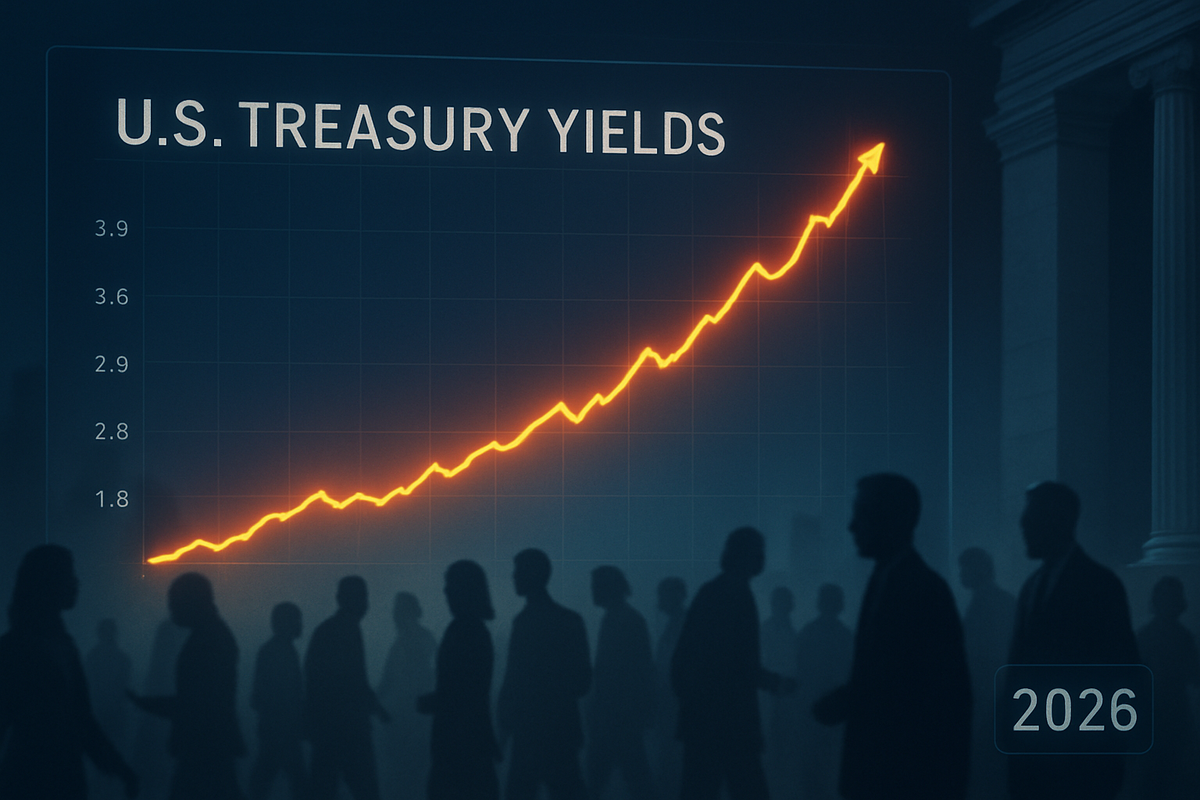
As 2025 draws to a close, the U.S. Treasury market is experiencing a significant repricing that has caught many fixed-income investors off guard. A series of robust labor market data points, culminating in a surprising drop in jobless claims, has sent yields on the 10-year Treasury note climbing back toward the 4.20% mark. This late-year surge effectively dampens expectations for an aggressive easing cycle in early 2026, as the "no landing" economic scenario gains renewed traction among Wall Street analysts and Federal Reserve officials alike.
The immediate implication of this yield spike is a tightening of financial conditions just as the market prepares for the new year. For bond investors, the promise of capital gains from falling rates has been replaced by a "higher-for-longer" reality 2.0. With the 10-year yield ending the year near 4.14%, up from its autumn lows, the market is signaling that the U.S. economy remains far more durable than the recessionary fears of mid-2025 had suggested. This resilience is forcing a total recalibration of portfolio strategies heading into the first quarter of 2026.
The Jobless Claims Catalyst and the Yield Response
The primary driver of this recent market volatility was the Department of Labor’s final December report, which showed initial jobless claims plummeting to 199,000. This figure broke the psychologically significant 200,000 barrier and represented the lowest non-holiday level seen in nearly a year. The data arrived as a shock to a market that had been focused on a rising unemployment rate, which recently hit 4.6%. The disconnect between low layoffs and a higher unemployment rate suggests a "labor hoarding" environment where firms are reluctant to let go of existing staff despite a slowdown in new hiring.
This labor market tightness has directly influenced the Treasury curve. Throughout 2025, yields had been on a general downward trend as the Federal Reserve initiated three rate cuts, bringing the federal funds rate to a range of 3.50%–3.75%. However, the December claims data acted as a firm floor. Investors quickly realized that if the labor market is not cracking, the Fed has little incentive to continue cutting rates into restrictive territory. The 10-year Treasury yield, which had dipped below 4.00% in November, surged back to 4.14% in the final weeks of the year, reflecting a market that is now pricing in a much slower pace of easing for 2026.
The timeline leading to this moment was further complicated by a 43-day federal government shutdown in the fourth quarter of 2025. The shutdown initially created "noise" in the economic data, leading some investors to believe the economy was cooling faster than it actually was. As the data cleared in late December, the underlying strength of the private sector became undeniable. Key stakeholders, including bond vigilantes and institutional pension funds, have pivoted from buying the long end of the curve to a more defensive, short-duration posture as the "Goldilocks" narrative of 2025 begins to fray.
Initial market reactions have been swift. The iShares 20+ Year Treasury Bond ETF (NASDAQ: TLT) saw a sharp decline in the final two weeks of December, erasing nearly two months of gains. Meanwhile, the inversion of the yield curve—a fixture of the last few years—has shown signs of further "bear steepening," where long-term rates rise faster than short-term rates. This shift suggests that while the Fed may be done with aggressive hikes, the market is demanding a higher term premium to hold long-term debt in an environment of persistent fiscal deficits and resilient employment.
Winners and Losers in a Rising Yield Environment
The banking sector stands out as a primary beneficiary of this yield curve steepening. Large-cap institutions like JPMorgan Chase & Co. (NYSE: JPM) and Bank of America Corp. (NYSE: BAC) are well-positioned to see an expansion in their Net Interest Margins (NIM). As long-term rates rise, these banks can charge more for mortgages and corporate loans, while their funding costs remain somewhat anchored by the Fed’s previous cuts. Regional players such as Fifth Third Bancorp (NASDAQ: FITB) and PNC Financial Services Group Inc. (NYSE: PNC) are also expected to see a boost in profitability as they head into 2026 with a more favorable lending backdrop.
Conversely, the real estate sector continues to face significant headwinds. High Treasury yields serve as the benchmark for commercial lending, and the recent surge has made refinancing more expensive for property owners. Prologis Inc. (NYSE: PLD), a leader in industrial real estate, and Equinix Inc. (NASDAQ: EQIX), a dominant player in the data center space, have managed to stay resilient due to the structural demand for AI infrastructure. However, broader real estate investment trusts (REITs) that lack these specific growth drivers are likely to struggle as the cost of capital remains elevated, potentially leading to a divergence in performance across the sector in early 2026.
The utilities sector presents a complex picture. Traditionally viewed as "bond proxies," utilities like NextEra Energy Inc. (NYSE: NEE) and The Southern Company (NYSE: SO) often see their stock prices fall when Treasury yields rise, as investors opt for the safety of government bonds. However, the massive surge in electricity demand from AI-driven data centers is providing a unique growth cushion. While Duke Energy Corp. (NYSE: DUK) and its peers must contend with higher debt-servicing costs on their massive capital expenditure projects, their ability to grow dividends at a 10% clip may keep them attractive to income-seeking investors even with the 10-year yield at 4.14%.
Broader Significance and Historical Context
The recent surge in yields fits into a broader industry trend of "structural resilience." For much of the post-2020 era, economists predicted that high interest rates would inevitably lead to a "hard landing." Yet, as of the end of 2025, the U.S. economy has repeatedly defied these forecasts. This event mirrors the "Higher for Longer" period of late 2023, but with a critical difference: inflation is much closer to the Fed's 2% target now than it was then. This suggests that the current yield surge is driven more by real economic growth and a "no landing" scenario than by a desperate scramble to contain runaway prices.
The ripple effects extend beyond U.S. borders. As U.S. yields rise, the dollar remains strong, putting pressure on emerging market central banks to keep their own rates high to prevent capital flight. This creates a global environment where the cost of borrowing remains stubbornly high, even as inflation moderates. Historically, such periods have often led to a "repricing of risk," where investors move away from speculative assets and toward high-quality, cash-generating companies. The current situation draws comparisons to the late 1990s, where a strong labor market and technological shifts allowed the economy to absorb higher rates without falling into recession.
From a policy perspective, the Federal Reserve is now in a difficult position. The "dot plot" released in mid-December suggests that many FOMC members are turning hawkish again. If jobless claims remain below 200,000 through the first quarter of 2026, the Fed may be forced to abandon its plan for further rate cuts entirely. This would represent a significant policy shift from the "normalization" narrative that dominated most of 2025. Regulatory focus may also shift toward the stability of regional banks, ensuring they are adequately hedged against further volatility in the long end of the Treasury curve.
Looking Ahead to 2026: Strategies and Scenarios
In the short term, investors should prepare for continued volatility in the bond market. The first major test for the "no landing" thesis will be the January jobs report. If payroll growth remains strong and jobless claims stay near historic lows, the 10-year yield could easily test the 4.50% level. Strategic pivots will likely involve a move toward "barbell" strategies—holding very short-term cash equivalents to capture current yields while selectively adding high-quality corporate bonds that offer a spread over Treasuries.
Long-term, the market must adjust to a new "terminal rate" reality. The days of 0% or even 2% interest rates appear to be a relic of the past. Markets are now pricing in a terminal federal funds rate of 3.25% to 3.50% for the foreseeable future. This requires a fundamental adaptation for growth-oriented companies that relied on cheap debt for expansion. Market opportunities may emerge in "value" sectors that have been unloved for a decade but thrive in an environment where capital has a real cost and the yield curve is positively sloped.
Potential scenarios for 2026 range from a "Goldilocks" continuation—where growth stays positive and yields stabilize—to a more disruptive "inflationary resurgence" if the labor market tightness leads to a new wage-price spiral. Investors will need to watch for any signs of a "policy error" by the Fed; if they pause too soon, inflation could re-accelerate, but if they stay too high for too long, the delayed impact of the 2025 rates could eventually trigger the recession that has so far been avoided.
Summary and Final Thoughts for Investors
The year 2025 is ending on a note of defiance. The U.S. labor market’s refusal to cool has effectively reset the stage for the global financial markets. Key takeaways include the fact that jobless claims are currently the most critical indicator for bond pricing, and the Federal Reserve’s path in 2026 is far less certain than it appeared just three months ago. The surge in yields to 4.14% is a clear signal that the economy is running hot, and the "risk-free" rate is no longer a falling target.
Moving forward, the market will likely be characterized by a greater focus on quality and yield. Investors should monitor the spread between the 2-year and 10-year Treasury notes, as a sustained un-inversion of the curve would signal a more traditional economic expansion phase. The performance of the banking and utility sectors will serve as a bellwether for how the broader equity market is handling the reality of sustained 4% yields.
In the coming months, the focus will remain on the Federal Reserve’s January meeting and the subsequent labor data releases. For the individual investor, the message is clear: the bond market is no longer a "set it and forget it" asset class. Vigilance and a focus on duration management will be the hallmarks of successful investing as we enter 2026. The resilient labor market has provided a floor for the economy, but it has also raised the ceiling for how long rates must stay high.
This content is intended for informational purposes only and is not financial advice.