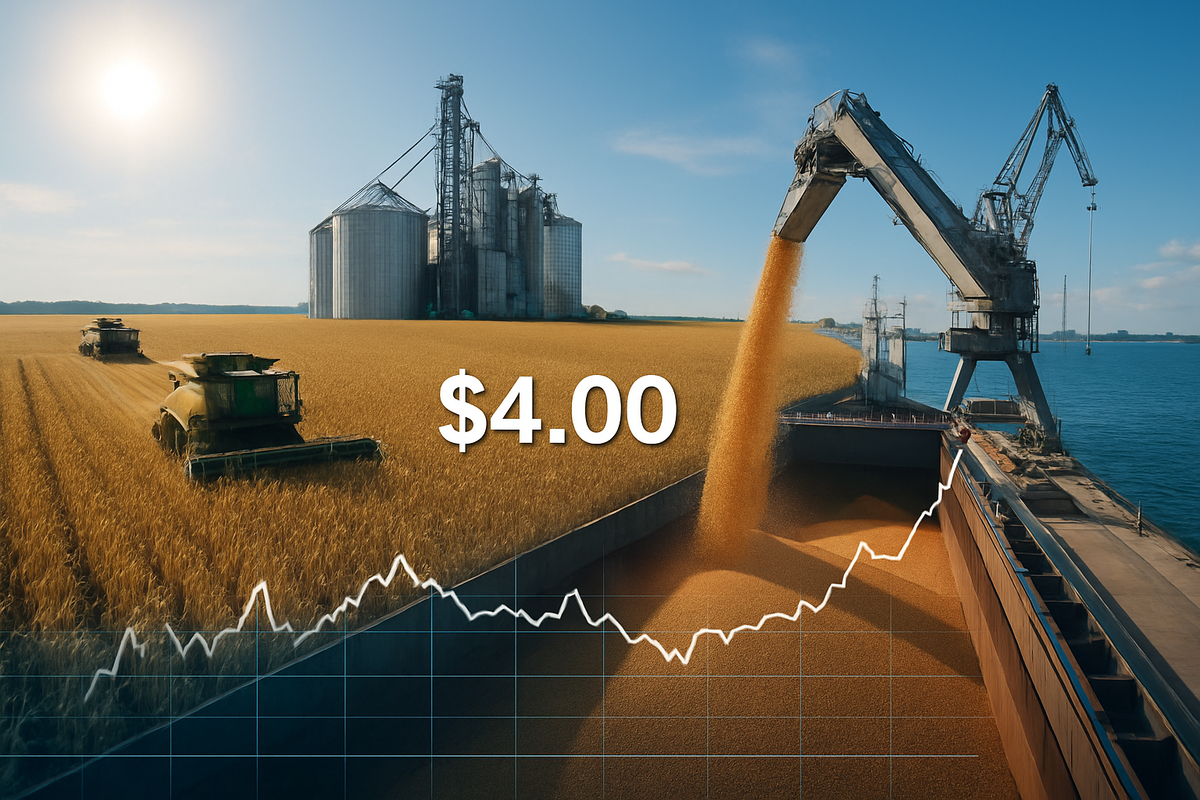
The American agricultural landscape has reached a historic crossroads this December as the U.S. Department of Agriculture (USDA) released its final World Agricultural Supply and Demand Estimates (WASDE) report for 2025. In a surprising twist for a year defined by a massive 16.752 billion bushel harvest, the USDA has significantly raised its corn export projections to a staggering 3.2 billion bushels. This record-breaking demand is effectively mopping up the excess supply, preventing a price collapse and keeping the season-average farm price anchored at a steady $4.00 per bushel.
For the markets, the December report served as a definitive signal that the global appetite for U.S. grain remains insatiable, even as domestic production hits all-time highs. While the sheer size of the 2025 crop initially sparked fears of a "glut" that would drive prices into the low $3.00 range, the surge in international buying—led by a recovery in Southeast Asian demand and continued strength in traditional markets—has shifted the narrative toward a delicate balance. This "Goldilocks" scenario of high volume and stable prices is creating a complex web of winners and losers across the agricultural value chain.
The WASDE Breakdown: A Record Crop Meets a Record Export Boom
The December 9, 2025, WASDE report will be remembered for its bold upward revision of export figures. The USDA raised its forecast for 2025/26 U.S. corn exports by 125 million bushels to the new 3.2 billion bushel benchmark. This move was supported by a blistering first quarter of the marketing year, where shipments between September and November exceeded 800 million bushels—the highest pace since 2007. This demand surge has forced the USDA to lower its projection for U.S. ending stocks to 2.029 billion bushels, a figure that, while high by historical standards, is significantly lower than the 2.16 billion bushels analysts had expected just a month ago.
The production side of the ledger remains equally impressive. The USDA held its record production estimate at 16.752 billion bushels, fueled by a national average yield of 186.0 bushels per acre across 90 million harvested acres. This massive output has acted as a natural ceiling on prices, preventing the kind of volatility seen during the supply shocks of 2021 and 2022. Market reactions were immediate; while the cash price remains near $4.00, March 2026 futures contracts have found a firm floor between $4.35 and $4.55, reflecting a market that is suddenly more concerned about logistics and delivery than it is about oversupply.
The timeline leading to this moment was marked by a nearly perfect growing season across the I-80 corridor, followed by an efficient, high-speed harvest in October. However, the unexpected variable was the rapid decline in the U.S. dollar during the fourth quarter, which made American corn the most competitive option on the global market. Key stakeholders, including the National Corn Growers Association and major grain cooperatives, have hailed the report as proof of the U.S. farmer’s efficiency, though many remain wary of the thin margins that $4.00 corn provides in an era of high input costs.
Corporate Impact: Navigating the $4.00 Corn Reality
The implications for public companies are multifaceted. For grain powerhouse Archer-Daniels-Midland (NYSE: ADM), the high volume of corn moving through the system is a double-edged sword. While ADM benefits from the increased throughput and record export activity, the company continues to face margin pressure in its processing segments. ADM recently set its 2025 earnings guidance at $3.25 to $3.50 per share, as analysts remain cautious about the company’s ability to turn high volume into high profits.
In contrast, Bunge Global SA (NYSE: BG) appears to be in a stronger position following the successful integration of its $34 billion Viterra merger in mid-2025. The combined entity now commands a massive share of the global grain handling market, specifically positioning it to capitalize on the 3.2 billion bushel export boom. Despite lowering its full-year EPS forecast to $7.30–$7.60 in October, Bunge’s stock has shown resilience as investors bet on the company’s enhanced ability to route U.S. corn to emerging markets in Africa and the Middle East.
The machinery and livestock sectors are feeling the pressure of this steady-price environment differently. Deere & Company (NYSE: DE) has signaled that the agricultural equipment cycle is entering a cooling phase. With corn prices hovering at $4.00, farmers are hesitant to make major capital investments. Deere’s management recently projected a 15% to 20% drop in large equipment sales for 2026, exacerbated by potential tariff headwinds that could add $1.2 billion in pretax expenses. Meanwhile, Tyson Foods (NYSE: TSN) is finding a silver lining. The steady and relatively affordable corn supply is a boon for its poultry division, helping to offset the massive losses in its beef segment, which recently saw the closure of a major facility in Nebraska due to tight cattle supplies and record-high retail beef prices.
Broader Significance: SAF and the New Trade Map
The 2025 corn story fits into a broader shift in the global energy and trade landscape. A significant portion of the "domestic demand" not captured in export figures is being driven by the nascent Sustainable Aviation Fuel (SAF) industry. As U.S. biorefineries scale up production to meet 2030 carbon reduction targets, corn-based ethanol is increasingly viewed as a critical feedstock. This creates a permanent new floor for corn demand that did not exist a decade ago, explaining why prices haven't collapsed despite the 16.7 billion bushel harvest.
Furthermore, the record export figure of 3.2 billion bushels highlights a shift in global trade alliances. With Brazil facing logistical bottlenecks in its own ports and Argentina struggling with economic instability, the U.S. has reclaimed its role as the "reliable supplier of last resort." However, this reliance on exports makes the U.S. market highly sensitive to geopolitical shifts. Any escalation in trade tensions with major importers like Mexico or China could quickly turn the current ending-stocks "cushion" into a burdensome surplus.
Historically, years of record production like 2014 or 2016 led to prolonged periods of depressed prices. The fact that 2025 is maintaining a $4.00 handle suggests a "new normal" for agricultural commodities, where higher production costs and diversified demand (biofuels + exports) prevent the sub-$3.00 prices of the past. This structural change is forcing competitors and partners alike to rethink their long-term supply chain strategies.
Looking Ahead: The 2026 Outlook and South American Competition
As we move into the first quarter of 2026, all eyes will turn to the Southern Hemisphere. The USDA’s record export projection for the U.S. assumes that the Brazilian "Safrinha" crop will not flood the market in the second half of the year. If South American weather remains favorable, the U.S. may find it difficult to maintain the 3.2 billion bushel pace, potentially leading to a buildup in ending stocks and a test of the $4.00 price floor.
Strategic pivots are already underway. Companies like Corteva, Inc. (NYSE: CTVA) are doubling down on biologicals and seed treatments that maximize yield even in marginal conditions, as farmers look for ways to stay profitable at $4.00 corn. The market opportunity in 2026 will likely lie in "precision" rather than "expansion." Farmers who can shave pennies off their cost of production will survive, while those who relied on $6.00 corn to cover inefficiencies will face a difficult restructuring period.
Conclusion: A Market in Equilibrium
The December 2025 WASDE report has provided a rare moment of clarity for the agricultural markets. The U.S. corn industry has proven it can produce at a record scale, and the world has proven it is ready to buy that production. The result is a market in a state of high-volume equilibrium—a "big crop, big demand" scenario that keeps the lights on for farmers and the supply chains moving for global grain traders.
For investors, the coming months will require a focus on logistics and policy. Watch the performance of Class I railroads like Union Pacific Corporation (NYSE: UNP), which will be tasked with moving this record 3.2 billion bushels to the ports. Additionally, keep a close eye on trade policy rhetoric as the 2026 election cycle begins to heat up. While the current outlook is stable, the reliance on international markets means that any disruption to the flow of grain could quickly upend the delicate balance the USDA has projected.
This content is intended for informational purposes only and is not financial advice.