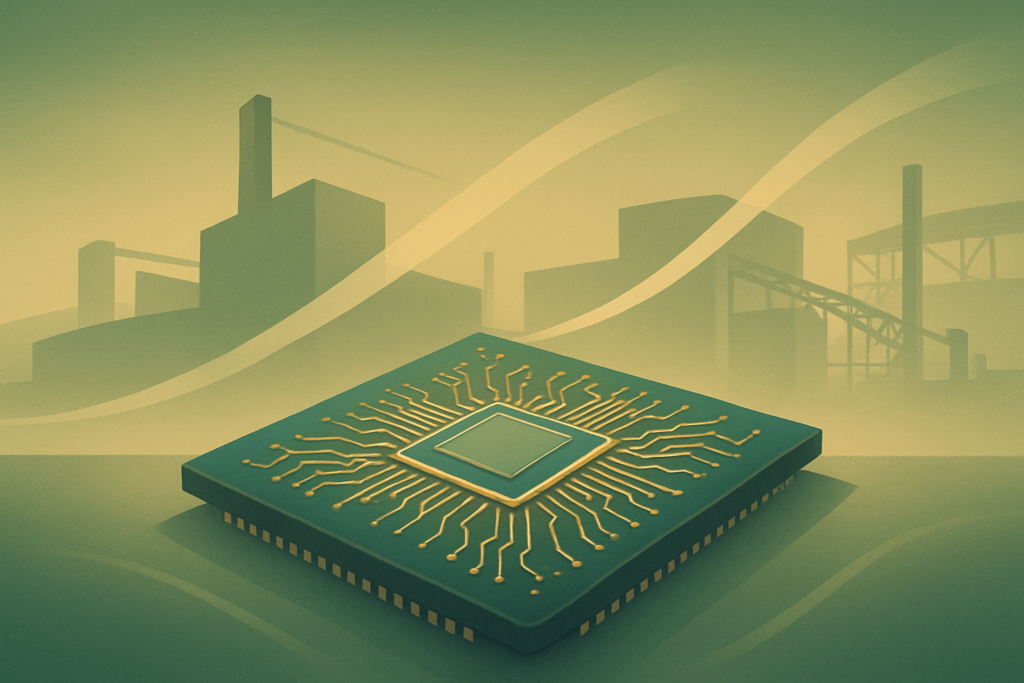
As of January 14, 2026, Intel Corporation (Nasdaq: INTC) finds itself at a pivotal "inflection point" that many industry veterans are calling the "Silicon Renaissance." After a brutal 2024 that saw the company’s valuation crater and the retirement of its visionary but beleaguered CEO, Pat Gelsinger, Intel has emerged in early 2026 as a leaner, more disciplined, and strategically vital entity.
The narrative surrounding Intel has shifted from a question of survival to a test of execution. With its high-stakes "18A" process node now in high-volume manufacturing and a new leadership team focused on operational rigor, Intel is no longer just a chipmaker; it has become the "National Champion" of Western semiconductor manufacturing. This article explores the company’s recent financial recovery, the impact of significant government intervention, and the long-term outlook for a stock that has staged one of the most remarkable rebounds in recent market history.
Historical Background
Intel’s story is the story of Silicon Valley itself. Founded in 1968 by Robert Noyce and Gordon Moore—the man behind "Moore’s Law"—Intel pioneered the microprocessor, beginning with the 4004 in 1971. For decades, the company maintained a vice-like grip on the computing world through its x86 architecture and the "Intel Inside" branding campaign.
Under the leadership of Andy Grove in the 1980s and 90s, Intel mastered the "Tick-Tock" manufacturing model, alternating between new chip architectures and smaller transistor sizes. However, this dominance bred complacency. The 2010s were marked by significant missteps: missing the mobile revolution (losing out to ARM-based designs) and facing debilitating delays in transitioning to 10nm and 7nm manufacturing. These delays allowed Advanced Micro Devices (Nasdaq: AMD) to seize market share and Taiwan Semiconductor Manufacturing Co. (Nasdaq: TSM) to claim the crown of process leadership.
Business Model
Intel operates a unique "IDM 2.0" (Integrated Device Manufacturer) model, which was significantly restructured in 2025 to create a firewall between its internal product groups and its manufacturing business.
- Intel Products: This remains the primary revenue driver, split into the Client Computing Group (CCG), which focuses on PC and laptop processors, and the Data Center and AI (DCAI) group.
- Intel Foundry: Rebranded as a separate reporting entity, this segment operates as a merchant foundry, manufacturing chips for Intel and external customers. By early 2026, this segment has begun to focus on high-margin, leading-edge nodes (18A) rather than high-volume, low-margin legacy chips.
- Altera and Mobileye: Intel has moved toward partial divestitures or IPOs of these subsidiary units (Altera for FPGAs and Mobileye for autonomous driving) to simplify its balance sheet and focus on core logic and manufacturing.
Stock Performance Overview
Intel’s stock performance has been a tale of two extremes. Over the 10-year horizon, INTC has significantly underperformed the S&P 500 and the PHLX Semiconductor Index (SOX), reflecting years of lost market share and manufacturing delays.
However, the 1-year performance tells a different story. In 2025, INTC was one of the top performers in the tech sector, surging over 80% from its late-2024 lows. This rally was driven by the "de-risking" of its balance sheet and the successful "power-on" of its 18A node. As of mid-January 2026, shares are trading in the $44–$48 range, a recovery that has restored over $100 billion in market capitalization since the 2024 trough.
Financial Performance
Intel's late 2025 earnings signaled a dramatic turnaround in fundamental health.
- Revenue Growth: In Q3 2025, Intel reported revenue of $13.7 billion, a 3% year-over-year increase, marking a return to growth after a period of contraction.
- Margins: Perhaps the most critical metric, non-GAAP gross margins recovered to 40.0% in late 2025, up from the sub-20% levels seen during the height of its manufacturing transition.
- Valuation: Despite the stock rally, Intel trades at a forward P/E ratio that is significantly lower than NVIDIA (Nasdaq: NVDA) or AMD, as the market still applies a "turnaround discount" until foundry yields reach maturity.
- Debt and Cash Flow: The company has aggressively cut costs, including a 15% workforce reduction in 2024-2025, which has stabilized free cash flow.
Leadership and Management
Following the retirement of Pat Gelsinger in December 2024, the board appointed Lip-Bu Tan as CEO in early 2025. Tan, the former CEO of Cadence Design Systems, is widely respected for his operational discipline and deep understanding of the semiconductor ecosystem.
While Gelsinger was the "architect" of the comeback plan, Tan is viewed as the "builder." His strategy has been to prioritize financial returns and foundry customer acquisition. The current leadership team has successfully shifted the culture from one of "engineering at any cost" to "manufacturing for profit," a change that has been warmly received by institutional investors.
Products, Services, and Innovations
The cornerstone of Intel’s 2026 product lineup is the 18A process node. This node introduced two breakthrough technologies:
- RibbonFET: A Gate-All-Around (GAA) transistor architecture that increases performance and reduces power leakage.
- PowerVia: The industry's first implementation of backside power delivery, which improves chip efficiency by separating power and signal wires.
In the consumer market, Panther Lake CPUs (launched at CES 2026) are leading the "AI PC" revolution with an integrated Neural Processing Unit (NPU) capable of 120+ TOPS (Trillion Operations Per Second). In the data center, Clearwater Forest is Intel’s first high-volume 18A server chip, designed to compete with AMD’s EPYC line in cloud efficiency.
Competitive Landscape
Intel faces a "three-front war":
- In Manufacturing: It competes with TSMC and Samsung. While TSMC still leads in volume and yield, Intel’s 18A has allowed it to claim a "feature lead" in power delivery for the first time in a decade.
- In CPUs: AMD remains a fierce rival. While Intel has narrowed the gap in laptops, AMD’s "Venice" EPYC chips still hold a significant edge in data center market share.
- In AI: NVIDIA dominates the training market. Intel has strategically pivoted, choosing to partner with NVIDIA to manufacture certain components while positioning its own Gaudi 3 accelerators as a cost-effective alternative for AI inference.
Industry and Market Trends
The semiconductor industry in 2026 is defined by "Sovereign AI" and "AI PCs." Countries are increasingly funding domestic manufacturing to reduce reliance on Taiwan, a trend that directly benefits Intel’s US-based fabs. Simultaneously, the shift toward edge AI—running AI models locally on PCs rather than in the cloud—is driving a major hardware refresh cycle, providing a tailwind for Intel’s Client Computing Group.
Risks and Challenges
Despite the recent success, Intel is not without significant risks:
- Yield Risk: While 18A is in production, achieving the high yields (70%+) necessary for massive profitability remains a challenge.
- Capital Intensity: Building state-of-the-art fabs requires tens of billions of dollars. If revenue growth stalls, the debt load could become unsustainable.
- Execution Missteps: Any delay in the upcoming 14A node (planned for 2027) could erase the hard-won confidence of foundry customers.
Opportunities and Catalysts
- Foundry "Whale" Customer: Rumors persist that a major hyperscaler (Amazon or Google) or a consumer giant (Apple) may announce a long-term manufacturing deal for 18A/14A in 2026.
- AI PC Supercycle: If AI-enabled software becomes a "must-have" for enterprises, the upgrade cycle for Intel-powered laptops could exceed expectations.
- CHIPS 2.0: Potential new legislation in 2026 or 2027 could provide further operational subsidies for US-based manufacturing.
Investor Sentiment and Analyst Coverage
Sentiment toward Intel has transitioned from "Bearish" to "Cautiously Optimistic." As of January 2026, the consensus rating is a Hold/Buy, with many analysts upgrading the stock as gross margins stabilized. Institutional ownership has increased, with several large hedge funds taking "turnaround" positions in late 2025. However, retail sentiment remains volatile, often reacting sharply to any news regarding foundry yields or geopolitical tensions.
Regulatory, Policy, and Geopolitical Factors
Intel is now inextricably linked to US national security. In August 2025, the U.S. Department of Commerce converted billions in grants into a 9.9% direct equity stake in Intel. This effectively makes the U.S. government a "silent partner," ensuring that Intel will not be allowed to fail. However, this also subjects the company to intense regulatory scrutiny regarding its operations in China and its executive compensation.
Conclusion
Intel Corporation enters 2026 as a radically different company than it was two years ago. The "Silicon Renaissance" is real, but it is still in its early stages. By successfully launching 18A and stabilizing its leadership, Intel has moved out of the "emergency room" and into a period of "rehabilitation."
For investors, Intel represents a unique play on the reshoring of American manufacturing and the AI PC cycle. While it lacks the explosive growth potential of NVIDIA, its "de-risked" valuation and strategic importance to the U.S. government provide a compelling narrative. The key factor to watch in 2026 will be the announcement of external foundry customers—the ultimate validation of Intel’s transition to a world-class manufacturing powerhouse.
This content is intended for informational purposes only and is not financial advice.