GameStop Corp. (GME) headquartered in Grapevine, Texas, is the world’s largest multichannel video game retailer. Founded in 1984 as Babbage’s, the company became a global household name through its unique buy-sell-trade model, which created a "circular economy" for physical gaming media.
The company is currently undergoing a transformation from a legacy brick-and-mortar retailer into a diversified technology and investment vehicle. With a streamlined footprint of approximately 2,200 stores worldwide, the company is aggressively expanding its high-margin collectibles segment and leveraging a multi-billion dollar "war chest" to ensure long-term solvency in an increasingly digital industry.
GameStop Stock Slips
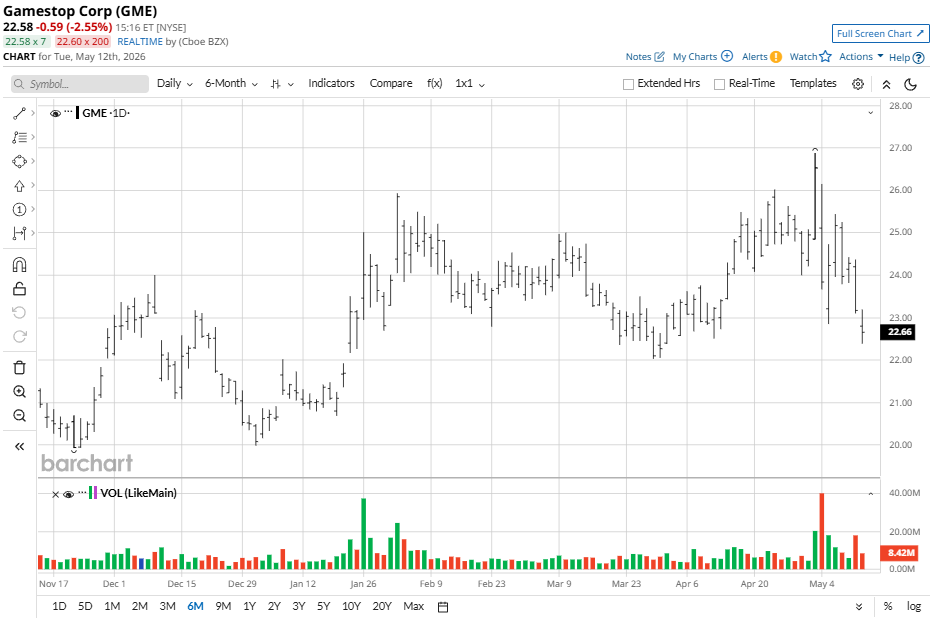
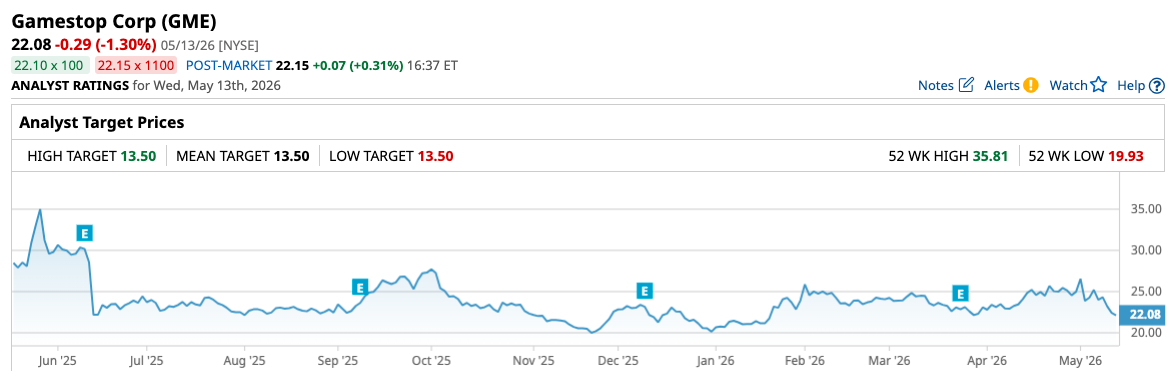
GameStop stock has maintained its reputation for extreme volatility, recently sliding 5% following reports of a rejected $56 billion bid for eBay (EBAY). Despite this dip, GME has shown resilience, trading above its 52-week low of $19.93. The narrative for 2026 remains centered on its $4.2 billion cash reserve, which provides a unique safety net compared to other retail peers. While still down from its multi-year peaks, the stock continues to attract a devoted retail following that prioritizes the company's balance sheet strength over traditional valuation metrics.
Compared to the S&P MidCap 400 Index ($IDX), GameStop has exhibited idiosyncratic performance that often decouples from broader mid-cap trends. While the S&P 400 has steadily climbed on mid-market industrial and financial growth, GME’s returns are largely driven by liquidity events and strategic announcements.
With a beta of 1.9, its pullbacks can be sharper than the broad market. This high-variance profile makes it a standout within the S&P 400, acting more as a high-stakes sentiment proxy than a standard consumer cyclical stock.
GameStop Results Beat Estimates
GameStop reported its fourth-quarter fiscal 2025 results in March, delivering earnings that beat expectations and marked a major milestone in its turnaround. The company posted an adjusted EPS of $0.49, crushing the analyst consensus of $0.31 by 58%. While net revenue reached $1.1 billion, coming in below the $1.47 billion expected, the focus remained on the bottom line.
GameStop achieved full-year profitability for the first time in years, a feat driven by a rigorous 21% reduction in selling, general, and administrative (SG&A) expenses. This move toward fiscal austerity has allowed the company to protect its capital even as hardware sales face pressure from a maturing console cycle.
Looking forward, GameStop is scheduled to report its Q1 2026 results on June 9 and management is doubling down on its retro gaming and pro membership initiatives to keep its niche community engaged. The company's RPO (remaining performance obligation) and its pivot toward private-label gaming accessories through the Zing and GameStop brands are intended to capture the high-growth pop culture market.
GameStop Stock Slips Following eBay Rejection
GameStop shares fell 4.1% after the eBay board formally rejected GameStop CEO Ryan Cohen’s unsolicited takeover bid, labeling the proposal "neither credible nor attractive." The rejection focused on significant doubts regarding GameStop's ability to finance an acquisition of a company nearly four times its market value. Despite GameStop's $9.4 billion cash reserve and a "highly confident" letter from TD Securities for $20 billion in debt financing, the board cited concerns about high leverage, operational risks, and GameStop's existing governance structure.
The market reaction reflects growing skepticism toward Cohen’s pivot and his goal of integrating GameStop’s retail locations into eBay’s fulfillment network. While the bid offered a meaningful premium, the skepticism was compounded by high-profile exits, including Michael Burry, who liquidated his GME position in protest of the deal's potential for shareholder dilution. Traders are now braced for a possible hostile takeover attempt, as Cohen says he is prepared to bypass the board and take the offer directly to eBay shareholders.
Should You Buy GME?
The rejection of the eBay bid highlights the gap between GameStop’s ambitious "holding company" vision and market skepticism about its financing. Investors should note that the stock currently has no active analyst ratings, with its final coverage ending in a "Hold" three months ago.
While the company’s $4.2 billion cash reserve provides a unique floor for the valuation, GME remains a high-risk, speculative play. Buying here depends entirely on one's belief in Cohen’s ability to successfully execute a hostile takeover or pivot the firm’s massive capital into high-yield AI infrastructure.
On the date of publication, Ruchi Gupta did not have (either directly or indirectly) positions in any of the securities mentioned in this article. All information and data in this article is solely for informational purposes. For more information please view the Barchart Disclosure Policy here.
More news from Barchart
- Microsoft Stock Is a Buy as Its AI Business’ Annual Revenue Run Rate Swells
- Nebius Group Stock Soars 16% as AI Revenue Growth Hits 684%. Its Meta Deal Changes Everything.
- 2 Unusually Active Shopify Stock Calls Work Out to 1 Interesting Strategy
- The AI Boom Has a Power Problem. This Stock May Be the Biggest Winner.