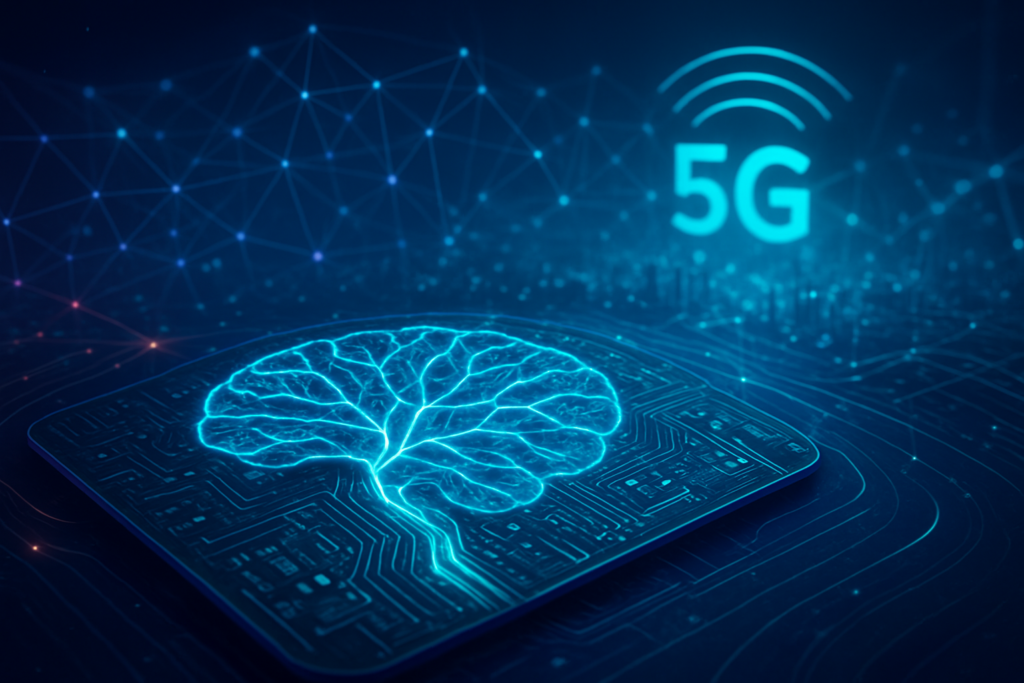
As of December 2025, the technological world stands on the precipice of a profound transformation, driven by the powerful convergence of Artificial Intelligence (AI), the ubiquitous reach of 5G connectivity, and the specialized prowess of custom silicon. This formidable trifecta is not merely enhancing existing capabilities; it is fundamentally redefining the very fabric of semiconductor innovation, revolutionizing global data infrastructure, and unlocking an unprecedented generation of technological possibilities. This synergy is creating an accelerated path to more powerful, energy-efficient, and intelligent devices across virtually every sector, from autonomous vehicles to personalized healthcare.
This architectural shift moves beyond incremental improvements, signaling a foundational change in how technology is conceived, designed, and deployed. The semiconductor industry, in particular, is witnessing a "Hyper Moore's Law" where AI itself is becoming an active participant in chip design, drastically shortening cycles and optimizing performance. Simultaneously, 5G's low-latency, high-bandwidth backbone is enabling the proliferation of intelligent edge computing, moving AI processing closer to the data source. Custom silicon, tailored for specific AI workloads, provides the essential power and efficiency, making real-time, sophisticated AI applications a widespread reality.
Engineering the Future: The Technical Tapestry of Convergence
The technical underpinnings of this convergence reveal a sophisticated dance between hardware and software, pushing the boundaries of what was once considered feasible. At the heart of this revolution is a radical transformation in semiconductor design and manufacturing. The industry is rapidly moving beyond traditional scaling, with the maturation of Extreme Ultraviolet (EUV) lithography for sub-7 nanometer (nm) nodes and a swift progression towards High-Numerical Aperture (High-NA) EUV lithography for sub-2nm process nodes. Innovations such as 3D stacking, advanced chiplet designs, and Gate-All-Around (GAA) transistors are redefining chip integration, drastically reducing physical footprint while significantly boosting performance. Furthermore, advanced materials like Gallium Nitride (GaN) and Silicon Carbide (SiC) are becoming standard for high-power, high-frequency applications crucial for 5G/6G base stations and electric vehicles.
A critical differentiator from previous approaches is the emergence of AI-driven chip design. AI is no longer just a consumer of advanced chips; it is actively designing them. AI-powered Electronic Design Automation (EDA) tools, leveraging machine learning and generative AI, are automating intricate chip design processes—from logic synthesis to routing—and dramatically shortening design cycles from months to mere hours. This enables the creation of chips with superior Power, Performance, and Area (PPA) characteristics, essential for managing the escalating complexity of modern semiconductors. This symbiotic relationship, where AI designs more powerful AI chips, is leading to a "Hyper Moore's Law," with some AI chipmakers expecting performance to double or triple annually.
The unprecedented demand for custom AI Application-Specific Integrated Circuits (ASICs) underscores the limitations of general-purpose chips for the rapid growth and specialized needs of AI workloads. Tech giants are increasingly pursuing vertical integration by designing their own custom silicon, gaining greater control over performance, cost, and supply chain. This move towards heterogeneous computing, integrating CPUs, GPUs, FPGAs, and specialized AI accelerators into unified architectures, optimizes diverse workloads and marks a significant departure from homogeneous processing. Initial reactions from the AI research community and industry experts highlight excitement over the potential for specialized hardware to unlock new AI capabilities that were previously computationally prohibitive, alongside a recognition of the immense engineering challenges involved in this complex integration.
Corporate Chessboard: Beneficiaries and Disruptors in the AI Landscape
The convergence of AI, 5G, and custom silicon is creating a new competitive landscape, profoundly impacting established tech giants, semiconductor manufacturers, and a new wave of innovative startups. Companies deeply invested in vertical integration and custom silicon design stand to benefit immensely. Hyperscale cloud providers like Google (NASDAQ: GOOGL), Meta Platforms (NASDAQ: META), and Amazon (NASDAQ: AMZN), alongside AI powerhouses such as OpenAI, are at the forefront, leveraging custom ASICs to optimize their massive AI workloads, particularly for large language models (LLMs). This strategic move allows them to gain greater control over performance, cost, and energy efficiency, reducing reliance on third-party general-purpose silicon.
The semiconductor industry itself is undergoing a significant reshuffle. Companies like Broadcom (NASDAQ: AVGO) are leading in the custom AI ASIC market, controlling an estimated 70% of this segment and forging critical partnerships with the aforementioned hyperscalers. Other major players like NVIDIA (NASDAQ: NVDA), while dominant in general-purpose GPUs, are adapting by offering highly specialized AI platforms and potentially exploring more custom solutions. Intel (NASDAQ: INTC) is also making significant strides in its foundry services and AI accelerator offerings, aiming to recapture market share in this burgeoning custom silicon era. The competitive implications are clear: companies that can design, manufacture, or facilitate the creation of highly optimized, custom silicon for AI will command significant market power.
This development poses a potential disruption to existing products and services that rely heavily on less optimized, off-the-shelf hardware for AI inference and training. Companies that fail to adapt to the demand for specialized, energy-efficient AI processing at the edge or within their core infrastructure risk falling behind. Startups focusing on niche AI hardware acceleration, specialized EDA tools, or novel neuromorphic computing architectures are finding fertile ground for innovation and investment. The market positioning for many companies will increasingly depend on their ability to integrate custom silicon strategies with robust 5G connectivity solutions, creating a seamless, intelligent ecosystem from the cloud to the edge.
Broader Horizons: Societal Impacts and Ethical Considerations
The convergence of AI, 5G, and custom silicon extends far beyond corporate balance sheets, weaving itself into the broader AI landscape and promising transformative, yet complex, societal impacts. This development fits squarely into the trend of pervasive AI integration, pushing intelligent systems into nearly every facet of daily life and industry. The ability to process data locally with custom AI silicon and low-latency 5G enables instantaneous responses for mission-critical applications, from advanced autonomous vehicles requiring real-time sensor processing and decision-making to predictive maintenance in smart factories and real-time diagnostics in healthcare. By 2025, AI adoption is expected to reach full integration across multiple sectors, with AI systems making decisions and adapting in real-time.
The impacts are wide-ranging. Economically, it promises new industries, enhanced productivity, and the creation of highly specialized jobs in AI engineering, chip design, and network infrastructure. Environmentally, the drive for energy-efficient custom silicon is crucial, as the computational appetite of modern AI, especially for large language models (LLMs), is immense. While custom chips offer better performance-per-watt, the sheer scale of deployment necessitates continued innovation in sustainable computing and cooling technologies. Socially, the enhanced capabilities promise advancements in smart cities, personalized education, and more responsive public services, enabled by intelligent IoT ecosystems powered by 5G and edge AI.
However, potential concerns loom large. The increasing sophistication and autonomy of AI systems, coupled with their ubiquitous deployment, raise significant ethical questions regarding data privacy, algorithmic bias, and accountability. The reliance on custom silicon could also lead to further concentration of power among a few tech giants capable of designing and producing such specialized hardware, potentially stifling competition and innovation from smaller players. Comparisons to previous AI milestones, such as the rise of deep learning or the early days of cloud computing, highlight a similar pattern of rapid advancement coupled with the need for thoughtful governance and robust ethical frameworks. This era demands proactive engagement from policymakers, researchers, and industry leaders to ensure equitable and responsible deployment.
The Road Ahead: Future Developments and Uncharted Territories
Looking forward, the convergence of AI, 5G, and custom silicon promises a cascade of near-term and long-term developments that will continue to reshape our technological reality. In the near term, we can expect to see further refinement and miniaturization of custom AI ASICs, with an increasing focus on specialized architectures for specific AI tasks, such as vision processing, natural language understanding, and generative AI. The widespread rollout of 5G, largely completed in urban areas by 2025, will continue to expand into rural and remote regions, solidifying its role as the essential connectivity backbone for edge AI and the Internet of Things (IoT). Enterprises, telecom providers, and hyperscalers will continue their significant investments in smarter, distributed colocation environments, pushing edge data centers along highways, in urban cores, and near industrial zones.
On the horizon, potential applications and use cases are breathtaking. The technology is expected to enable real-time large language models (LLMs) to operate directly at the user's fingertips, delivering localized, instantaneous AI assistance without constant cloud reliance. Enhanced immersive experiences in augmented reality (AR) and virtual reality (VR) will become more seamless and interactive, blurring the lines between the physical and digital worlds. The groundwork laid by this convergence is also critical for the development of 6G, where AI is expected to play an even more central role in delivering massive improvements in spectral efficiency and potentially enabling 6G functionalities through software upgrades to existing 5G hardware. Experts predict a future where AI is not just integrated but becomes an invisible, ambient intelligence, anticipating needs and proactively assisting across all aspects of life.
However, significant challenges remain. The escalating energy consumption of AI, despite custom silicon's efficiencies, demands continuous innovation in sustainable computing and cooling technologies, particularly for high-density edge deployments. Security concerns around distributed AI systems and 5G networks will require robust, multi-layered defenses against sophisticated cyber threats. The complexity of designing and integrating these disparate technologies also necessitates a highly skilled workforce, highlighting the need for ongoing education and talent development. What experts predict will happen next is a relentless pursuit of greater autonomy, intelligence, and seamless integration, pushing the boundaries of what machines can perceive, understand, and accomplish in real-time.
A New Technological Epoch: Concluding Thoughts on the Convergence
The convergence of AI, 5G, and custom silicon represents far more than a mere technological upgrade; it signifies the dawn of a new technological epoch. The key takeaways from this profound shift are multifold: a "Hyper Moore's Law" driven by AI designing AI chips, the indispensable role of 5G as the low-latency conduit for distributed intelligence, and the critical performance and efficiency gains offered by specialized custom silicon. Together, these elements are dismantling traditional computing paradigms and ushering in an era of ubiquitous, real-time, and highly intelligent systems.
This development's significance in AI history cannot be overstated. It marks a pivotal moment where AI transitions from primarily cloud-centric processing to a deeply embedded, pervasive force across the entire technological stack, from the core data center to the furthest edge devices. It enables the practical realization of previously theoretical AI applications and accelerates the timeline for many futuristic visions. The long-term impact will be a fundamentally rewired world, where intelligent agents augment human capabilities across every industry and personal domain, driving unprecedented levels of automation, personalization, and responsiveness.
In the coming weeks and months, industry watchers should closely observe several key indicators. Look for further announcements from hyperscalers regarding their next-generation custom AI chips, the expansion of 5G Standalone (SA) networks enabling more sophisticated edge computing capabilities, and partnerships between semiconductor companies and AI developers aimed at co-optimizing hardware and software. The ongoing evolution of AI-driven EDA tools and the emergence of new neuromorphic or quantum-inspired computing architectures will also be critical signposts in this rapidly advancing landscape. The future of technology is not just being built; it is being intelligently designed and seamlessly connected.
This content is intended for informational purposes only and represents analysis of current AI developments.
TokenRing AI delivers enterprise-grade solutions for multi-agent AI workflow orchestration, AI-powered development tools, and seamless remote collaboration platforms.
For more information, visit https://www.tokenring.ai/.