Hotel company Hilton (NYSE: HLT) fell short of the market’s revenue expectations in Q1 CY2026, but sales rose 9% year on year to $2.94 billion. Its non-GAAP profit of $2.01 per share was 1.8% above analysts’ consensus estimates.
Is now the time to buy Hilton? Find out by accessing our full research report, it’s free.
Hilton (HLT) Q1 CY2026 Highlights:
- Revenue: $2.94 billion vs analyst estimates of $2.98 billion (9% year-on-year growth, 1.4% miss)
- Adjusted EPS: $2.01 vs analyst estimates of $1.97 (1.8% beat)
- Adjusted EBITDA: $901 million vs analyst estimates of $891.3 million (30.7% margin, 1.1% beat)
- Management raised its full-year Adjusted EPS guidance to $8.85 at the midpoint, a 1.6% increase
- EBITDA guidance for the full year is $4.04 billion at the midpoint, in line with analyst expectations
- Operating Margin: 23.1%, up from 19.9% in the same quarter last year
- Free Cash Flow Margin: 0.3%, down from 16.1% in the same quarter last year
- RevPAR: $105.97 at quarter end, up 2.3% year on year
- Market Capitalization: $76.06 billion
Christopher J. Nassetta, President & Chief Executive Officer of Hilton, said, "We delivered great top and bottom-line results for the quarter with RevPAR growth across all chain-scales and brands and customer segments. The results demonstrate a continuation of strengthening demand trends we’ve seen since late 2025 that are supported by macroeconomic tailwinds most evident in the U.S. On the development side, we achieved the largest pipeline in our history, and we remain confident in our ability to deliver net unit growth of 6.0 percent to 7.0 percent in 2026 and beyond.”
Company Overview
Founded in 1919, Hilton Worldwide (NYSE: HLT) is a global hospitality company with a portfolio of hotel brands.
Revenue Growth
A company’s long-term sales performance is one signal of its overall quality. Any business can experience short-term success, but top-performing ones enjoy sustained growth for years. Over the last five years, Hilton grew its sales at a 30.4% compounded annual growth rate. Though this growth is acceptable on an absolute basis, we need to see more than just topline growth for the consumer discretionary sector, which can display significant earnings volatility. This means our bar for the sector is particularly high, reflecting the non-essential and hit-driven nature of the products and services offered. Additionally, five-year CAGR starts around Covid, when revenue was depressed then rebounded.
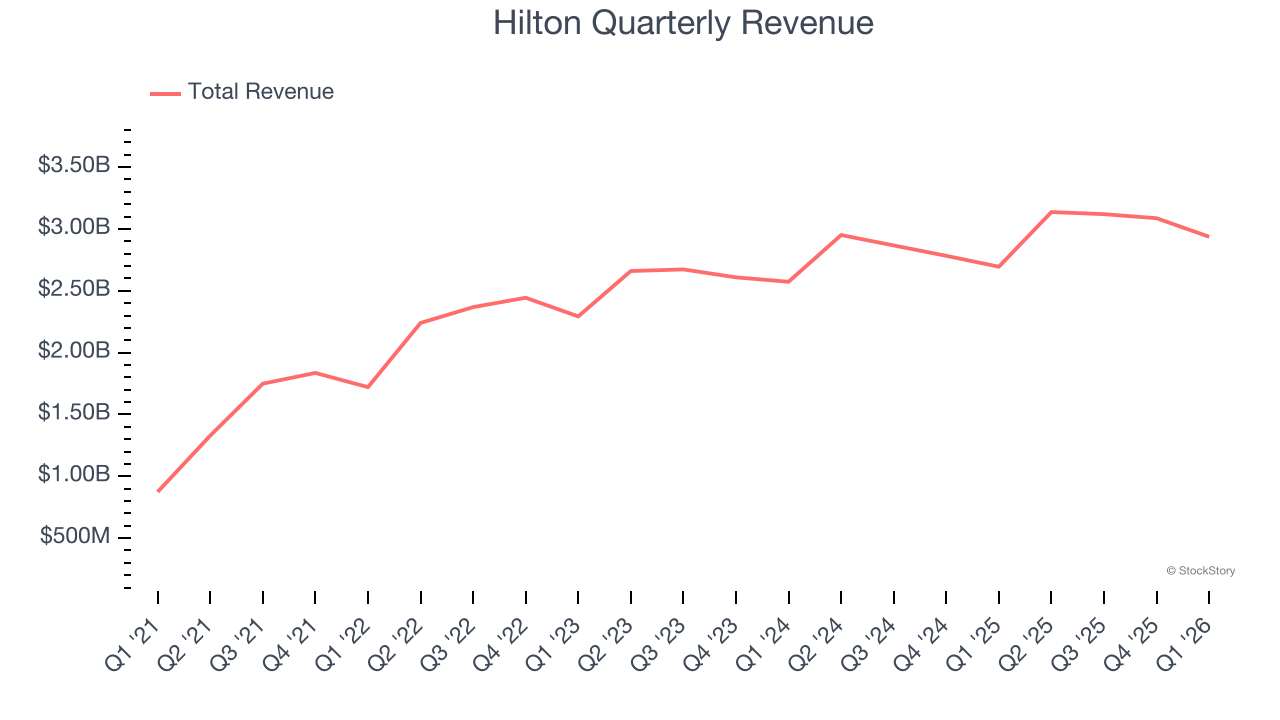
We at StockStory place the most emphasis on long-term growth, but within consumer discretionary, a stretched historical view may miss a company riding a successful new property or trend. Hilton’s recent performance shows its demand has slowed as its annualized revenue growth of 8.1% over the last two years was below its five-year trend. We’re wary when companies in the sector see decelerations in revenue growth, as it could signal changing consumer tastes aided by low switching costs. 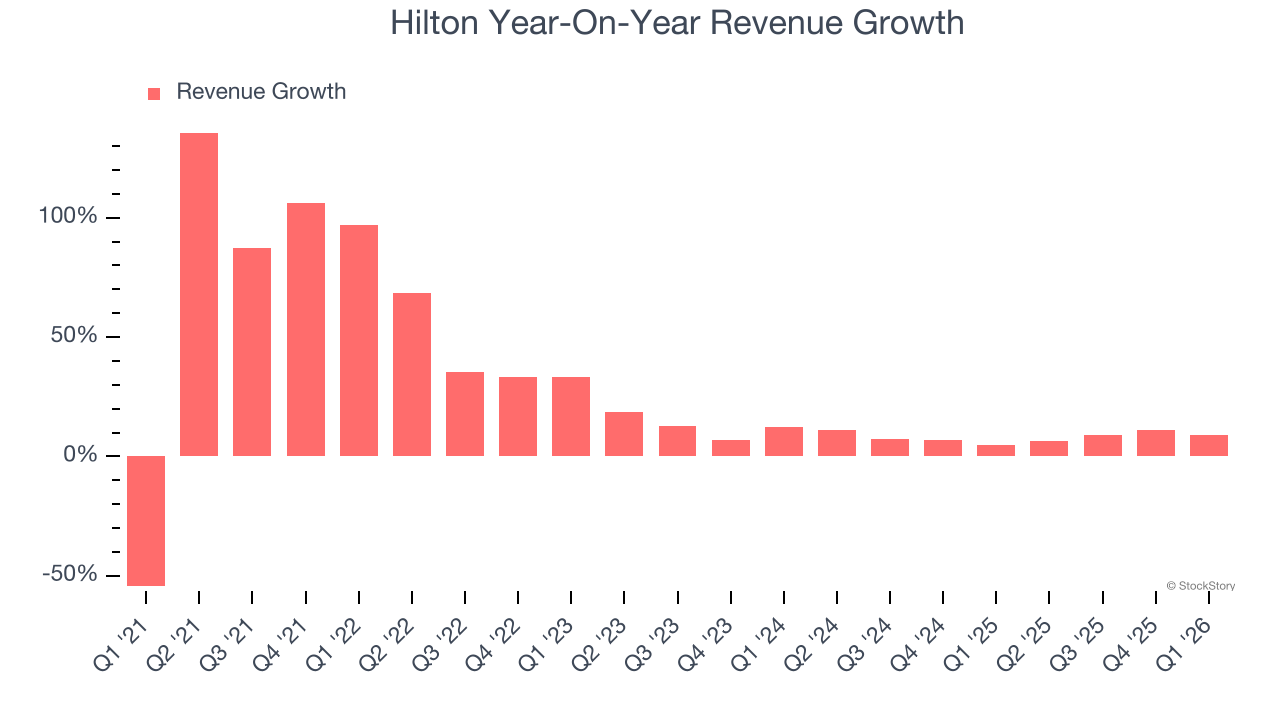
We can better understand the company’s revenue dynamics by analyzing its revenue per available room, which clocked in at $105.97 this quarter and is a key metric accounting for daily rates and occupancy levels. Over the last two years, Hilton’s revenue per room was flat. Because this number is lower than its revenue growth, we can see its sales from other areas like restaurants, bars, and amenities outperformed its room bookings. It is sometimes the strategy of hotels to grow ancillary revenues because they are price takers in room revenues. 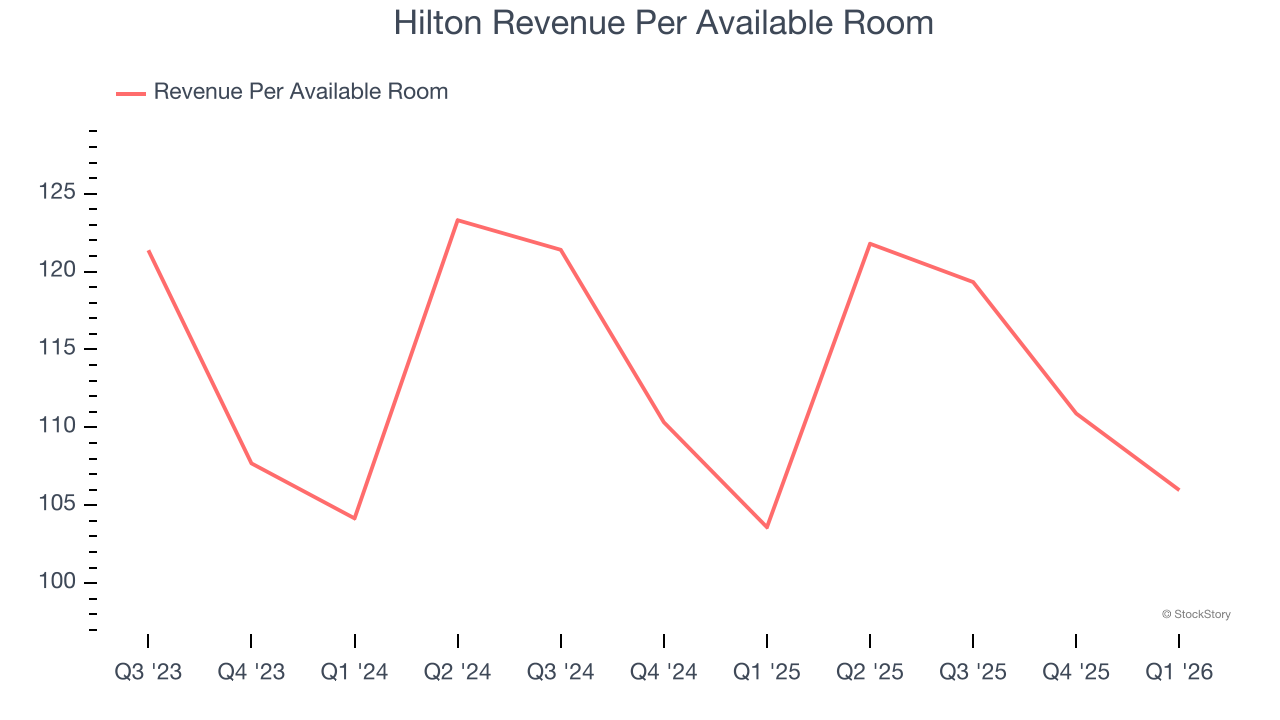
This quarter, Hilton’s revenue grew by 9% year on year to $2.94 billion, missing Wall Street’s estimates.
Looking ahead, sell-side analysts expect revenue to grow 8.8% over the next 12 months, similar to its two-year rate. This projection is underwhelming and suggests its newer products and services will not accelerate its top-line performance yet.
WHILE YOU’RE HERE: The Next Palantir? One satellite company captures images of every point on Earth. Every single day. The Pentagon wants it. Hedge funds are using it to beat earnings. You’ve probably never heard of it.
This is what the early days of Palantir looked like before it became a $437 billion giant. Same playbook. Different technology. If you missed Palantir, you need to see this. Claim The Stock Ticker for Free HERE.
Operating Margin
Hilton’s operating margin has risen over the last 12 months and averaged 22.1% over the last two years. The company’s higher efficiency is a breath of fresh air, but its suboptimal cost structure means it still sports lousy profitability for a consumer discretionary business.
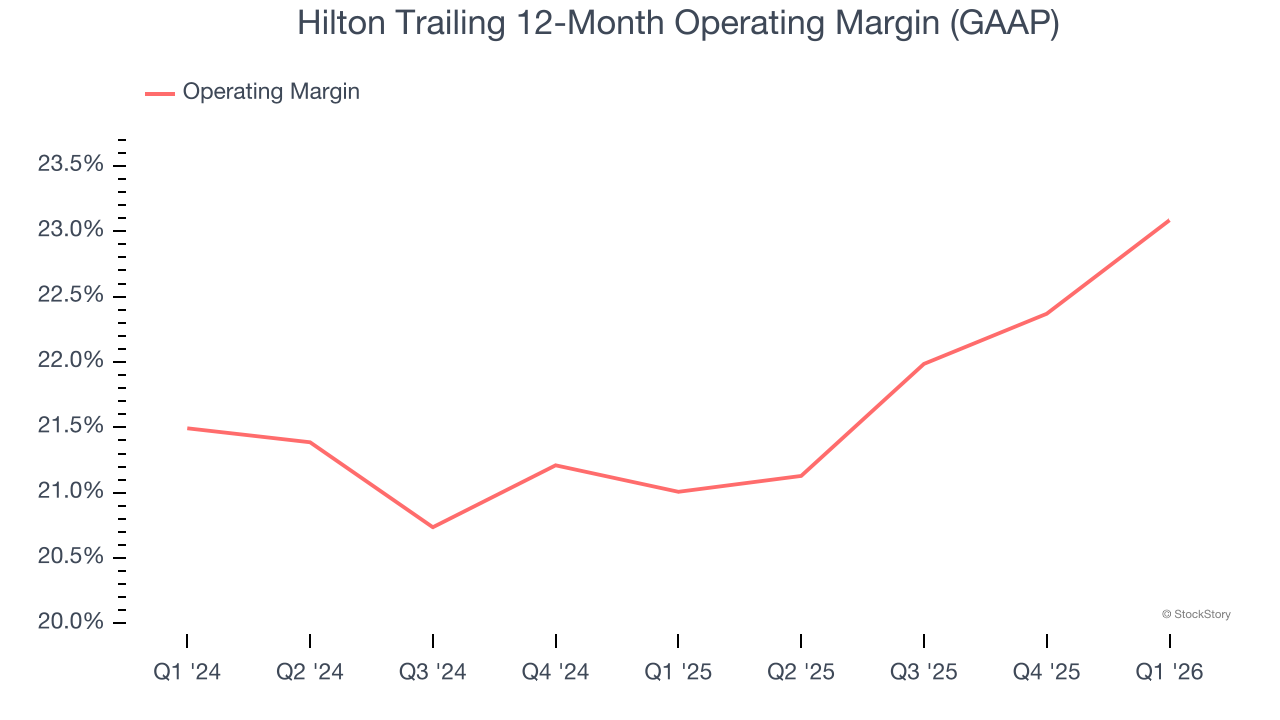
This quarter, Hilton generated an operating margin profit margin of 23.1%, up 3.2 percentage points year on year. This increase was a welcome development and shows it was more efficient.
Earnings Per Share
We track the long-term change in earnings per share (EPS) for the same reason as long-term revenue growth. Compared to revenue, however, EPS highlights whether a company’s growth is profitable.
Hilton’s full-year EPS flipped from negative to positive over the last five years. This is encouraging and shows it’s at a critical moment in its life.
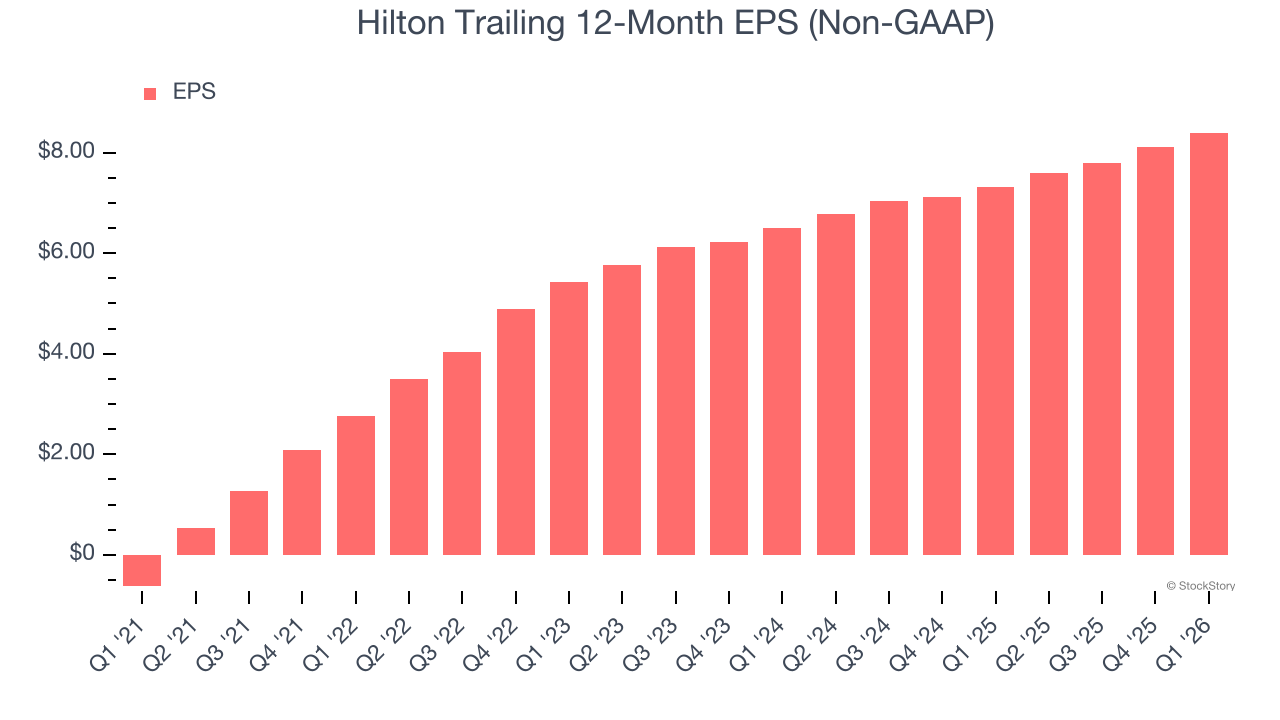
In Q1, Hilton reported adjusted EPS of $2.01, up from $1.72 in the same quarter last year. This print beat analysts’ estimates by 1.8%. Over the next 12 months, Wall Street expects Hilton’s full-year EPS of $8.40 to grow 10.4%.
Key Takeaways from Hilton’s Q1 Results
We struggled to find many positives in these results. Its EBITDA guidance for next quarter missed and its revenue fell slightly short of Wall Street’s estimates. Overall, this was a softer quarter. The stock traded down 3% to $322.50 immediately after reporting.
Hilton didn’t show it’s best hand this quarter, but does that create an opportunity to buy the stock right now? We think that the latest quarter is only one piece of the longer-term business quality puzzle. Quality, when combined with valuation, can help determine if the stock is a buy. We cover that in our actionable full research report which you can read here (it’s free).