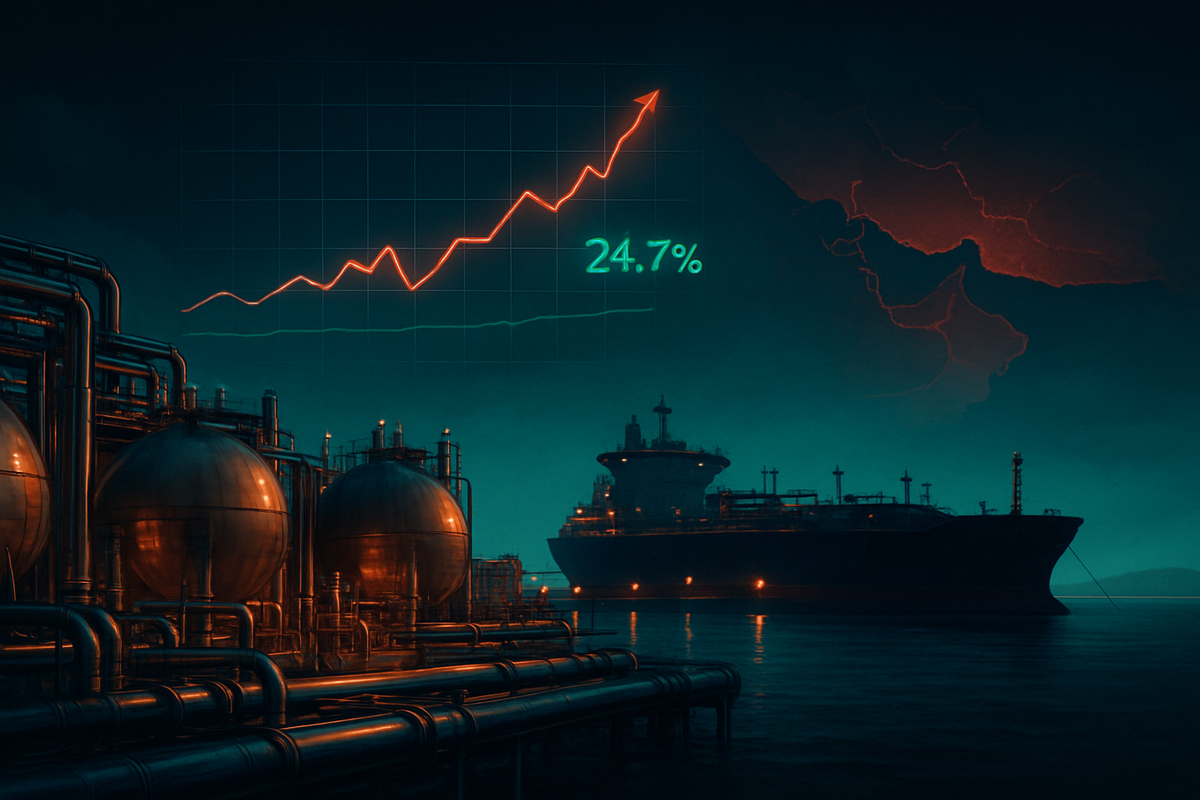
The U.S. energy landscape witnessed a staggering divergence in February 2026, as the Bureau of Labor Statistics reported a 24.7% surge in natural gas import prices. This massive spike, the largest monthly increase in nearly four years, has sent ripples through the broader fuel markets, contributing to a 1.3% rise in total U.S. import costs. The jump highlights the growing "internationalization" of the American energy sector, where global geopolitical volatility increasingly dictates the cost of supplemental energy supplies even as domestic production remains robust.
While the import price shock has raised alarms regarding renewed inflationary pressures, the impact remains curiously lopsided. This surge was primarily driven by a sudden tightening of global supply chains and a massive redirection of liquefied natural gas (LNG) cargoes away from North American ports toward high-premium markets in Europe and Asia. For the average American consumer, the immediate implications are felt most acutely in secondary fuel costs and industrial inputs, rather than direct heating bills, marking a complex new chapter in global energy interconnectedness.
The Hormuz Crisis and the Global Supply Scramble
The primary catalyst for this price explosion was the eruption of the Hormuz Crisis in late February 2026. Following military escalations in the Middle East, including targeted strikes on Iranian infrastructure and subsequent retaliation, the Strait of Hormuz—a critical chokepoint responsible for approximately 20% of global LNG trade—was effectively shuttered. The situation worsened when Iranian missiles struck the Ras Laffan Industrial City in Qatar, the world’s largest LNG export hub. QatarEnergy was forced to declare force majeure on several major contracts after damaging critical production trains, removing roughly 17% of Qatar’s export capacity from the global market almost overnight.
This catastrophic loss of supply triggered an immediate global bidding war. As Asian JKM futures soared nearly 90%, buyers in Japan, South Korea, and Taiwan began outbidding all other regions for available spot cargoes. In Europe, where the phase-out of remaining Russian pipeline gas had already left the continent vulnerable, Dutch TTF prices jumped from €32/MWh to over €60/MWh. The U.S. import price surge of 24.7% reflects the high premium American importers had to pay to secure the small volume of specialized gas needed for coastal regions that lack direct pipeline access to the interior U.S. basins.
In stark contrast to this international chaos, the domestic U.S. benchmark, Henry Hub, remained remarkably range-bound. Throughout February and into late March 2026, Henry Hub prices hovered between $2.93 and $3.20/MMBtu. This "decoupling" occurred because the U.S. was already operating at its maximum LNG export capacity. With no physical way to send more gas overseas to capture the international price premium, the domestic surplus—driven by a record production year and high storage levels—kept local prices suppressed. The Energy Information Administration (EIA) even lowered its domestic forecast during this period, citing a mild end to the winter and healthy inventory levels.
Initial market reactions have been a mix of relief for domestic consumers and dread for global logistics. While the U.S. heartland is shielded by its own abundance, the cost of imported energy and the resulting spike in global benchmarks have re-ignited fears of a "hawkish pivot" by the Federal Reserve. The timeline of events suggests that while the initial price shock was a reaction to the Hormuz closure, the lasting impact will be determined by how long the Qatari facilities remain offline and whether the U.S. can accelerate its export infrastructure to meet the desperate demand from its allies.
Winners and Losers in a Bifurcated Market
The sudden supply crunch has created a clear set of winners and losers across the public markets. Leading the gains are major integrated energy firms like ExxonMobil (NYSE: XOM) and Chevron (NYSE: CVX), whose stock prices rose nearly 30% in the first quarter of 2026. These giants benefited not only from the general rise in global energy benchmarks but also from their diversified production portfolios in regions unaffected by the Middle East crisis, such as the Permian Basin and offshore Guyana. Similarly, Occidental Petroleum (NYSE: OXY) saw significant investor interest as a primary domestic producer shielded from international supply shocks but poised to benefit from long-term price support.
In the midstream and export sectors, Cheniere Energy (NYSE: LNG) remained a standout performer. As the leading U.S. LNG exporter, Cheniere’s facilities were at the center of the redirection efforts, with its shares hovering near all-time highs as global buyers sought long-term stability away from the Strait of Hormuz. EQT Corp (NYSE: EQT), the largest natural gas producer in the U.S., also saw strategic gains as it pivoted its marketing efforts toward "direct-to-international" pricing, attempting to capture a larger slice of the global premium through its export agreements. Midstream infrastructure players like Oneok, Inc. (NYSE: OKE) gained as the importance of moving domestic gas to coastal export terminals reached a fever pitch.
On the losing side, global energy majors with heavy exposure to Qatari production, such as Shell (NYSE: SHEL), faced immediate headwinds. The damage to the Pearl GTL plant and the disruption of Qatari LNG flows forced Shell to navigate a complex series of supply redirections and potential contract defaults. Furthermore, the transportation sector felt the burn of rising fuel costs. Delta Air Lines (NYSE: DAL) and other major carriers saw their stocks punished as jet fuel costs surged 75% following the broader energy spike. Airlines are now facing the prospect of significantly higher operating expenses through the peak summer travel season, threatening to erase the margin gains made over the previous year.
Finally, international utility providers and heavy industrial users in Europe and Asia are the most severely impacted. Utilities in regions like Italy and South Korea, which depend heavily on spot LNG shipments, have faced force majeure cuts and are being forced to pass these astronomical costs onto consumers. This has led to a cooling of industrial activity in those regions, which may eventually dampen global demand for other commodities, creating a secondary wave of economic pressure on multinational corporations.
Analyzing the Significance: A Fragmented Global Market
The events of February 2026 represent a critical shift in the global energy paradigm, marking the definitive end of the era of cheap, easily accessible global gas. The 24.7% jump in U.S. import prices, despite a domestic surplus, underscores a significant market fragmentation. We are no longer seeing a single global price for natural gas; instead, we are seeing a world divided by infrastructure bottlenecks. The U.S. has effectively become an "energy island," where domestic abundance provides a buffer for its citizens, but its limited export capacity prevents it from fully stabilizing its global partners.
This event also highlights a potential regulatory and policy shift in Washington. The Biden-Harris administration, facing pressure from international allies, recently granted emergency authorization to projects like Venture Global's Plaquemines LNG to increase export volumes. However, these moves often face domestic opposition from consumer advocacy groups who fear that increased exports will eventually bridge the gap between low Henry Hub prices and high global benchmarks, leading to higher utility bills for Americans. This tension between being a global energy guarantor and maintaining domestic price stability will likely dominate the 2026 political landscape.
Historically, this event draws comparisons to the 2022 energy crisis following the invasion of Ukraine, but with a crucial difference: the current crisis is maritime and infrastructure-based rather than pipeline-based. The vulnerability of the Strait of Hormuz and the physical destruction of LNG trains in Qatar have proven that the "maritime bridge" of LNG is just as fragile as any pipeline. This realization is pushing many nations to reconsider their reliance on long-distance energy imports, potentially accelerating the transition to localized renewable energy or nuclear power in a bid for true energy sovereignty.
The ripple effects are already being felt in the shipping industry. With the Strait of Hormuz compromised, the demand for longer-haul routes from the U.S. and West Africa to Asia has skyrocketed. This has led to a spike in daily charter rates for LNG carriers, adding another layer of cost to an already expensive commodity. For investors, this signifies that the "energy transition" is not just about moving from fossil fuels to renewables, but also about the complex and often volatile reorganization of how the world’s remaining fossil fuels are transported and priced.
The Path Forward: Strategic Pivots and Market Scenarios
Looking ahead, the energy market is bracing for a period of sustained volatility. In the short term, the primary focus will be on the repair timeline for the Ras Laffan facilities in Qatar. If the damage is permanent or repairs are delayed by further conflict, the redirection of U.S. gas to Europe and Asia will become a permanent feature of the 2026 market. This would keep U.S. import prices elevated and potentially put upward pressure on domestic Henry Hub prices as more export capacity comes online in late 2026 and 2027, finally allowing the domestic surplus to "leak" into the global market.
Strategically, U.S. energy companies are likely to accelerate their investments in liquefaction and regasification technology. We may see a wave of new "floating LNG" projects that can be deployed faster than traditional land-based terminals. Furthermore, companies like EQT and ExxonMobil may seek to further integrate their operations, owning everything from the wellhead to the international delivery point to maximize their capture of the global price spread. For the public, this may mean that the era of sub-$3.00 gas is nearing its end as the U.S. infrastructure finally catches up with global demand.
A secondary scenario involves a potential "demand destruction" event in Europe and Asia. If prices remain at these elevated levels, industrial heavyweights in Germany and Japan may be forced to scale back production permanently. This would reduce global demand and eventually lead to a price collapse, but at the cost of significant global economic growth. Investors should watch for the monthly export data and any signs of a "truce" in the Middle East, as the reopening of the Strait of Hormuz remains the single most important factor for normalizing the market.
Final Assessment: What to Watch for in 2026
The 24.7% surge in natural gas import prices is a stark reminder that in the modern economy, no market is an island—even one as well-supplied as the United States. While domestic Henry Hub prices have remained stable for now, the global "energy tax" imposed by the Hormuz Crisis is beginning to filter through the economy in the form of higher import costs and transportation surcharges. The key takeaway for investors is the importance of geographical and operational diversity; those companies capable of navigating the bottlenecked infrastructure are the ones positioned to thrive.
Moving forward, the market will be hyper-focused on three key indicators: the status of the Strait of Hormuz, the pace of new U.S. LNG export terminal completions, and the Federal Reserve’s reaction to import-driven inflation. If the Fed interprets the 1.3% rise in total import prices as a sign of structural inflation, we could see interest rates remain higher for longer, further impacting the capital-intensive energy and utility sectors.
For the remainder of 2026, the primary narrative will be the "Great Redirection." As the U.S. attempts to fill the void left by Qatar, every cubic foot of gas will be contested by global powers. Investors should keep a close eye on the weekly storage reports from the EIA and the progress of major infrastructure projects. The era of range-bound domestic prices may be a temporary reprieve, and the volatility we see in the import data today could be a harbinger of the "new normal" for the American energy consumer in the years to come.
This content is intended for informational purposes only and is not financial advice