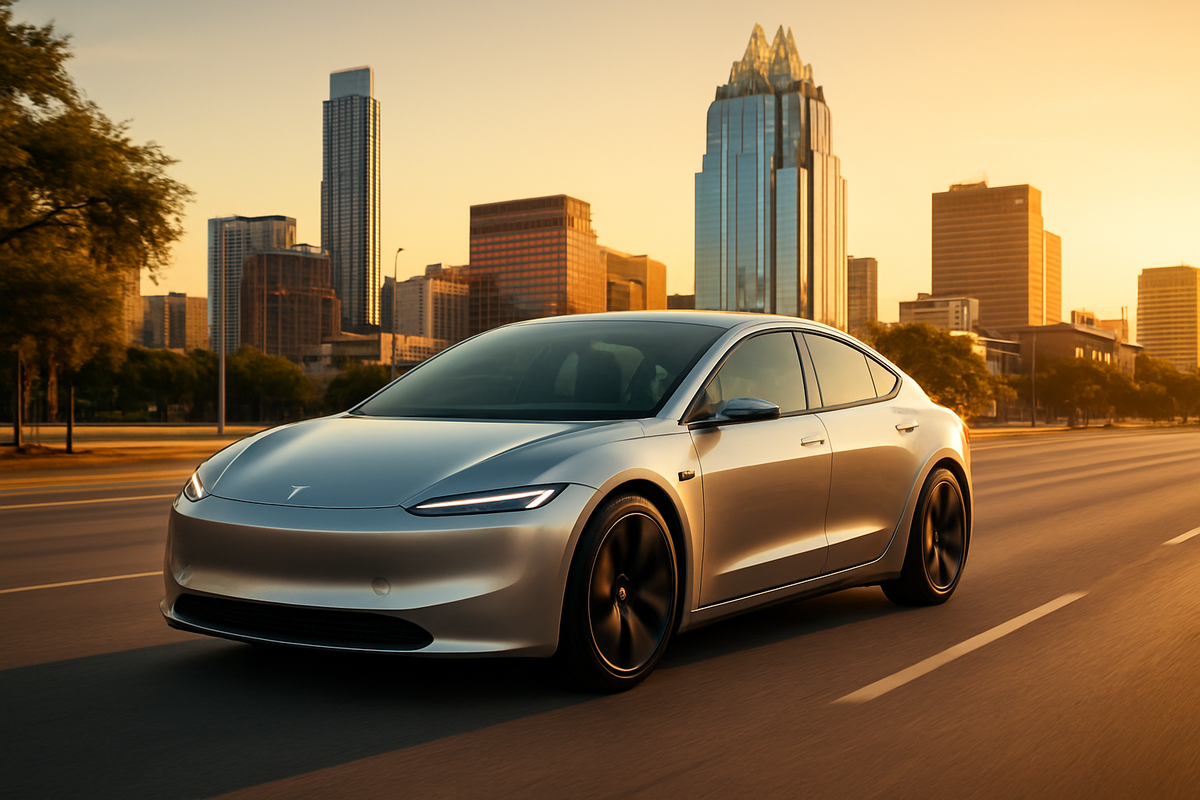
The announcement, which saw the company’s stock price jump 3.5% in midday trading, marks the first time the electric vehicle giant has permitted public riders to travel in vehicles with no human backup driver in the front seat. This milestone effectively transitions Tesla (NASDAQ: TSLA) from a traditional automaker into a fully realized artificial intelligence and robotics powerhouse, fulfilling a nearly decade-long promise from CEO Elon Musk.
The immediate market reaction reflects a cautious but growing optimism that Tesla can finally monetize its Full Self-Driving (FSD) software at scale. While the stock had suffered a rocky start to the year—falling nearly 7% in early January due to disappointing 2025 delivery numbers—the Austin launch has provided a much-needed catalyst. Investors are now weighing the potential for a high-margin recurring revenue stream against the logistical and regulatory hurdles that still remain as Tesla prepares for mass production of its purpose-built "Cybercab."
The Road to Autonomy: From "We, Robot" to Unsupervised Reality
The journey to this week’s launch began in earnest during the "We, Robot" event in October 2024, where Tesla first unveiled the Cybercab, a vehicle designed without a steering wheel or pedals. Over the course of 2025, Tesla conducted limited "supervised" pilot programs in Texas and California, using safety monitors to oversee the system’s performance. The transition to fully unsupervised rides in Austin today was made possible by the wide rollout of FSD v14.2.2.3, which utilizes a vision-based neural network to handle complex urban navigation, including real-time detours and emergency vehicle interactions.
Key stakeholders, including Tesla’s engineering team and the Texas Department of Transportation, have been working quietly to ensure the fleet’s safety protocols meet local requirements. Unlike its competitors, who rely on expensive LiDAR and pre-mapped "geofences," Tesla’s approach uses pure vision, allowing its vehicles to operate in areas without high-definition maps. However, the rollout has not been without controversy. Just weeks ago, the United States Patent and Trademark Office (USPTO) suspended Tesla’s application for the "Cybercab" name due to a prior filing by a French beverage firm, UniBev, creating a potential branding headache for the company as it approaches mass production.
Furthermore, the timeline for the dedicated Cybercab hardware has been clarified. During the launch event in Austin, Musk confirmed that "unboxed" manufacturing of the Cybercab will begin at Gigafactory Texas in April 2026. He warned, however, that the production ramp would follow an "S-curve," starting slowly before reaching millions of units annually by late 2027. This staggered approach is intended to refine the revolutionary manufacturing process, which removes the traditional assembly line in favor of modular sub-assemblies.
Market Disruptors: Winners and Losers in the Robotaxi Era
Tesla stands as the primary beneficiary of this milestone, as the successful deployment of unsupervised vehicles validates its massive investment in the Dojo supercomputer and AI training. By proving the software works in a major metropolitan area, Tesla is positioned to capture a significant share of the global ride-hailing market, which analysts estimate could be worth trillions by the 2030s. The company’s plan to pivot FSD to a subscription-only model on February 14, 2026, further signals a shift toward software-as-a-service (SaaS) margins that traditional car companies cannot match.
On the losing side of this shift are legacy ride-hailing platforms like Uber Technologies (NYSE: UBER) and Lyft (NASDAQ: LYFT). While both companies have attempted to integrate autonomous partners into their apps, Tesla’s "Tesla Network" poses a direct existential threat. If Tesla can achieve the $0.20 per-mile operating cost projected by some analysts, it would undercut the current ride-hailing model so significantly that human-driven services might become obsolete in high-density areas. Uber and Lyft shares saw a slight downturn following the Austin announcement as investors questioned their long-term viability in a world of vertically integrated robotaxi fleets.
The broader automotive industry, including Ford Motor Company (NYSE: F) and General Motors (NYSE: GM), also faces increased pressure. While GM’s Cruise unit has been working to regain its footing after safety setbacks in 2024, Tesla’s rapid software iteration and massive data advantages have created a widening gap. Meanwhile, Alphabet Inc. (NASDAQ: GOOGL), the parent company of Waymo, remains a formidable competitor. Waymo’s established presence in several U.S. cities provides a counterpoint to Tesla’s vision-only approach, though Waymo’s reliance on expensive sensor suites may limit its ability to scale as quickly as Tesla's hardware-light fleet.
Regulatory Tightropes and Global Implications
Tesla’s Austin launch is a significant data point in the broader trend of AI-driven automation, but it arrives amidst a complex regulatory landscape. The National Highway Traffic Safety Administration (NHTSA) is currently extending its investigation into FSD safety violations, with a deadline of February 23, 2026, to determine if previous software versions were responsible for specific traffic infractions. The outcome of this probe could lead to mandatory recalls or operational restrictions that might temper the excitement surrounding the Austin rollout.
Internationally, the eyes of the world are on Europe. The Dutch vehicle authority, RDW, has scheduled a compliance demonstration for Tesla’s FSD Supervised system in February 2026. If approved, it would pave the way for Tesla to bring its autonomy software to the European Union, a market traditionally more stringent regarding safety and privacy than the United States. This move would likely trigger a ripple effect, forcing European regulators and domestic manufacturers like Volkswagen and Mercedes-Benz to accelerate their own autonomous vehicle (AV) frameworks to remain competitive.
Historically, the launch of the Tesla Network can be compared to the introduction of the Model T or the first iPhone—a "platform shift" that redefines how people interact with technology and transportation. However, unlike those hardware-centric shifts, the robotaxi era is governed by the "law of the miles." Tesla’s ability to leverage billions of miles of real-world data gives it a "data moat" that is difficult for newcomers to bridge. The regulatory response to this data-dominant model will likely set the precedent for other AI applications, from delivery drones to humanoid robots.
The Horizon: What Investors Should Watch Next
Looking ahead, the next six months will be critical for Tesla. The immediate focus will be the "S-curve" production of the Cybercab in April. Investors should look for signs of manufacturing bottlenecks or delays, which have historically plagued Tesla’s new product launches. Additionally, the transition to a subscription-only FSD model on February 14 will provide the first real test of consumer demand for autonomy as a service. If take-rates remain high despite the lack of a "buy-it-forever" option, it will confirm the market's appetite for the technology.
In the long term, the expansion of the Tesla Network into "a dozen cities" by the end of 2026, as promised by Musk at Davos, will be the true benchmark of success. Each new city brings unique weather patterns, traffic laws, and cultural driving habits that will test the limits of FSD v14. Each city also introduces new regulatory environments that must be navigated. The company will also need to address the "HW3" hardware gap. With older vehicles requiring a "Lite" version of the software, Tesla may eventually face the choice of a costly hardware retrofit for millions of cars or leaving early adopters behind—a move that could spark legal and brand loyalty challenges.
Strategic pivots may also emerge in the form of licensing. If Tesla successfully scales in Austin and beyond, other automakers may abandon their own AV efforts and seek to license Tesla’s FSD software, similar to how the industry adopted the North American Charging Standard (NACS). This would represent a secondary, high-margin revenue stream for Tesla, potentially turning every car on the road—regardless of the brand—into a contributor to Tesla’s bottom line.
A Decisive Moment for the "AI Play"
The events of January 22, 2026, represent a decisive victory for Tesla’s vision of the future. By moving from supervised "beta" testing to unsupervised public service, the company has cleared the highest technical hurdle in the autonomous vehicle space. While challenges regarding trademarks, hardware limitations, and federal investigations persist, the momentum has clearly shifted in favor of the "Tesla Network" model. The 3.5% stock surge is a reflection of a market that is starting to believe in the $1.43 trillion valuation not as a car company, but as a robotics leader.
For investors, the coming months will require a focus on execution and regulatory clarity. The success of the Austin pilot will be the blueprint for a nationwide rollout, and any safety incidents will be magnified by the lack of a human driver. However, if the service maintains a clean safety record while lowering costs for consumers, the financial implications will be profound. The transition from selling vehicles to selling miles is no longer a theoretical exercise; it is currently happening on the streets of Texas.
As we look toward the February 23 NHTSA deadline and the April production start for the Cybercab, the narrative surrounding Tesla will likely remain volatile. Investors should watch for quarterly "miles-per-intervention" data and the official resolution of the UniBev trademark dispute. For now, the "Robotaxi" is no longer a distant promise—it is a passenger-carrying reality that has rewritten the rules of the road.
This content is intended for informational purposes only and is not financial advice