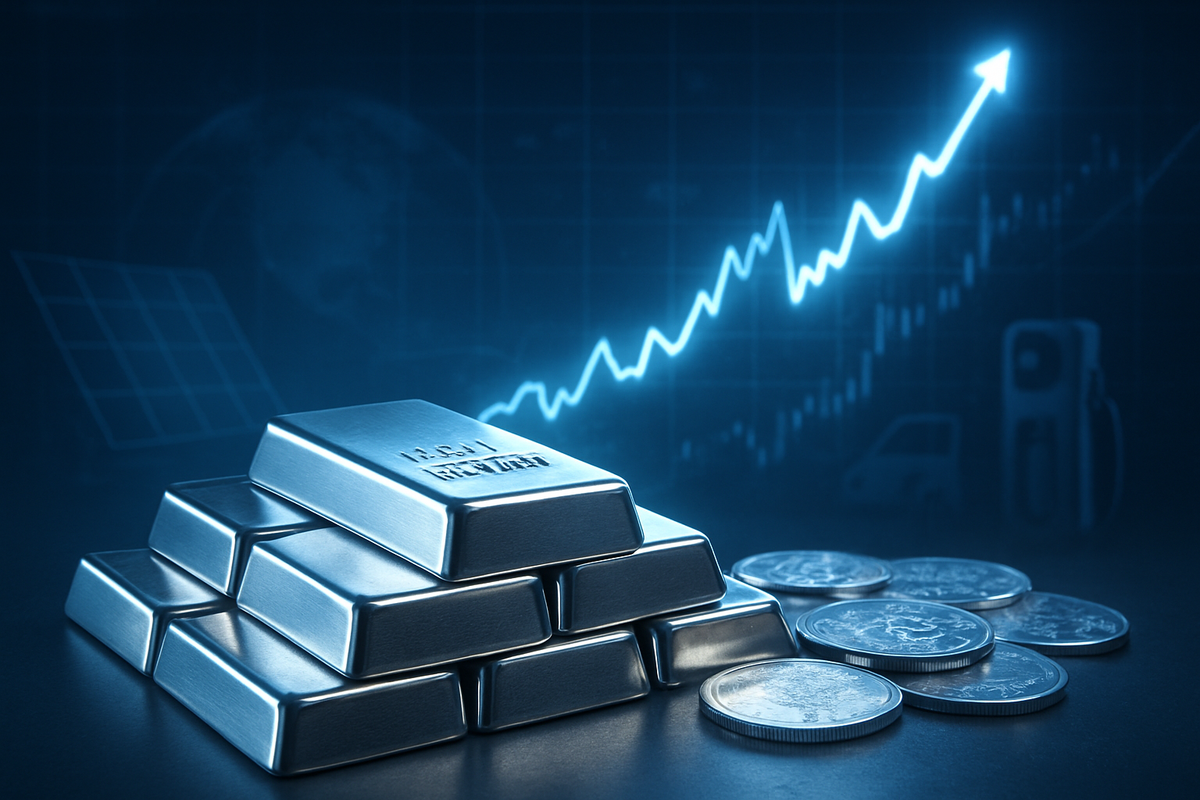
As the financial world rings in 2026, silver has emerged as the undisputed titan of the commodities market. Trading at approximately $74.10 per ounce on January 2, 2026, the metal has solidified its status as a critical pillar of the global economy, having recently touched a staggering all-time high of $84.01 in late December 2025. This historic surge represents a year-over-year gain of nearly 170%, a performance that has left gold and traditional equities in its dust.
The implications for the market are profound. Once dismissed as "poor man’s gold," silver is now being re-evaluated as a "double-engine" asset, powered simultaneously by its essential role in the green energy transition and its traditional function as a safe-haven during times of geopolitical chaos. For U.S. commodity investors, the current price action signals a fundamental shift in the supply-demand balance, suggesting that the era of cheap silver is likely a relic of the past.
The Road to $84: A Year of Unprecedented Volatility
The journey to silver's current heights began in early 2025, when a confluence of supply shortages and a sudden pivot in global monetary policy ignited a rally. By mid-year, the metal had cleared the psychological $50 barrier, a level not seen in decades. The momentum accelerated in the fourth quarter of 2025 as geopolitical tensions in the Middle East and a U.S. naval blockade on Venezuelan oil tankers injected a massive "war premium" into precious metals. On December 29, 2025, silver hit its intraday peak of $84.01, fueled by a "silver squeeze" sentiment that swept through retail and institutional trading desks alike.
Key stakeholders, including the Chicago Mercantile Exchange (CME), have struggled to manage the volatility. Throughout 2025, the CME implemented several margin hikes to curb speculative froth, yet the physical market remained tight. Central banks in emerging markets, led by China and Poland, have also entered the fray, diversifying their reserves away from the U.S. Dollar and into physical bullion. This institutional backing has created a "hard floor" for prices, preventing the sharp crashes that historically followed silver rallies.
Winners and Losers in the High-Silver Era
The primary beneficiaries of this price explosion have been the pure-play silver miners and streaming companies. First Majestic Silver (NYSE: AG) has been a standout performer, posting a 209% return in 2025 following its strategic acquisition of Gatos Silver. Similarly, Pan American Silver (NYSE: PAAS) has leveraged its integration of the Juanicipio mine to deliver a 164% gain, positioning itself as the premier large-cap vehicle for silver exposure. For those looking for lower-risk participation, Wheaton Precious Metals (NYSE: WPM) has outperformed the broader market by 113%, as its streaming model allows it to capture record spot prices while remaining insulated from the rising operational costs and labor strikes that have plagued traditional miners.
However, the surge is a double-edged sword for industrial consumers. Manufacturers of photovoltaic (PV) cells and electric vehicles (EVs) are facing a "margin squeeze" as their primary conductive material becomes prohibitively expensive. Large-scale solar installers and EV giants like Tesla, Inc. (NASDAQ: TSLA) are now forced to choose between passing these costs on to consumers or accelerating research into silver alternatives, such as copper-plated cells, which are still years away from mass-market efficiency.
Silver as a Strategic Asset: Green Tech and Geopolitics
The wider significance of this rally lies in silver's new classification as a "U.S. Critical Mineral," a designation granted in 2025. This move reflects the metal's indispensable role in the 21st-century economy. The European Union’s push to reach 700GW of solar capacity by 2030 has created a structural deficit that mining supply cannot meet. Furthermore, the 2025 explosion in Artificial Intelligence infrastructure has added a new demand vector; high-performance data centers require silver-intensive cooling systems and high-speed switches to function.
Historically, silver has tracked gold, but the current "super-cycle" is different. We are witnessing a decoupling where silver's industrial utility is driving the price as much as its monetary value. The current "paper-to-physical" ratio—estimated at 356:1—suggests that the futures market is severely disconnected from the reality of physical availability. This mirrors the nickel crisis of 2022 but on a much larger, more systemic scale, potentially leading to a permanent re-rating of the silver-to-gold ratio.
What Lies Ahead: The Path to $100?
As we look further into 2026, the short-term outlook remains bullish but volatile. Analysts from major investment banks are already forecasting a move toward $100 per ounce by year-end, provided that China’s recent export restrictions on refined silver remain in place. Investors should prepare for a "buy the dip" environment as the Federal Reserve is expected to implement at least two interest rate cuts in the first half of 2026, further weakening the U.S. Dollar and making non-yielding assets like silver more attractive.
In the long term, the industry may see a wave of consolidation. High silver prices provide miners with the capital needed to explore deep-underground deposits that were previously uneconomical. However, the lead time for new mines to come online is typically seven to ten years, meaning the supply crunch is likely to persist through the end of the decade. Strategic pivots toward silver recycling and urban mining are expected to become major themes in the 2026 corporate landscape.
Investing in the New Silver Age
The takeaways for the start of 2026 are clear: silver is no longer just a speculative play for retail investors; it is a strategic necessity for the global energy transition. The iShares Silver Trust (NYSEARCA: SLV), which now manages over $38 billion in assets, remains the primary vehicle for those seeking liquid exposure to the metal's price movements.
Moving forward, investors should watch for any signs of "demand destruction" in the solar sector and monitor the CME for further margin adjustments. While the volatility can be harrowing, the underlying fundamentals of silver—scarcity, industrial necessity, and geopolitical utility—suggest that the "White Metal" will remain at the center of the financial stage for the foreseeable future. The era of $20 silver is gone; the era of $100 silver may be just around the corner.
This content is intended for informational purposes only and is not financial advice.