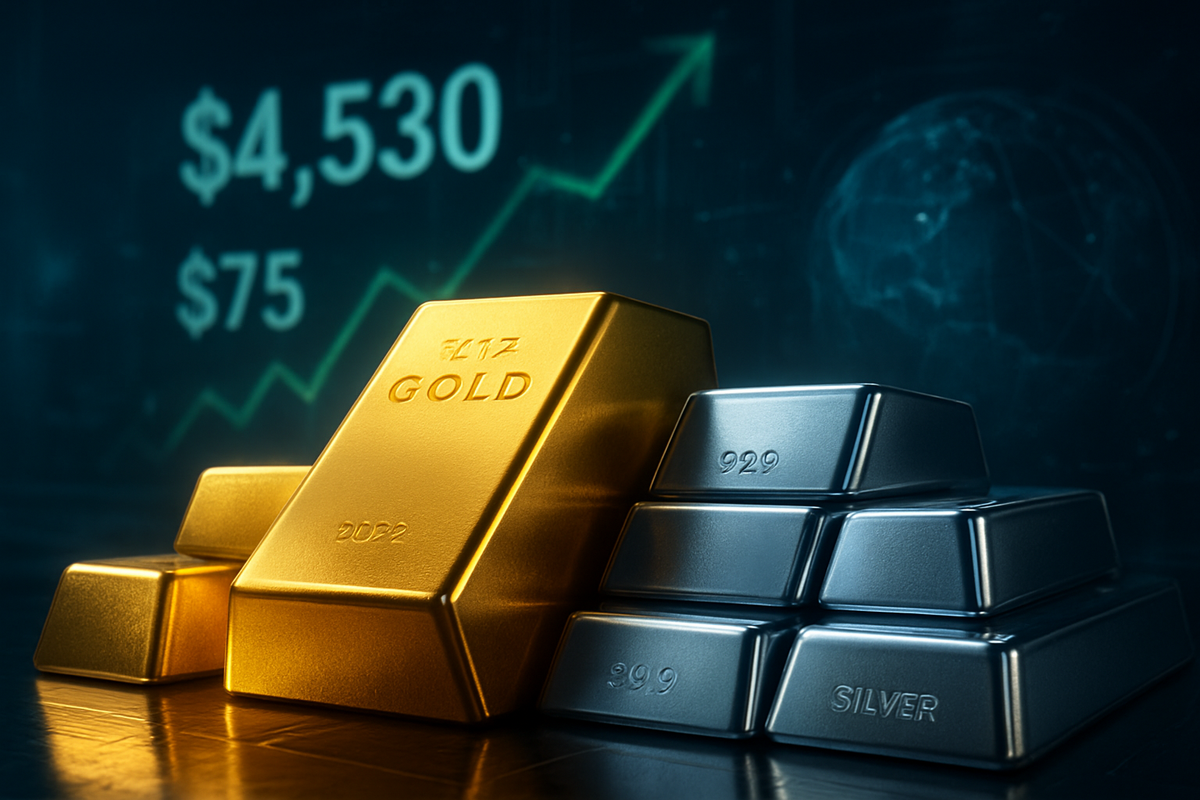
In a historic culmination of geopolitical instability and monetary shifts, the precious metals market has reached a fever pitch as 2025 draws to a close. Spot gold prices surged past the psychological barrier of $4,530 per ounce this week, marking an unprecedented 72% annual gain—the strongest performance for the yellow metal since 1979. Not to be outdone, silver has staged a meteoric rise of its own, surpassing $75 per ounce as a structural supply deficit and a new status as a "critical mineral" fueled a frantic year-end scramble for physical bullion.
The rally, which intensified during the final quarter of 2025, represents a fundamental realignment of global finance. Driven by a "perfect storm" of safe-haven demand, aggressive central bank accumulation, and a pivot in Federal Reserve policy, the surge has transformed gold and silver from mere inflation hedges into the primary beneficiaries of a broader "Everything Rally." As investors flee traditional dollar-denominated assets in favor of "hard money," the implications are reverberating across every sector of the global economy, from mining boardrooms to high-tech manufacturing floors.
A Perfect Storm: The Path to $4,530 Gold
The road to gold’s record-shattering peak of $4,530.60 per ounce was paved by a series of escalating global crises throughout 2025. The primary catalyst arrived in early December when a U.S. naval blockade of Venezuelan oil tankers sparked fears of a wider regional conflict and a potential global energy shock. This geopolitical flashpoint, combined with continued instability in Eastern Europe and recent U.S. airstrikes in Nigeria, sent institutional investors rushing toward the safety of bullion.
Simultaneously, the Federal Reserve’s monetary policy provided the necessary tailwinds for a sustained breakout. After a series of three 25-basis-point rate cuts in the latter half of the year—concluding with a final cut in mid-December—the U.S. Dollar Index (DXY) plummeted to two-month lows. This easing cycle significantly reduced the opportunity cost of holding non-yielding assets like gold and silver, inviting a massive wave of capital into physically-backed ETFs, which saw net inflows exceeding $82 billion in 2025 alone.
Perhaps most significantly, the "de-dollarization" trend accelerated to a breaking point. Central banks, led by the People’s Bank of China and the Reserve Bank of India, maintained a relentless buying spree for the fourth consecutive year. With total central bank purchases expected to top 1,000 tonnes by year-end, the move away from U.S. Treasuries toward gold has provided a solid floor for prices, ensuring that every minor dip was met with aggressive institutional buying.
Winners and Losers: The Corporate Fallout
The "melt-up" in precious metals has created a stark divide between those who extract the metals and those who must consume them. Mining giants are currently enjoying a "margin explosion" as the price of their output has far outpaced their all-in sustaining costs (AISC). Newmont Corporation (NYSE: NEM), the world’s largest gold producer, has seen its stock price surge over 174% this year, trading near $102 per share as of late December. The company recently reported a record free cash flow of $4.5 billion, much of which is being returned to shareholders via special dividends and buybacks.
Similarly, Barrick Gold (NYSE: GOLD) has seen its market capitalization effectively double in 2025. The company’s strategic decision to explore an IPO of its North American assets has further buoyed investor sentiment. Meanwhile, Agnico Eagle Mines (NYSE: AEM) has capitalized on record production results from its Canadian operations, with its stock rising 121% year-to-date. In the silver space, miners have seen even more dramatic gains, though the volatility remains high.
Conversely, industrial consumers are facing a "cost-push" crisis. Signet Jewelers (NYSE: SIG), the parent company of Kay and Zales, has struggled with "demand destruction" as middle-market consumers balk at the soaring prices of gold jewelry. In the renewable energy sector, traditional silicon-based solar manufacturers like JinkoSolar (NYSE: JKS) are facing margin compression due to the rising cost of silver paste. However, First Solar (NASDAQ: FSLR) has emerged as a surprise winner; its thin-film technology requires 98% less silver than traditional panels, granting it a significant competitive cost advantage in the current high-price environment. High-tech firms like Amkor Technology (NASDAQ: AMKR) and even Tesla (NASDAQ: TSLA) are also feeling the pinch, with rising material costs for semiconductors and EV electronics impacting bottom-line margins.
Broader Significance: AI, Critical Minerals, and De-dollarization
The 2025 rally is more than just a speculative bubble; it reflects a structural shift in how the world values industrial and monetary commodities. Silver’s rise to $75 was heavily influenced by its addition to the U.S. Critical Minerals List in November. This recognition highlighted the metal's indispensable role in the AI revolution—where silver’s high conductivity is essential for advanced data centers—and the ongoing green energy transition. With global silver inventories hitting record lows in London and New York, the market entered a historic short squeeze in the final quarter of the year.
This event also marks a historical precedent, drawing comparisons to the stagflationary environment of the late 1970s. However, the current era is defined by a more complex interplay of technology and geopolitics. The "Everything Rally" of December 2025 saw gold and silver rising alongside equities, suggesting that investors are not just hedging against a crash, but are repositioning for a new era of persistent inflation and fragmented global trade.
The regulatory implications are also mounting. As silver becomes a "critical mineral," we may see increased government intervention in mining supply chains or the implementation of strategic stockpiles. This could lead to a more nationalistic approach to resource management, further complicating the global trade landscape for mining companies and their partners.
What Comes Next: A New Floor or a Looming Correction?
As we look toward 2026, the primary question for investors is whether these record prices are sustainable. In the short term, the momentum remains firmly to the upside. The technical breakout above $4,500 for gold and $75 for silver has cleared the way for further speculative gains as "Fear Of Missing Out" (FOMO) takes hold of retail and institutional traders alike. However, the extreme pace of the rally suggests that a period of consolidation or a sharp corrective pullback is likely in the first quarter of the year.
Strategically, industrial consumers are already pivoting. We are seeing an acceleration in "thrifting" technologies, where manufacturers attempt to substitute silver with copper or other cheaper alloys. While this may dampen industrial demand over the long term, the transition is expected to take years, leaving the market in a supply deficit for the foreseeable future. Investors should watch for any signs of a "peace dividend" in Venezuela or Eastern Europe, as a de-escalation of geopolitical tensions remains the most significant downside risk to the current safe-haven premium.
Conclusion: The New Gold Standard
The end-of-year rally of 2025 has cemented gold and silver’s status as the ultimate arbiters of value in an increasingly uncertain world. With gold at $4,530 and silver at $75, the "barbarous relic" has proven its relevance in the age of AI and digital finance. The key takeaway for the market is that the drivers of this rally—de-dollarization, structural supply shortages, and geopolitical fragmentation—are not transitory issues but permanent features of the new economic landscape.
Moving forward, the market will likely remain highly volatile. Investors should keep a close eye on central bank reserve reports and the U.S. Geological Survey’s next steps regarding silver’s critical status. While the astronomical gains of 2025 may be difficult to repeat in 2026, the fundamental shift toward hard assets suggests that the floor for precious metals has been permanently raised.
This content is intended for informational purposes only and is not financial advice.