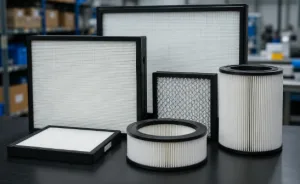
Air purifiers, robot vacuums, and cabin filtration systems have turned into a crowded market over the past few years, and the filter inside each product is doing most of the actual work. According to the U.S. Environmental Protection Agency, people spend roughly 90 percent of their time indoors, where pollutant levels can run two to five times higher than they do outside. That single statistic explains why so many appliance brands, distributors, and private-label sellers are now hunting for a dependable filtration partner instead of just buying whatever shows up first in a supplier directory. The problem is that “HEPA” gets printed on packaging far more often than it gets earned. Picking the wrong supplier doesn’t just hurt performance. It can sink a certification audit or trigger a wave of returns once customers realize the filter isn’t doing what the box promised. Why “HEPA” Is a Regulated Term, Not a Marketing WordHEPA stands for high-efficiency particulate air filter, and the term isn’t just industry slang. It was formally defined by the U.S. Department of Energy and is used by the EPA to describe filters that remove at least 99.97 percent of airborne particles measuring 0.3 microns in diameter. That size, 0.3 microns, isn’t picked at random. It’s known as the Most Penetrating Particle Size (MPPS), the size range that’s genuinely hardest for any filter media to trap. Particles larger or smaller than that are caught even more effectively, which is why the 0.3-micron figure is treated as a worst-case benchmark rather than an average. This is also where a lot of consumer confusion comes from. Products labeled “HEPA-type” or “HEPA-like” are not required to meet this threshold at all. A true HEPA filter should have test data behind it, not just a claim printed on a box. H13, H14, and the Standards Worth Asking ForOutside the U.S., filter performance is usually classified under EN 1822, the European standard, which has since been aligned with the international ISO 29463 standard. Both systems grade filters by how they perform against the MPPS, and the two classes buyers run into most often are H13 and H14.
For most home appliance and automotive cabin applications, H13 already delivers strong performance without the higher pressure drop and energy cost that comes with H14 or ULPA-grade media. Specifying a higher class than the application actually needs is a common, and expensive, mistake. Off-the-Shelf Filters vs. Custom-Engineered FiltersWhen a standard size actually worksIf you’re replacing a filter for an existing, well-known appliance model, a standard cartridge or panel size might fit without any redesign. This is common for aftermarket replacement parts sold to consumers. When custom geometry becomes necessaryMost new product development doesn’t work that way. A new air purifier housing, a redesigned robot vacuum, or a cabin filter for a specific vehicle platform usually needs a filter built around the equipment, not the other way around. That means matching frame dimensions, pleat depth, sealing method, and airflow resistance to a specific CAD drawing or physical sample before the first production run ever happens. This is the point where working with a manufacturer that actually offers Custom HEPA Filters makes a real difference, rather than one that only resells generic panels. A custom-capable factory should be able to combine HEPA media with activated carbon or other adsorption layers for combined particulate and odor control, adjust the frame material (plastic, molded pulp, or aluminum) for weight and cost targets, and hold consistent pressure drop across a full production run, not just on the first sample sent for approval. Questions to Ask Before You Sign a Purchase OrderA supplier’s website can say almost anything. Before committing to a bulk order, it’s worth getting direct answers to a short list of questions:
A manufacturer that answers these clearly, with documents rather than general reassurances, is usually one worth pursuing further. Common Sourcing Mistakes That Cost Brands MoneyA few patterns show up again and again with buyers who’ve been burned before. The first is trusting a percentage that isn’t tied to a particle size. “99.99% efficient” sounds impressive printed on a spec sheet, but on its own it means very little. That number only becomes meaningful once it’s attached to a specific particle size and a named test standard, which is exactly the detail that gets left off marketing copy. The second is ignoring airflow and pressure drop. A filter can technically meet a HEPA efficiency rating and still choke airflow so badly that the appliance’s motor overheats or the unit becomes noticeably louder. Buyers who only ask “what’s the efficiency” and never ask “what’s the pressure drop at rated airflow” tend to find out the hard way, usually after customers start complaining. The third is skipping third-party verification. Test data supplied by the factory itself is a reasonable starting point, but it isn’t proof. Independent lab reports carry far more weight once a compliance audit is on the table, and asking for them upfront is much easier than scrambling for them later. The fourth is underestimating private-label lead times. Custom packaging, printed cartons, and compliance labeling often add more time to a production schedule than the filter media itself does. Brands that build this into the launch timeline early avoid the last-minute delays that catch everyone else off guard. Finding the Right Long-Term Manufacturing PartnerFiltration is one of those components that customers rarely notice when it works and complain about loudly when it doesn’t. For appliance brands, distributors, and OEM buyers scaling into new markets, the safer long-term move is building a relationship with an established Wholesale HEPA Filter Manufacturer that can produce consistent, verifiable filtration media at volume, rather than switching suppliers every time a batch falls short. A factory with in-house testing, documented certifications, and real custom engineering capability tends to save far more money over a two- or three-year product cycle than the cheapest quote ever does upfront. |
||||||||||||