Recently, CATARC Brand Technology (Tianjin) Co., Ltd. (hereinafter referred to as "CATARC Brand Technology") successfully conducted the verification for TOP Intelligence smart anti-motion sickness. This verification strictly adhered to authoritative protocols and innovatively introduced a dual-dimensional verification system comprising a "bionic dummy for motion sickness" and "user human factors." It integrated the SGS vehicle-level low motion sickness Premium Performance Mark certification standards, forming a comprehensive evaluation scheme that combines an international perspective with the characteristics of Chinese road conditions. Through inclusive and proactive innovative practices, it accelerates the construction of a new ecosystem for automotive comfort technology centered on user experience, providing solid support for building a strong automotive nation.
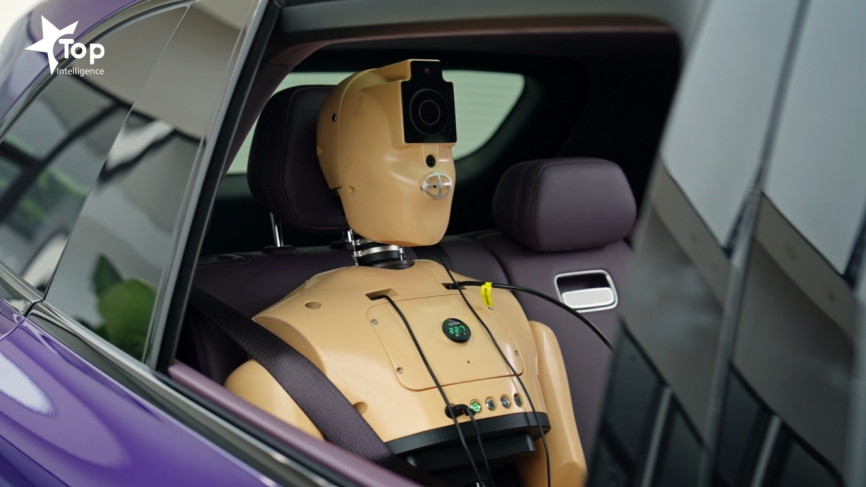
Bionic Dummy for Motion Sickness: Precisely Collecting and Quantifying the Triggers of Motion Sickness
The verification employed a "bionic dummy for motion sickness" equipped with built-in multi-axis acceleration and angular velocity sensors to precisely simulate the dynamic responses of the occupant's body. In typical road scenarios in Chongqing (covering nine types of operating conditions, including start-stop in traffic jams, continuous curves, bumpy roads, and lane changes), parameters such as the longitudinal and lateral acceleration of the dummy, as well as the pitch and roll angular velocities, were collected in real time. Combined with a multi-dimensional sensory evaluation model for motion sickness based on subjective-objective mapping, the vehicle's anti-motion sickness performance was quantitatively presented using an "anti-motion sickness index."
Data Collection from Real Occupants: Dynamically Monitoring and Calibrating Discomfort Boundaries
At the same time, this verification recruited representative real occupants. Under typical real-vehicle driving conditions, multi-modal physiological signals—such as electrocardiogram (ECG), respiration, galvanic skin response, and skin temperature—were collected simultaneously. The occupants were also required to fill out the MISC subjective rating scale for motion sickness. The verification team conducted a correlational modeling analysis on the objective motion sickness index, the physiological signals of the occupants, and the subjective ratings. By incorporating the kinematic posture indicators for the head and shoulders of the occupants, the team comprehensively evaluated the actual effectiveness of the vehicle's anti-motion sickness system. By incorporating the subjective physical sensations of users into a closed loop of technical verification, the process brings the research and development of anti-motion sickness technologies to real populations. This serves as a direct response to the demands of consumers for preventing motion sickness during daily travel, genuinely serving the expectations of the public for a high-quality travel experience.
The Dual-Dimensional System Integrates International Certification Standards, Taking a Crucial Step in the International Exploration of Motion Sickness Evaluation
The capability to prevent motion sickness is transitioning from an implicit aspect of the user experience to a core dimension in the evaluation of overall vehicle comfort. This verification deeply integrates the SGS international low motion sickness certification with the independent dual-dimensional verification system, serving as an important practice in aligning data from Chinese road conditions with international standards. The unique ecosystem of urban traffic in China drives the industry to continuously deepen its research on the sensitive mechanisms of the vestibular function in users. Meanwhile, the continuous expansion of subjective physical sensations and the capabilities for technical redundancy jointly elevate the driving and riding experience to new heights, reshaping the logic for evaluating the product competitiveness of automobiles at a deeper level. This verification drives the industry to shift from "passively responding to discomfort" to "proactively defining comfort." It marks a solid step in the systematic exploration of vehicle-level prevention of motion sickness in China. Furthermore, it will spur the entire industry to engage in a new round of technological competition and system construction centered on the comfort of travel, injecting robust momentum into the progression of the Chinese automotive industry toward the middle and upper end of the global value chain.
The current open road verification for TOP Intelligence smart anti-motion sickness transforms the discomfort of motion sickness from a vague physical sensation into quantifiable technical indicators. It establishes a baseline for a higher-quality experience in public travel and serves as another innovative milestone for the progression of the Chinese automotive industry toward high-quality development.
Media Contact
Company Name: CATARC Brand Technology (Tianjin) Co., Ltd
Contact Person: Peiyu Yang
Email: Send Email
City: Tianjin
Country: China
Website: https://www.catarc-cait.com.cn/