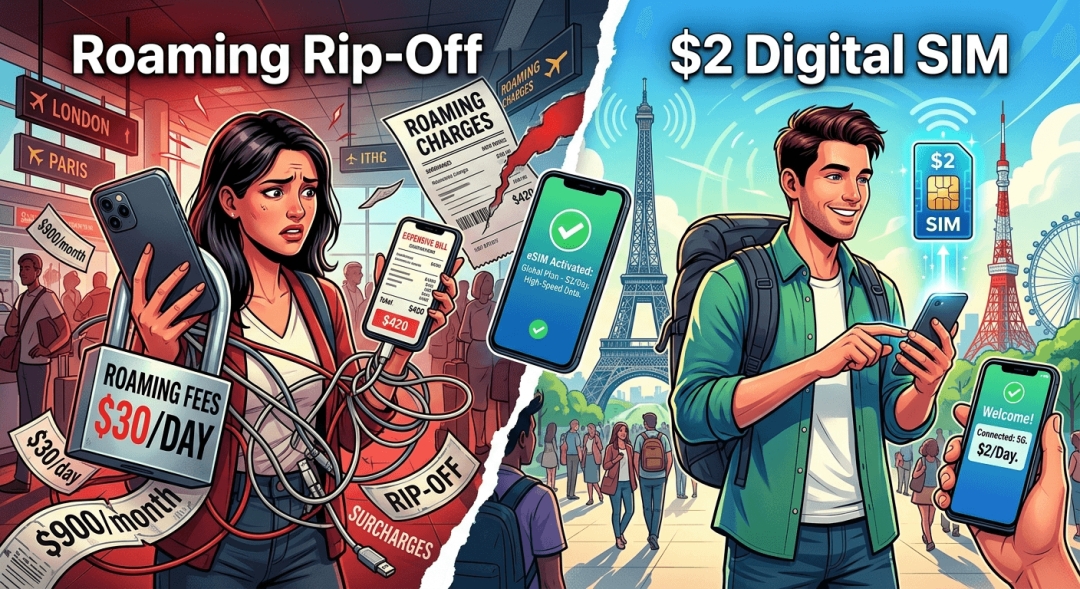
How a $2 Digital SIM is Killing the $30-a-Day Roaming Rip-Off
You land at the airport. You switch off airplane mode. And within seconds, your phone carrier sends a cheerful little notification: "Welcome to Japan! Roaming is now active at $30 per day." For millions of travelers, that message has been a recurring nightmare. A tax on movement. A penalty for leaving home. But something has changed. A $2 digital SIM, delivered to your inbox in seconds, is quietly making that $30 charge look like highway robbery.
Traditional roaming charges can cost travelers $30 or more per day, but eSIM technology now lets you buy a local data plan for as little as $2, activate it in under two minutes, and connect to 4G/5G networks without ever swapping a physical SIM card. Providers like uPhone cover 150+ countries with no contracts, no hidden fees, and plans built for every type of traveler.
The Roaming Racket Nobody Talks About Enough
Roaming fees have been a cash cow for mobile carriers for decades. The concept is simple and brutal: your home carrier charges you a premium to use a partner network abroad. You pay, often without realizing how fast it adds up. A five-day city break can easily generate $150 in roaming charges alone. Add a week in Southeast Asia and you might come home to a bill that hurts more than the flights.
The frustrating part? The data itself is cheap. Local SIM cards in most countries cost a few dollars and offer generous data allowances. The markup from your home carrier is not covering a technical cost. It is covering a business model that assumed travelers had no alternative.
Now they do.
What an eSIM Actually Is
An eSIM is a digital SIM card embedded directly into your phone. Instead of a plastic chip that slides into a tray, it is a programmable chip that can store multiple carrier profiles at once. You can switch between them without touching your phone's hardware.
The practical effect is significant. You no longer need to hunt for a SIM card vendor at the airport. You do not need to hand your passport to a stranger at a kiosk. You do not need to juggle tiny cards and risk losing your home SIM in a foreign country.
With a service like uPhone's eSIM guide, the process looks like this:
-
Choose a country, region, or global plan
-
Pay online, often for as little as $2
-
Receive a QR code by email within seconds
-
Scan the QR code in your phone's settings
-
Connect to a local 4G or 5G network in under two minutes
Your existing SIM stays in your phone the entire time. You keep your home number for calls and texts. You just stop paying your carrier's extortionate data rates.
Why $2 is Not a Gimmick
The price point sounds almost suspicious. But short-trip country plans genuinely start at $2 for basic data coverage. The reason is structural. eSIM providers like uPhone work directly with local network operators in each country. They buy data in bulk and pass the savings to the traveler, cutting out the home carrier middleman entirely.
Pricing scales with your needs. A weekend in one city costs less than a month across multiple continents. Plans are available for individual countries, regions like Europe or Southeast Asia, and global plans for the restless type who never quite knows where they will end up next.
If you are planning a trip to Tokyo, for example, Japan eSIM plans are available at a fraction of what your home carrier would charge for the same data. The networks are fast, coverage is reliable, and activation takes less time than finding a coffee shop with free Wi-Fi.
The Travelers Who Are Switching Fastest
Not every traveler has the same relationship with their phone abroad. The eSIM shift is being felt differently across different groups.
Business travelers have been early adopters. When a day of work depends on a reliable connection, a $30 daily fee is a controllable expense. But it adds up fast across quarterly travel schedules. Switching to eSIM plans turns a variable and unpredictable cost into something planned and manageable.
Digital nomads have arguably been the loudest advocates. Someone who spends three months in one country and two in another cannot sustain traditional roaming plans. Monthly eSIM subscriptions designed for long-term travel have become a practical default for this group. uPhone offers subscription options specifically suited to people who need consistent connectivity across extended trips.
Casual vacationers are catching on more slowly, largely because the old habits die hard. Many travelers still assume the easiest path is to just let their carrier handle it. But as more people share their $30-a-day horror stories online, and as eSIM support becomes standard on most modern phones, awareness is growing fast.
Checking If Your Phone Is Ready
The main barrier to eSIM adoption is device compatibility, and it is shrinking rapidly. Most flagship smartphones released in the last three years support eSIM. Apple has been building eSIM-only iPhones for the US market since 2022. Android manufacturers including Samsung, Google, and OnePlus have followed.
The easiest way to confirm whether your device is ready is to use an eSIM device checker before you buy a plan. It takes thirty seconds and removes any guesswork.
It is worth noting that some phones purchased through certain carriers are locked and may not support eSIM from third-party providers. Checking compatibility before your trip avoids a frustrating surprise at the airport.
What Good Coverage Actually Looks Like
One of the most common concerns with budget travel SIMs is network quality. Will you actually get usable speeds, or will you be stuck on a slow edge network while everyone else loads maps at full speed?
uPhone connects travelers to local 4G and 5G networks in each destination. Coverage spans 150+ countries. You can review eSIM country coverage before purchasing to confirm which networks are available in your destination and what speeds you can expect.
For most urban and suburban travel destinations, the coverage is comparable to what locals use day to day. Rural and remote areas will always present limitations regardless of which SIM you use, but for the destinations that most travelers actually visit, the experience is solid.
The Fine Print That Is Not Actually Fine Print
Traditional roaming plans have a reputation for burying the real costs. Data caps that trigger throttling. Daily fees that activate the moment your plane lands, even before you need data. Charges for receiving calls. Automatic renewals that catch you off guard.
uPhone's approach is deliberately straightforward. No contracts. No automatic roaming fees. No penalty for keeping your home SIM active. Plans are purchased for specific trips or periods. When the data is used or the plan expires, nothing renews without your consent.
There is also a 30-day money-back guarantee, which matters when you are trying a new service for the first time. And 24/7 support for the moments when something does not go as expected, which is occasionally a reality of any travel technology.
Planning Around Your Destination
A data plan is only part of the picture. Knowing what you will actually need once you arrive makes the planning process smarter. If you are heading to Japan, the Japan travel guide on uPhone's site covers practical connectivity considerations alongside destination information. That kind of integrated resource makes the whole process feel less fragmented.
The best travel preparation is not just booking flights and hotels. It includes knowing you will have a working phone from the moment the wheels touch down.
The $2 SIM Has Already Won
The $30-a-day roaming charge is not dead yet. Carriers are still collecting it from travelers who have not made the switch. But the logic that once sustained it, that travelers had no real choice, no longer holds.
eSIM technology has removed the friction. The prices are low enough that there is no meaningful financial trade-off. The activation process is faster than most airport queues. And providers like uPhone have built the kind of coverage, support, and reliability that turns a skeptical first-time user into a repeat customer.
The next time that roaming notification tries to land in your inbox, you will already be online. On a $2 plan. With 5G speeds. And absolutely zero regrets.
Media Contact
Company Name: uPhone Limited
Contact Person: Henrick Heilesen
Email: Send Email
Country: United States
Website: https://uphone.com