Food and beverage company PepsiCo (NASDAQ: PEP) reported Q1 CY2026 results beating Wall Street’s revenue expectations, with sales up 8.5% year on year to $19.44 billion. Its non-GAAP profit of $1.61 per share was 3.8% above analysts’ consensus estimates.
Is now the time to buy PepsiCo? Find out by accessing our full research report, it’s free.
PepsiCo (PEP) Q1 CY2026 Highlights:
- Revenue: $19.44 billion vs analyst estimates of $18.9 billion (8.5% year-on-year growth, 2.9% beat)
- Adjusted EPS: $1.61 vs analyst estimates of $1.55 (3.8% beat)
- Adjusted EBITDA: $4.05 billion vs analyst estimates of $3.69 billion (20.8% margin, 9.8% beat)
- Operating Margin: 16.5%, up from 14.4% in the same quarter last year
- Free Cash Flow was -$406 million compared to -$1.44 billion in the same quarter last year
- Organic Revenue rose 2.6% year on year (beat)
- Sales Volumes were flat year on year (-2% in the same quarter last year)
- Market Capitalization: $211.7 billion
Company Overview
With a history that goes back more than a century, PepsiCo (NASDAQ: PEP) is a household name in food and beverages today and best known for its flagship soda.
Revenue Growth
A company’s long-term performance is an indicator of its overall quality. Even a bad business can shine for one or two quarters, but a top-tier one grows for years.
With $95.45 billion in revenue over the past 12 months, PepsiCo is one of the most widely recognized consumer staples companies. Its influence over consumers gives it negotiating leverage with distributors, enabling it to pick and choose where it sells its products (a luxury many don’t have). However, its scale is a double-edged sword because there are only so many big store chains to sell into, making it harder to find incremental growth. To accelerate sales, PepsiCo likely needs to optimize its pricing or lean into new products and international expansion.
As you can see below, PepsiCo grew its sales at a sluggish 2.7% compounded annual growth rate over the last three years as consumers bought less of its products. We’ll explore what this means in the "Volume Growth" section.
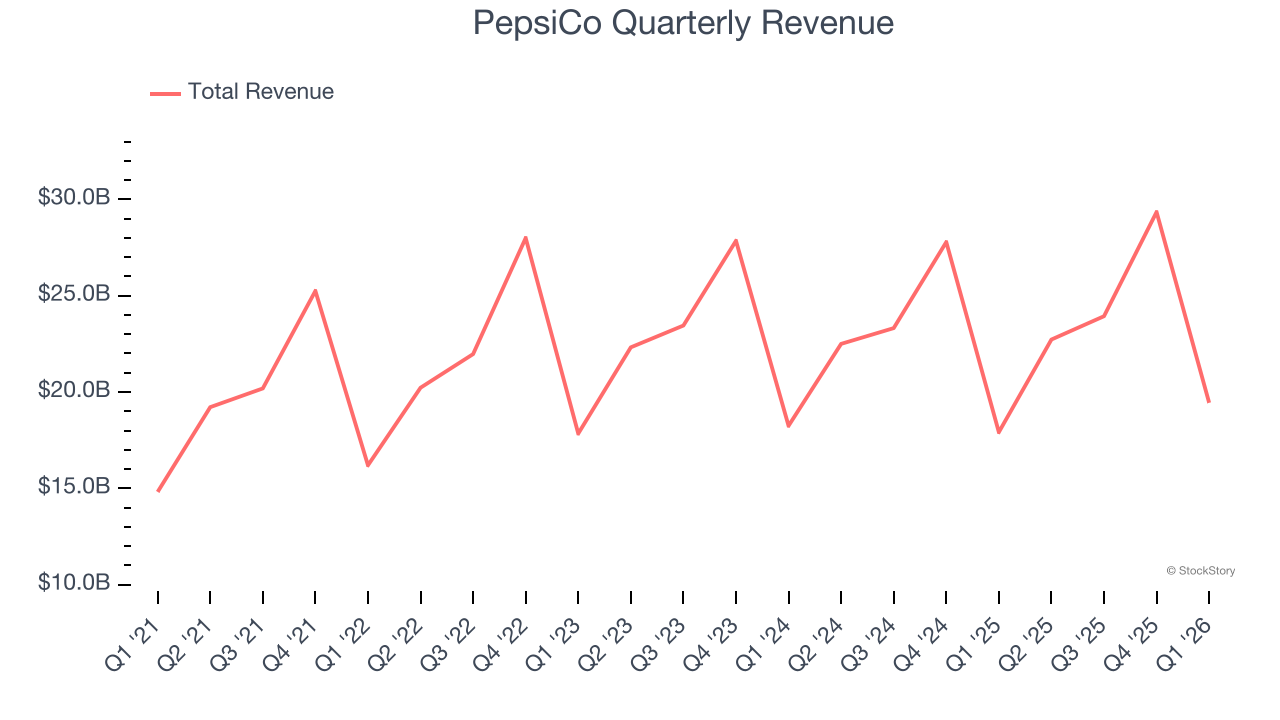
This quarter, PepsiCo reported year-on-year revenue growth of 8.5%, and its $19.44 billion of revenue exceeded Wall Street’s estimates by 2.9%.
Looking ahead, sell-side analysts expect revenue to grow 3.6% over the next 12 months, similar to its three-year rate. This projection is underwhelming and implies its newer products will not lead to better top-line performance yet.
ONE MORE THING: The $21 AI Application Stock Wall Street Forgot. While Wall Street obsesses over who’s building AI, one company is already using it to print money. And nobody’s paying attention.
AI chip stocks trade at ridiculous valuations. This company processes a trillion consumer signals monthly using AI and trades at a third of the price. The gap won’t last. The institutions will figure it out. You need to see this first. Read the FREE Report Before They Notice.
Volume Growth
Revenue growth can be broken down into changes in price and volume (the number of units sold). While both are important, volume is the lifeblood of a successful staples business as there’s a ceiling to what consumers will pay for everyday goods; they can always trade down to non-branded products if the branded versions are too expensive.
To analyze whether PepsiCo generated its growth from changes in price or volume, we can compare its volume growth to its organic revenue growth, which excludes non-fundamental impacts on company financials like mergers and currency fluctuations.
Over the last two years, PepsiCo’s average quarterly sales volumes have shrunk by 1.8%. This decrease isn’t ideal as the quantity demanded for consumer staples products is typically stable. Luckily, PepsiCo was able to offset fewer customers purchasing its products by charging higher prices, enabling it to generate 1.8% average organic revenue growth. We hope the company can grow its volumes soon, however, as consistent price increases (on top of inflation) aren’t sustainable over the long term unless the business is really really special.
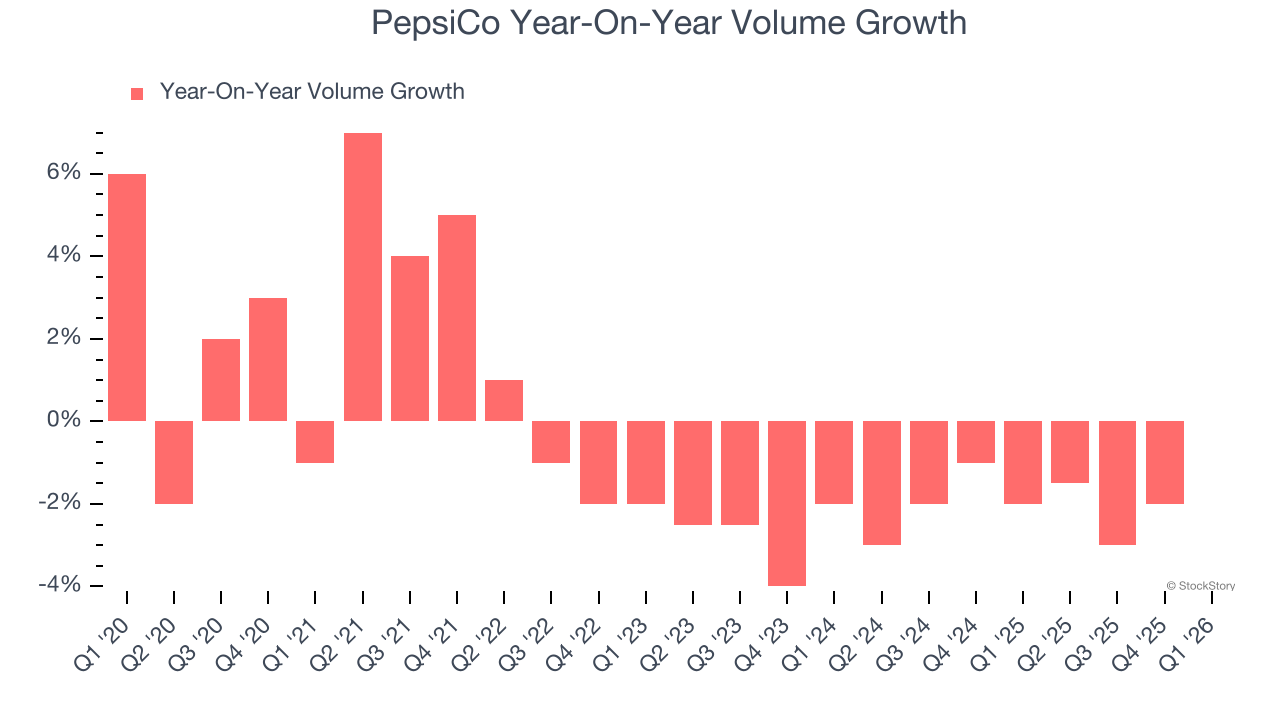
In PepsiCo’s Q1 2026, year on year sales volumes were flat. This result was a well-appreciated turnaround from its historical levels, showing the company is heading in the right direction.
Key Takeaways from PepsiCo’s Q1 Results
We like how PepsiCo beat analysts’ revenue and EPS expectations this quarter. Overall, we think this was a decent quarter. The stock remained flat at $154.04 immediately following the results.
Is PepsiCo an attractive investment opportunity right now? The latest quarter does matter, but not nearly as much as longer-term fundamentals and valuation, when deciding if the stock is a buy. We cover that in our actionable full research report which you can read here (it’s free).