Discount grocery store chain Grocery Outlet (NASDAQ: GO) reported revenue ahead of Wall Street’s expectations in Q3 2026, but revenue was flat year on year at $1.18 billion. The company expects the full year’s revenue to be around $4.71 billion, close to analysts’ consensus estimates. Its non-GAAP profit of $0.16 per share was in line with analysts’ consensus estimates.
For more on Grocery Outlet, read our free full research report.
Grocery Outlet (GO) Q3 2026 highlights:
- Revenue $1.18 billion vs S&P analyst consensus of $1.17 billion (flat year on year, 1.1% beat)
- Adjusted EPS $0.16 vs S&P analyst consensus of $0.15 (in line)
- Adjusted EBITDA $59.43 million vs analysts’ consensus estimates of $60.81 million (5% margin, 2.3% miss)
- Revenue guidance The company reconfirmed its revenue guidance for the full year of $4.71 billion at the midpoint
- Adjusted EPS guidance Management slightly raised its full-year adjusted EPS guidance to $0.54 at the midpoint
- EBITDA guidance $227 million at the midpoint for the full year, below analysts’ consensus estimates of $232.2 million
- Operating margin 2%, in line with the same quarter last year
- Free cash flow -$7.09 million compared to -$21.57 million in the same quarter last year
- Locations 561 at quarter end, down from 563 in the same quarter last year
- Same-store sales were flat year on year, in line with the same quarter last year
- Market capitalization $1.37 billion
“In the third quarter we returned to positive comparable store sales, driven by continued improvements to the execution of our opportunistic product offering,” said Jason Potter, President and CEO of Grocery Outlet. “Traffic accelerated and basket trends again improved sequentially as we enhanced our value proposition. In partnership with our operators and suppliers, we will continue to build on this progress with a focus on driving sustainable sales growth and improved profitability over time. This stronger foundation increases our confidence in our long-term opportunity.”
Revenue growth
A company’s long-term revenue performance is one signal of its overall quality. Any business can experience short-term success, but top-performing ones sustain growth for years.
With $4.75 billion in revenue over the past 12 months, Grocery Outlet is a small retailer, which sometimes brings disadvantages compared to larger competitors benefiting from economies of scale and negotiating leverage with suppliers.
Grocery Outlet grew its revenue at a tepid 6.7% compounded annual growth rate over the last three years.
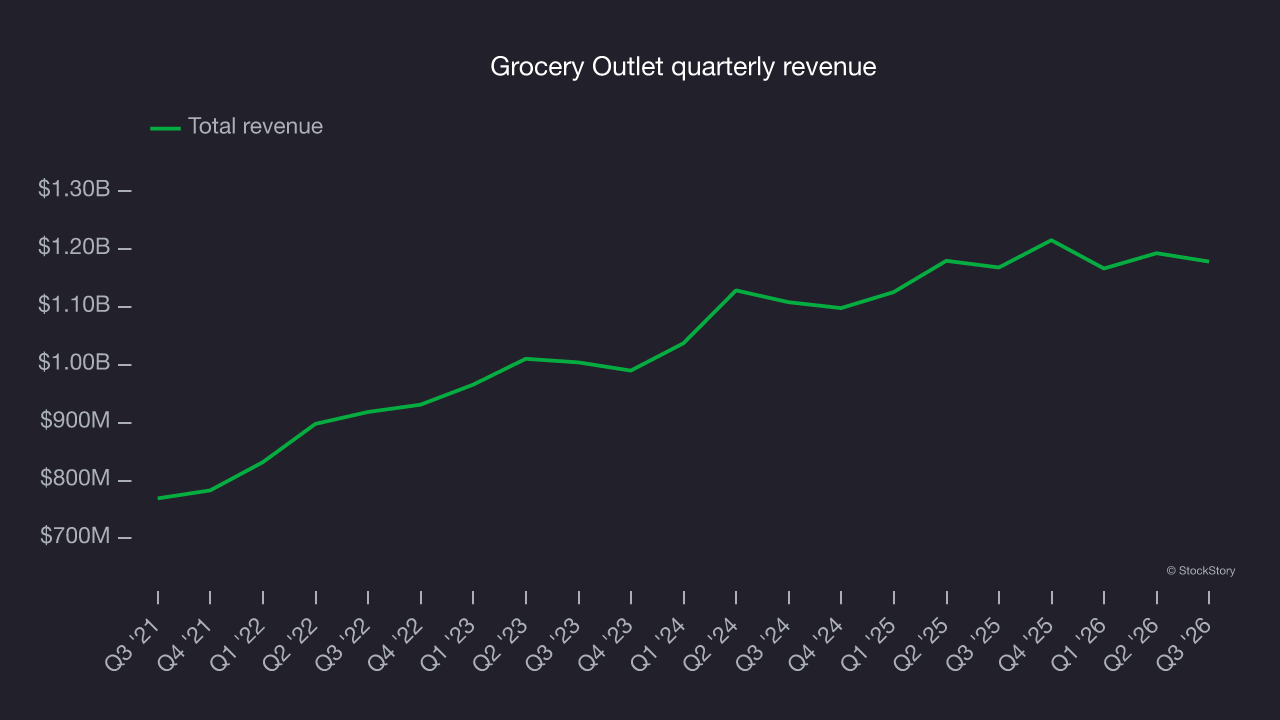
This quarter, Grocery Outlet’s $1.18 billion of revenue was flat year on year but beat Wall Street’s estimates by 1.1%.
Looking ahead, sell-side analysts expect revenue to grow 2.1% over the next 12 months, according to S&P, a deceleration versus the last three years. This projection is underwhelming and suggests its products will face some demand challenges.
Store performance
Number of stores
A retailer’s store count influences how much it can sell and how quickly revenue can grow.
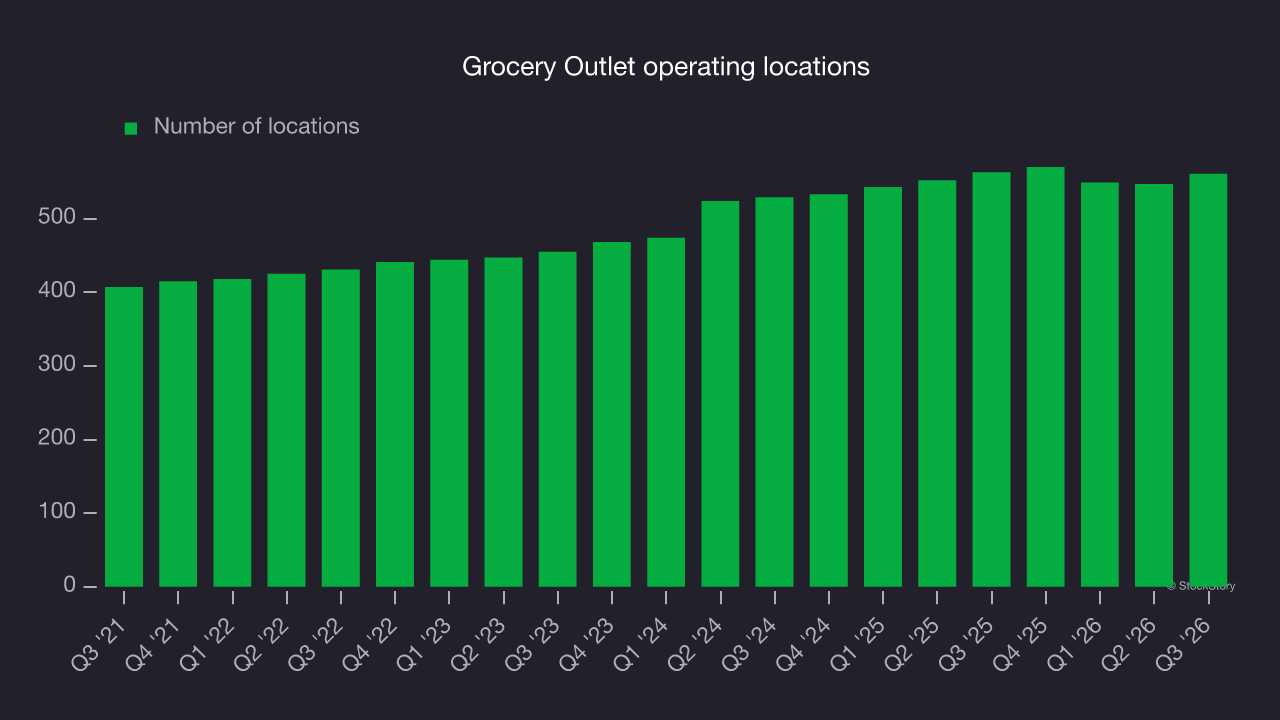
Grocery Outlet operated 561 locations in the latest quarter. Over the last two years, it has opened new stores at a rapid pace, averaging 5.9% annual growth, among the fastest in the consumer retail sector. This gives it a chance to grow into a mid-sized business over time.
When a retailer opens new stores, it usually means it’s investing for growth because demand is greater than supply, especially in areas where consumers may not have a store within reasonable driving distance.
Same-store sales
A company’s store base only paints one part of the picture. When demand is high, it makes sense to open more. But when demand is low, it’s prudent to close some locations and use the money in other ways. Same-store sales provide a deeper understanding of this issue because they measure organic growth at brick-and-mortar shops open for at least a year.
Grocery Outlet’s demand within its existing locations has barely increased over the last two years as its same-store sales were flat. Grocery Outlet should consider improving its foot traffic and efficiency before expanding its store base.
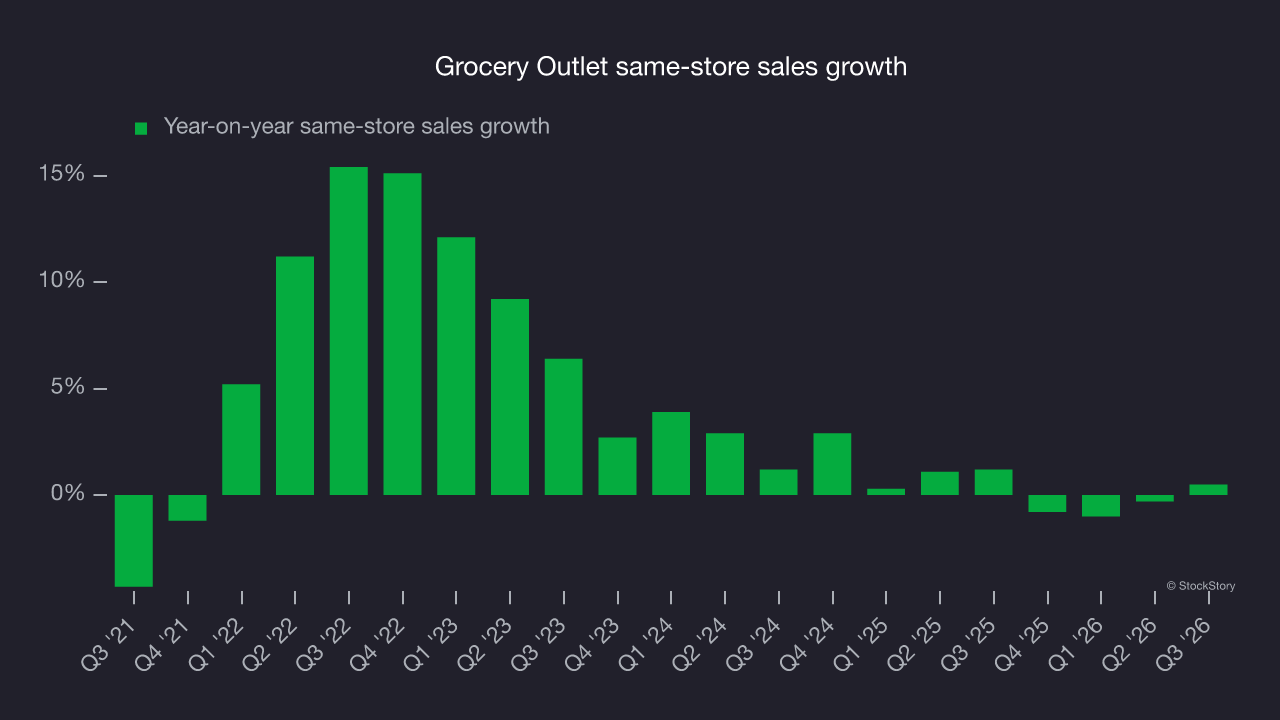
In the latest quarter, Grocery Outlet’s year-over-year same-store sales were flat. This performance was more or less in line with its historical levels.
Key takeaways from Grocery Outlet’s Q3 results
An EBITDA miss and full-year EBITDA guidance below Wall Street’s consensus made this a weaker quarter for Grocery Outlet. Revenue narrowly beat analysts’ consensus estimates, but EPS only matched Wall Street’s expectations. Shares tumbled 8.5% to $12.82 immediately after the report.
When deciding whether Grocery Outlet is a buy, the latest quarter matters, but not nearly as much as longer-term fundamentals and valuation. Read the free full research report here for more on those factors.