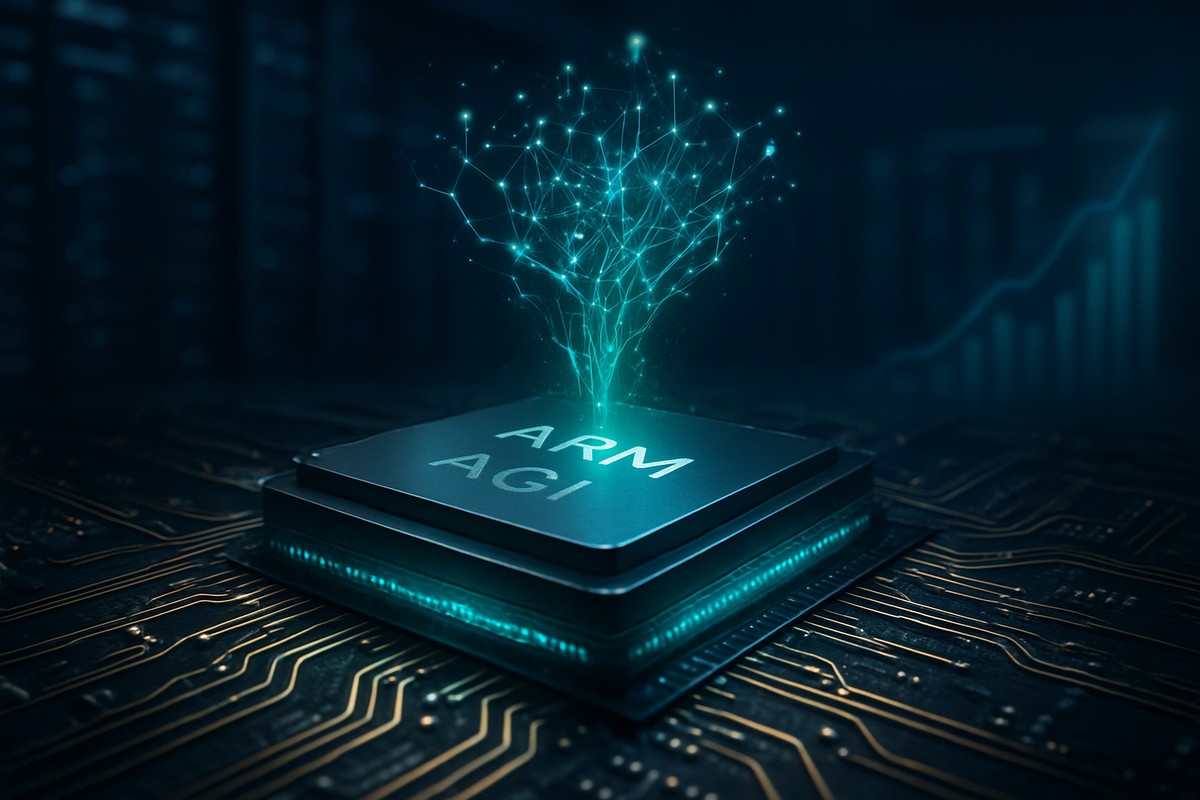
The semiconductor landscape witnessed a tectonic shift this week as Arm Holdings (NASDAQ: ARM) abandoned its three-decade-old identity as a neutral architect to become a high-performance silicon powerhouse. The announcement of the "Arm AGI CPU"—the company's first-ever in-house production chip—sent shares of the British firm soaring by more than 16% on March 25, 2024, as investors scrambled to price in a future where Arm captures the full value of the AI hardware stack.
This move marks a radical departure for a company that has traditionally played the "Switzerland" of the tech world, licensing its blueprints to rivals and partners alike. By moving into direct silicon production, Arm is signaling its intent to dominate the next phase of artificial intelligence: Agentic AI. This shift has immediate implications for the broader market, as the industry begins to transition from the raw power requirements of LLM training to the efficiency-driven orchestration required for autonomous AI agents.
The "Arm Everywhere" Revelation: A New Era of Silicon
The pivot was officially unveiled during the "Arm Everywhere" keynote on March 24, 2026, held in San Francisco. CEO Rene Haas introduced the Arm AGI CPU, describing it as the "defining moment" for the company since its founding. The chip, which has been in clandestine development for over two years, was co-designed in a strategic partnership with Meta Platforms (NASDAQ: META). It is specifically engineered to solve the "CPU bottleneck" that has plagued massive AI data centers, which currently rely on aging x86 architectures to manage the orchestration for Nvidia (NASDAQ: NVDA) GPUs.
Technically, the AGI CPU is a behemoth designed for density and efficiency. Utilizing a dual-chiplet design based on the Arm Neoverse V3 architecture and manufactured on TSMC’s (NYSE: TSM) cutting-edge 3nm (N3P) process node, the chip features up to 136 cores. More importantly, it is optimized for high memory bandwidth and low-latency serial processing—features essential for "Agentic AI" systems that must reason and execute multi-step tasks independently. Volume manufacturing is slated to begin in the second half of 2026, with Arm projecting that the AGI CPU line could generate $15 billion in annual revenue by 2031.
The timeline leading to this moment is critical. Industry observers noted that the alliance between Arm and Nvidia began to fray in early 2026, culminating in Nvidia liquidating its remaining equity stake in Arm in February. This paved the way for Arm to emerge as a direct competitor to Nvidia’s own Grace CPU. The market reaction was immediate and fierce; following the March 24 announcement, ARM shares surged to record highs of approximately $166.70, as analysts at HSBC and Guggenheim issued aggressive price target upgrades, citing a fundamental shift in the company’s earnings potential from "pennies per chip" in royalties to "thousands of dollars" in merchant silicon margins.
Winners and Losers: Redrawing the Competitive Map
The clear winner in this transition is Arm Holdings itself. For years, the bull case for Arm was hampered by its low royalty rates. By selling finished silicon, the company is effectively bypassing the middleman, allowing it to capture the significant premiums usually reserved for its customers. Meta Platforms also emerges as a major victor; as the lead co-developer, Meta has secured a customized "head node" optimized for its Llama 4 agentic ecosystem, potentially reducing its reliance on more expensive, general-purpose server hardware from traditional vendors.
On the other side of the ledger, traditional x86 heavyweights Intel (NASDAQ: INTC) and Advanced Micro Devices (NASDAQ: AMD) face a daunting challenge. While both stocks saw a temporary 7-8% bump in the week following the announcement, analysts attribute this to emergency price hikes of 10-15% enacted by both firms to compensate for a severe global CPU shortage. However, the long-term outlook for x86 in the data center is increasingly clouded. Arm’s claim of 2x performance-per-rack efficiency over flagship x86 chips directly targets the primary pain point for modern data centers: power consumption.
Infrastructure providers like Super Micro Computer (NASDAQ: SMCI) and Lenovo Group Ltd. are positioned to benefit as they pivot to offer the specialized liquid-cooled racks required to house the dense Arm AGI clusters. Conversely, Nvidia finds itself in a "frenemy" dynamic. While it remains the undisputed king of the GPU, its Vera and Grace CPU lines now face a direct challenge from the very architecture they are built upon. The dissolution of the "Switzerland" alliance means Nvidia must now compete on performance rather than just ecosystem integration.
A Wider Shift: From Training to Agentic Inference
This event signifies a broader industry rotation from 2024’s obsession with Large Language Model (LLM) training toward 2026’s focus on Agentic Inference. While the previous two years were defined by the acquisition of as many GPUs as possible to train models, the current market is shifting toward how those models are deployed. Agentic AI—systems that can autonomously browse the web, manage schedules, or code software—requires a different type of compute. The AGI CPU’s focus on orchestration and memory bandwidth reflects this new reality.
The regulatory implications of Arm’s move are also beginning to surface. By vertically integrating from architecture design to finished silicon, Arm may face scrutiny from antitrust regulators in the UK and EU who are concerned about fair access to the underlying IP for Arm’s other licensees. Historically, whenever a dominant IP provider enters the market as a merchant vendor, it creates a "vertical squeeze" that can stifle smaller innovators. However, the current demand for AI efficiency is so high that policy makers may prioritize domestic silicon production over traditional competition concerns in the short term.
Furthermore, this event mirrors the historical shift seen in the early 2010s when mobile computing transitioned from general-purpose chips to highly specialized SoCs. Just as Arm-based designs eventually pushed Intel out of the mobile market, the AGI CPU represents a credible threat to the x86 hegemony in the server room. The "efficiency-first" mantra has moved from the smartphone to the hyperscale data center, driven by a global power grid that can no longer keep up with the exponential growth of AI energy demands.
The Road Ahead: H2 2026 and Beyond
In the short term, the primary challenge for Arm will be execution. Transitioning from a fabless IP licensor to a silicon provider is a massive logistical undertaking. Arm must navigate the complexities of supply chain management, yield rates at TSMC, and the global distribution of hardware. Any delay in the H2 2026 manufacturing timeline could deflate the current stock premium and provide an opening for Intel’s "18A" process-node chips or AMD’s "Zen 6" architecture to regain lost ground.
Looking toward the end of the decade, the market will be watching for the emergence of "Arm-native" software ecosystems. For the AGI CPU to truly succeed, software developers must optimize their agentic workflows specifically for the Neoverse V3 instruction set. If Arm can successfully build a "moat" around its hardware-software integration—similar to Apple’s success with the M-series chips—it could become the dominant platform for the entire AI agent economy. Strategic pivots by other major cloud providers like Amazon (NASDAQ: AMZN) and Alphabet (NASDAQ: GOOGL), who already have their own Arm-based chips (Graviton and Axion), will be a key indicator of whether they choose to adopt Arm’s in-house silicon or continue developing their own.
The Final Verdict: An Arm Renaissance
The launch of the Arm AGI CPU represents a watershed moment for the semiconductor industry. It is the boldest move in the company’s history and effectively ends the era of the "neutral" chip architect. By aligning with Meta and targeting the high-margin data center market, Arm has positioned itself at the center of the most lucrative growth engine in tech. Investors are no longer just buying a royalty stream; they are buying a stake in the infrastructure that will power the next generation of autonomous intelligence.
Moving forward, the market will be hyper-focused on three things: the yield rates of the 3nm production at TSMC, the formal adoption rates of the AGI CPU by other hyperscalers like Microsoft (NASDAQ: MSFT), and any potential retaliatory moves from Nvidia. For now, the "Arm Renaissance" is in full swing, and the traditional hierarchies of Silicon Valley are being rewritten in real-time. Investors should watch for the first production samples in late 2025, which will provide the first real-world benchmarks to validate the company's lofty efficiency claims.
This content is intended for informational purposes only and is not financial advice