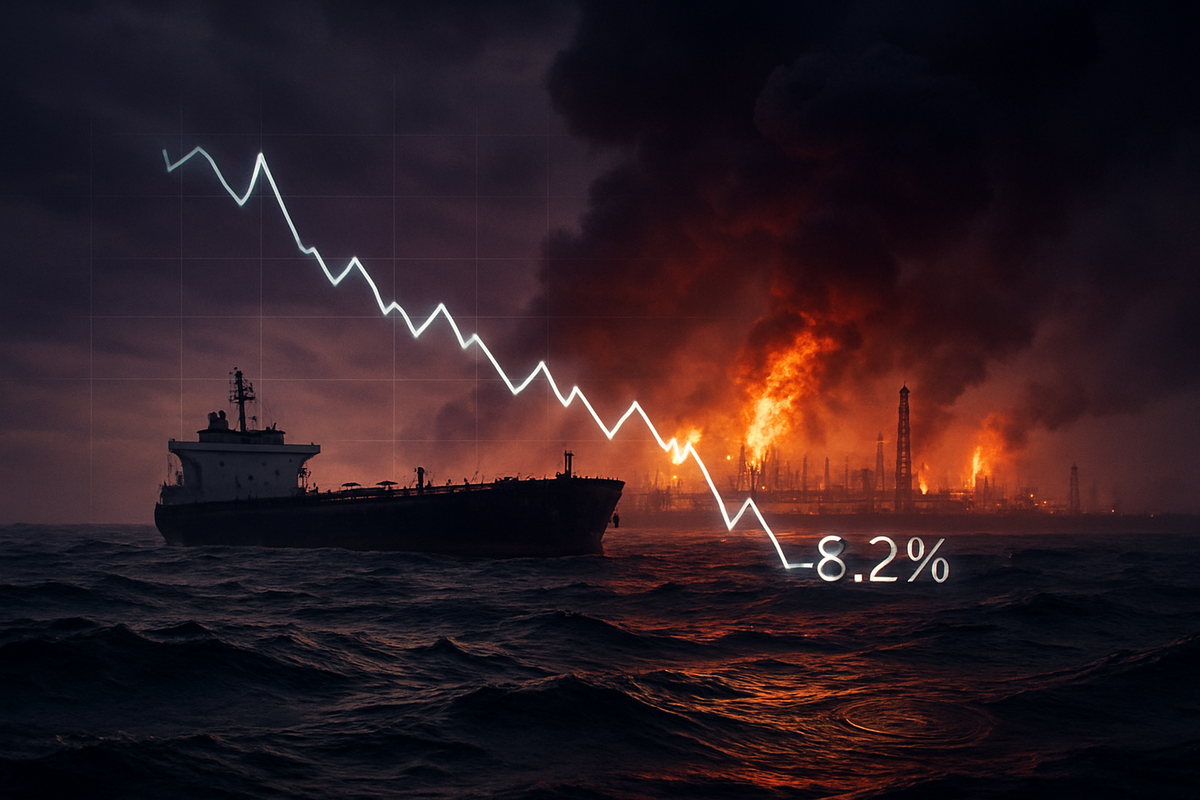
The global financial landscape was upended on March 19, 2026, as a "Geopolitical Paradox" shattered long-held assumptions about safe-haven assets. Despite an escalating military conflict in the Middle East that saw energy prices skyrocket, precious metals—traditionally the ultimate hedge against chaos—suffered their most violent liquidation in decades. Gold prices plummeted to $4,600.70, while silver endured a staggering 8.2% "flash crash," leaving investors stunned by the breakdown of traditional market correlations.
The catalyst for this unprecedented move was the "Hormuz Shock," a series of Iranian strikes on critical energy infrastructure that sent Brent crude oil soaring past $110 per barrel. However, instead of driving investors toward the safety of bullion, the surge in energy costs fueled a "higher-for-longer" inflation panic. Central banks, led by the Federal Reserve, signaled they would prioritize price stability over market liquidity, effectively pulling the rug out from under non-yielding assets like gold and silver.
The Hormuz Shock: A Timeline of Escalation
The crisis reached a fever pitch in late February 2026, following a period of heightened tensions between regional powers. The situation detonated on March 19 when Iranian forces launched "Operation Martyr Soleimani II," a sophisticated drone and missile campaign. The primary target was the Ras Laffan Industrial City in Qatar, home to the world’s largest liquefied natural gas (LNG) complex. The strikes successfully neutralized nearly 17% of global LNG export capacity in a single afternoon. Simultaneous attacks on the Samref refinery in Saudi Arabia and Kuwaiti loading terminals forced the Islamic Revolutionary Guard Corps to implement a full blockade of the Strait of Hormuz.
Within hours, maritime traffic through the world’s most vital energy artery plummeted by 80%. With roughly 20% of the world’s daily oil supply suddenly trapped, energy markets reacted with a ferocity not seen since the 1970s. Brent crude, which had been trending in the $80 range earlier in the year, surged past $110, with some regional benchmarks like Murban oil hitting $160 per barrel due to their proximity to the conflict zone.
The immediate market reaction was a frantic dash for liquidity. While gold initially spiked toward $5,400 in early March as the drums of war grew louder, the reality of the "Hormuz Shock" created a liquidity trap. Institutional investors, facing massive margin calls on energy-short positions and broader equity portfolios, were forced to liquidate their most liquid "winners"—their gold and silver holdings. This forced selling, combined with a surging U.S. Dollar Index (DXY), turned gold’s safe-haven status into a liability.
The Great Divide: Winners and Losers in a Volatile Market
The fallout from the March 19 crash created a sharp divergence between the energy sector and the mining industry. Global energy giants emerged as the primary beneficiaries of the scarcity premium. Companies such as Exxon Mobil Corp (NYSE: XOM) and Chevron Corp (NYSE: CVX) saw their valuations swell as realized oil prices surged. Domestic LNG exporters also gained significant traction; Cheniere Energy Inc (NYSE: LNG) witnessed record volumes as European and Asian buyers scrambled to secure non-Middle Eastern supply after the Ras Laffan disaster.
Conversely, the precious metals mining sector was decimated by a "double whammy" of falling bullion prices and rising operational costs. Newmont Corp (NYSE: NEM), the world’s largest gold miner, saw its shares drop over 26% from its February highs as the value of its reserves shrank while the cost of diesel for its heavy machinery doubled. Barrick Gold Corp (NYSE: GOLD) faced a similar fate, losing billions in market capitalization in a matter of days.
The carnage extended to silver producers as well. Hecla Mining Co (NYSE: HL) and Coeur Mining Inc (NYSE: CDE) were caught in the 8.2% downdraft, as silver’s dual role as an industrial metal and a monetary asset failed to protect it from the broader liquidation. Even diversified miners like Freeport-McMoRan Inc (NYSE: FCX), while cushioned by high copper demand for the ongoing green transition, were not immune to the bearish sentiment surrounding the metals complex.
The Death of the Safe Haven? Analyzing the Paradox
This event marks a fundamental shift in how markets interpret geopolitical risk in an era of high interest rates. Historically, war in the Middle East was a "buy gold" signal. However, the 2026 Geopolitical Paradox highlights a new reality: when geopolitical strife causes a massive supply-side inflation shock, it forces central banks into a hawkish corner. The Federal Reserve held interest rates steady at 3.5%–3.75% during its mid-March meeting, with officials signaling that "energy-driven inflation taxes" make rate cuts impossible for the foreseeable future.
The 10-year Treasury yield surged toward 4.22% in the wake of the attacks, making the opportunity cost of holding gold—which pays no yield—prohibitive. This "higher-for-longer" stance essentially broke the "debasement trade." Investors realized that as long as oil prices remained elevated, the Fed would keep the liquidity spigot closed, even if the world was on the brink of conflict. This mirrors the late 1970s, where aggressive Volcker-era rate hikes eventually broke gold's momentum despite persistent geopolitical instability.
The ripple effects are now being felt across the broader commodity spectrum. The liquidation of SPDR Gold Shares (NYSE: GLD) and iShares Silver Trust (NYSE: SLV) on March 19 reached record volumes, suggesting that the "Geopolitical Paradox" has forced a massive re-allocation of capital. Portfolio managers are shifting away from metals and into "inflation-resilient" cash equivalents and high-yielding debt, a move that would have been unthinkable during previous global crises.
What Comes Next: Strategic Pivots and Market Outlook
In the short term, the precious metals market remains in a state of shock. For gold to reclaim its $5,000 psychological floor, a significant de-escalation in the Strait of Hormuz is likely required—not to lower the risk, but to lower the inflationary pressure that is keeping central banks hawkish. Market participants are now closely watching the April inflation prints; if energy costs begin to bleed into core CPI, the pressure on gold and silver could intensify as even more aggressive rate hikes are priced in.
Strategic adaptations are already underway in the mining sector. We expect to see a wave of consolidation as larger players like Barrick Gold seek to acquire smaller, distressed producers to achieve better economies of scale in a high-cost environment. Furthermore, "gold-linked" yield products may see a surge in popularity as investors look for ways to hold bullion while still capturing some of the high interest rates currently available in the bond market.
The primary challenge moving forward will be the "USD Dominance" factor. As long as the U.S. dollar remains the primary beneficiary of global energy flows and high domestic rates, precious metals will face a stiff headwind. Investors should prepare for a period of extreme volatility, where traditional "textbook" reactions to news events are replaced by complex, liquidity-driven movements.
Conclusion: Lessons from the Hormuz Shock
The events of March 19, 2026, will be remembered as the day the "Safe Haven" trade evolved. The plunge of gold to $4,600.70 and the collapse of silver were not signs of a lack of fear, but rather a sign that inflation and interest rate policy have become more powerful market drivers than the fear of war itself. The "Geopolitical Paradox" has proven that in a world of $110 oil and 4% yields, even the most legendary store of value is not immune to the gravity of central bank policy.
Moving forward, the market is entering a "New Macro Era." Investors must watch the correlation between energy prices and Treasury yields more closely than the headlines coming out of the Middle East. If the "Hormuz Shock" persists, the resulting inflationary pressure may continue to keep precious metals suppressed, regardless of the level of global instability.
For now, the era of gold as a simple "fear barometer" is over. In its place is a more complex asset that is increasingly sensitive to real rates and global liquidity. As we close out March 2026, the question for investors is no longer "is there a crisis?" but rather "how will the central banks respond to it?"
This content is intended for informational purposes only and is not financial advice.