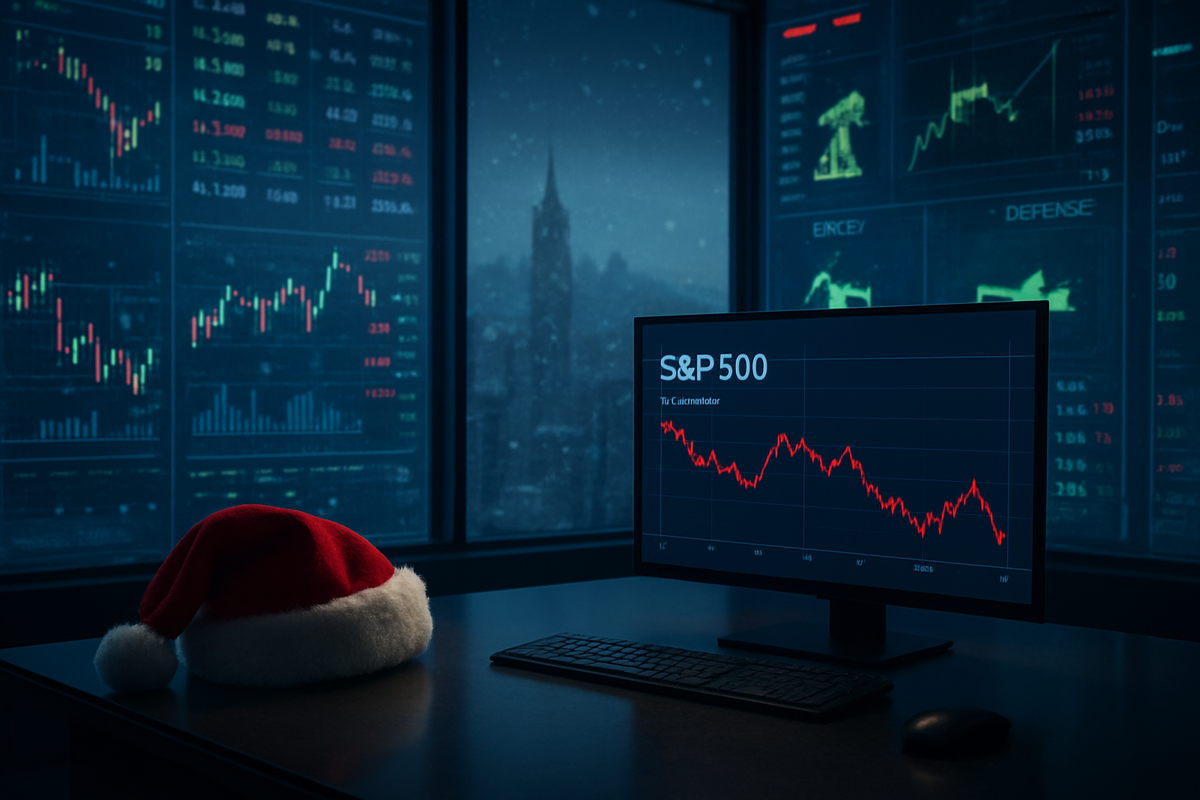
The first trading sessions of 2026 have delivered a dramatic paradox for Wall Street. While the Dow Jones Industrial Average (DJIA) surged to a record high on January 5, 2026, the broader market has officially triggered a "failed" Santa Claus Rally indicator for the third consecutive year. Despite a massive single-day rally fueled by geopolitical shifts in South America, the S&P 500 (NYSE: SPY) finished the seven-session "Santa window" with a cumulative loss of approximately 0.25%, leaving market technicians and historians sounding the alarm for the year ahead.
The failure of this seasonal indicator—traditionally defined as the performance of the S&P 500 during the last five trading days of December and the first two of January—suggests that the underlying momentum of the market may be more fragile than the headline-grabbing gains of early January imply. Historically, when "Santa fails to call," the market often faces increased volatility and lower-than-average returns in the first half of the year, a trend that could challenge the multi-year bull run dominated by artificial intelligence and high-growth technology.
A Tale of Two Tides: The Timeline of the 2025-2026 Window
The 2025–2026 Santa Claus Rally window opened on December 24, 2025, with the S&P 500 closing at a record high of 6,932.05. However, the holiday cheer was short-lived. Following the Christmas Eve peak, institutional investors engaged in aggressive tax-loss harvesting and de-risking, leading to four consecutive losing sessions to close out 2025. By the time the closing bell rang on December 31, the index had retreated to 6,845.50, as sectors like Consumer Staples and Real Estate dragged on the broader market.
The narrative shifted abruptly over the first weekend of 2026. News broke of the U.S. military capture of Venezuelan leader Nicolás Maduro, an event that sent shockwaves through the energy and defense sectors. On Monday, January 5, 2026, the market exploded in a "Venezuela Shock" rally. The Dow Jones surged over 600 points to hit 48,858, and the S&P 500 climbed roughly 40 points to approximately 6,915. However, because the S&P 500 failed to reclaim its December 24 starting level of 6,932.05, the cumulative seven-day performance remained negative. This technicality marks the first time in decades that the indicator has failed for three straight years (2023, 2024, and 2025).
Winners and Losers: The Great Rotation of 2026
The January 5 surge was not a "rising tide lifts all boats" event; rather, it was a violent rotation out of high-flying technology and into value and cyclical stocks. The clear winners were energy majors and defense contractors. Chevron (NYSE: CVX) led the charge, jumping 5% as the only U.S. oil major with significant active assets in Venezuela, while Valero (NYSE: VLO) soared 9% on hopes of a more stable global oil supply. In the defense sector, Lockheed Martin (NYSE: LMT) rose 3.5%, and RTX Corp (NYSE: RTX) hit an all-time high of $188.14, bolstered by both the geopolitical uncertainty and a new $438 million FAA contract.
Conversely, the "Magnificent Seven" and other tech titans that defined 2025 saw a cooling period. Nvidia (NASDAQ: NVDA) slipped 0.55% despite reaching a $5 trillion market cap milestone just days prior, and Apple (NASDAQ: AAPL) fell 0.31% as investors expressed concern over the pace of AI monetization. Software giants like Salesforce (NYSE: CRM) and ServiceNow (NYSE: NOW), which struggled in the final week of December, continued to see capital rotate away from them. Financials, however, found a footing, with JPMorgan Chase (NYSE: JPM) hitting an all-time intraday high of $337.25, as hawkish Federal Reserve sentiment suggested interest rates might remain "higher for longer."
The Historical Shadow: "Bears May Come to Broad and Wall"
The failure of the Santa Claus Rally is more than just a statistical quirk; it is a historical "canary in the coal mine." Market historians at the Stock Trader’s Almanac have long noted the adage: “If Santa should fail to call, bears may come to Broad and Wall.” Since 1950, a negative Santa window has often preceded flat or negative returns in January and the first quarter. In years like 1990, 2000, 2008, and 2015, a failed rally was a precursor to significant market corrections or full-blown bear markets.
While the markets in 2023 and 2024 managed to finish with double-digit gains despite failed Santa rallies, the statistical probability of a blockbuster year (returns exceeding 15%) drops significantly when the indicator is negative. Furthermore, the "January Trifecta"—which requires a positive Santa Rally, a positive "First Five Days," and a positive "January Barometer"—is already broken for 2026. This suggests that while the year may still end in the green, investors should prepare for a much bumpier ride with an average expected return of 6.1%, compared to the 10.4% average seen after a positive rally.
What Lies Ahead: A Pivot Toward Value?
As we move deeper into January, the primary question is whether the "Maduro Rally" in energy and defense can offset the technical weakness in the broader S&P 500. Short-term, the market will be hyper-focused on the "First Five Days" indicator, which concludes later this week. If the S&P 500 can manage a gain over those five days, it may mitigate some of the bearish sentiment from the failed Santa window. However, the strategic pivot seen on January 5 suggests that the 2026 market may be defined by a shift away from growth-at-any-price and toward tangible assets and geopolitical hedging.
Investors should watch for potential "valuation digestion" in the tech sector. With Nvidia and Microsoft (NASDAQ: MSFT) trading at historically high multiples, any sign of slowing AI infrastructure spending could lead to further rotation into undervalued sectors like Energy (NYSEARCA: XLE) and Financials (NYSEARCA: XLF). The geopolitical situation in Venezuela will also remain a wildcard; while the initial reaction was bullish for oil majors, any prolonged instability in the region could introduce new supply-chain risks.
The Investor's Playbook for 2026
The 2026 Santa Claus Rally—or lack thereof—serves as a reminder that seasonal trends are evolving in the age of algorithmic trading and instant geopolitical shocks. The fact that a massive 600-point Dow surge on January 5 could not save the indicator highlights the depth of the selling that occurred in late December. For investors, the key takeaway is a need for cautious optimism. The market remains near record highs, but the "easy money" phase of the AI-driven rally may be giving way to a more disciplined, value-oriented environment.
In the coming months, keep a close eye on the "January Barometer." Historically, as January goes, so goes the year. If the market can shake off this failed seasonal indicator and finish the month in positive territory, it will signal that the 2026 bull market still has legs. However, if the weakness seen in late December returns, the "bears at Broad and Wall" may become a more permanent fixture of the 2026 financial landscape.
This content is intended for informational purposes only and is not financial advice.