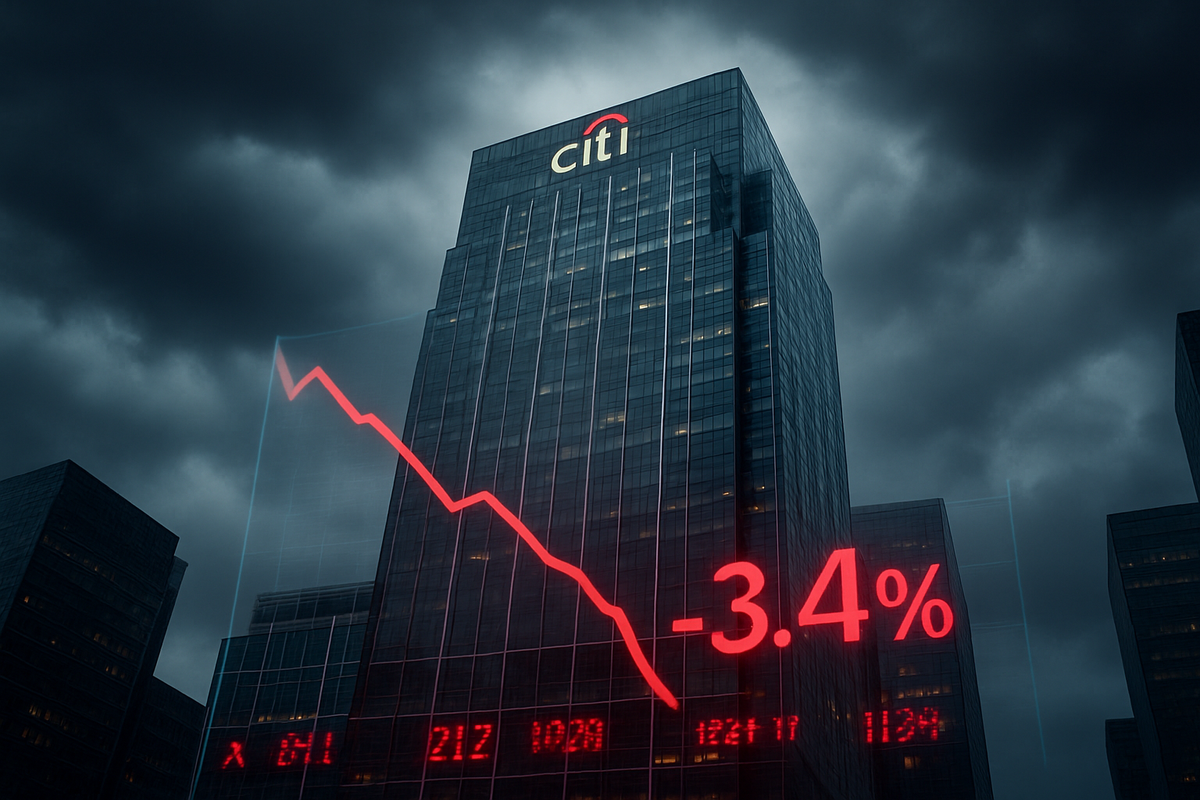
The financial sector faced a wave of volatility this week as Citigroup (NYSE: C) reported its fourth-quarter 2025 earnings, sending shares down 3.4% in a single session. The decline, which permeated through the broader banking sector, highlights the compounding pressures of internal restructuring costs and external regulatory shifts. While the bank’s adjusted figures showed signs of underlying resilience, the headline miss on revenue and earnings per share (EPS) sparked a sell-off that reflects growing investor anxiety over the bank’s massive "Project Bora Bora" transformation and a shifting political landscape in Washington.
The immediate implications for the U.S. market are stark. Citigroup's struggle to manage one-time charges while simultaneously navigating a proposed federal cap on credit card interest rates has put the entire financial industry on notice. As the first major bank to feel the sting of 2026’s early-year volatility, Citigroup’s performance serves as a bellwether for how the "Big Four" will handle a cooling domestic economy and the ripple effects of aggressive new trade policies that have recently rattled global markets.
A Perfect Storm: Restructuring Charges and the Russia Exit
On January 14, 2026, Citigroup (NYSE: C) reported a fourth-quarter revenue of $19.9 billion, missing the analyst consensus of $20.55 billion. The bank’s reported net income fell to $2.5 billion, a 13.5% decrease from the previous year, while its reported EPS of $1.19 fell significantly short of the $1.65 expected by Wall Street. The primary culprit for this discrepancy was a massive $1.2 billion pre-tax loss related to the finalized sale of its Russian subsidiary, AO Citibank. This "Russia Exit" charge, largely comprised of currency translation adjustments, marked the final chapter of a complex and costly withdrawal from the region.
The timeline of this earnings slump was further complicated by the bank's internal overhaul. CEO Jane Fraser confirmed that "Project Bora Bora"—a strategic initiative to flatten the bank's management structure—resulted in $800 million in severance and restructuring costs for the year. Just in the first week of January 2026, the bank eliminated an additional 1,000 roles, part of a broader plan to cut 20,000 positions by the end of the year. While these moves are designed to increase efficiency in the long run, the short-term impact on the bank's efficiency ratio, which reached 70% this quarter, has left investors skeptical of the bank’s ability to hit its 10–11% Return on Tangible Common Equity (RoTCE) target for late 2026.
Initial market reactions were swift. Beyond the 3.4% drop in Citi’s own stock, the broader KBW Bank Index saw a decline as traders processed the news of rising credit loss provisions. Citigroup set aside $2.22 billion for credit losses, with a specific focus on the US card market, where net credit losses in retail services reached 5.73%. This internal data coincided with a broader "risk-off" mood in the market, exacerbated by geopolitical friction involving U.S. trade threats against several NATO members, leading to a volatile trading week for all financial institutions.
Winners and Losers in a Re-Regulated Market
The most significant "loser" in this current environment appears to be the high-exposure credit card issuers. Following the earnings report, the Trump administration moved forward with a proposal to impose a one-year, 10% cap on credit card interest rates. This policy, effective as of January 20, 2026, disproportionately affects banks like Citigroup (NYSE: C) and Capital One (NYSE: COF), which rely heavily on interest income from their massive revolving credit portfolios. Analysts estimate that such a cap could slash pre-tax earnings for major card issuers by as much as 18%, causing Citigroup’s peers like Discover Financial Services (NYSE: DFS) to also see sharp pullbacks in valuation.
Conversely, the "winners" in this scenario are fewer, but include diversified giants with less reliance on unsecured consumer credit. JPMorgan Chase (NYSE: JPM) and Bank of America (NYSE: BAC) experienced stock declines of 2.9% and 3.7% respectively following the news, yet their massive scale and diversified revenue streams from investment banking and wealth management offer a sturdier cushion than Citi’s current position. Investors seeking safety have also pivoted toward hard assets; as bank stocks slipped, gold and silver reached all-time highs, benefiting commodity-focused firms and exchange-traded funds like the SPDR Gold Shares (NYSE Arca: GLD).
The regional banking sector, represented by firms such as KeyCorp (NYSE: KEY) and Fifth Third Bancorp (NASDAQ: FITB), faces a mixed outlook. While they are less impacted by the international charges that plagued Citi, they are highly sensitive to the credit loss trends highlighted in Citi’s Q4 report. If consumer defaults continue to rise in the retail services segment, these mid-sized lenders may find themselves forced to tighten lending standards even further, potentially stifling small business growth across the United States.
The Broader Impact: From "Project Bora Bora" to the Greenland Shock
Citigroup’s Q4 results are not an isolated event but rather a reflection of three converging industry trends: aggressive corporate downsizing, the re-politicization of banking regulations, and the return of geopolitical risk as a primary market driver. The bank's plan to shed 20,000 jobs is one of the largest workforce reductions in the financial sector since the 2008 crisis. This shift toward a leaner, more tech-driven model is being mirrored by competitors, though none have pursued it with the same public-facing intensity as Jane Fraser’s Citigroup.
The "Greenland Shock"—a term coined by market analysts after President Trump threatened new tariffs on NATO members including Denmark and Germany—has introduced a new layer of systemic risk. For global banks like Citigroup, which operate in over 160 countries, the threat of fragmented trade and diplomatic friction creates operational hurdles that go beyond simple currency fluctuations. This geopolitical instability, paired with the 10% interest rate cap proposal, represents a return to an era of high-interventionist policy that many bank executives hoped was in the rearview mirror.
Historically, periods of rapid bank restructuring often precede broader economic slowdowns. The rise in Citigroup’s credit loss provisions for branded cards suggests that the American consumer is finally reaching a breaking point under the weight of sustained high interest rates. If the 10% rate cap is fully implemented and survives legal challenges, it could fundamentally alter the profitability of the US banking model, shifting the focus from high-yield lending to fee-based services, a transition that is notoriously difficult to execute during a period of market volatility.
The Path Ahead: Strategic Pivots and Scenarios
In the short term, Citigroup (NYSE: C) must prove to shareholders that its restructuring is more than just a cost-cutting exercise. The market will be watching closely for the Q1 2026 results to see if the severance expenses begin to taper and if the bank can regain its footing in revenue growth. A potential strategic pivot may involve a more aggressive expansion into its Treasury and Trade Solutions (TTS) business, which has remained a bright spot, growing even as the consumer side of the bank faces regulatory and credit headwinds.
The long-term outlook hinges on the fate of the credit card rate cap. If the 10% cap becomes a permanent fixture of the US financial landscape, Citigroup may be forced to further divest from its retail services division to protect its overall margins. This could lead to a scenario where the "Big Four" become even more specialized, with Citigroup potentially shrinking its US footprint to focus almost exclusively on global institutional banking. Alternatively, if the bank successfully navigates its workforce reduction and hits its 2026 RoTCE targets, it could emerge as a much more efficient competitor, finally closing the valuation gap with its peers.
Market opportunities may emerge for fintech disruptors and non-bank lenders who are not subject to the same stringent capital requirements as traditional "Too Big to Fail" institutions. However, if the current volatility leads to a broader liquidity crunch, the stability and "flight to quality" associated with the major banks may eventually provide a floor for their stock prices, provided they can manage their exposure to the deteriorating consumer credit market.
Summary of Market Movement and Investor Outlook
The 3.4% drop in Citigroup (NYSE: C) shares following its Q4 earnings is a clear signal that the road to recovery for the banking giant remains fraught with obstacles. While the bank’s adjusted EPS beat expectations, the combination of massive one-time charges, rising credit losses, and a looming interest rate cap has created a cloud of uncertainty. The broader market remains on edge, as the financial sector's performance often dictates the health of the wider S&P 500.
Moving forward, investors should keep a close eye on the implementation of new trade tariffs and the legal developments surrounding the 10% credit card rate cap. These external factors will likely have a greater impact on bank valuations in 2026 than internal operational improvements. Furthermore, the pace of Citigroup's "Project Bora Bora" job cuts will be a vital metric for assessing whether the bank can truly transform its culture and efficiency.
In the coming months, the focus will shift to the Federal Reserve's reaction to this volatility. If the banking sector continues to struggle under the weight of regulatory caps and geopolitical shocks, the calls for a shift in monetary policy may grow louder. For now, the takeaway is one of caution: the financial sector is in the midst of a significant transition, and Citigroup is at the very heart of the storm.
This content is intended for informational purposes only and is not financial advice.