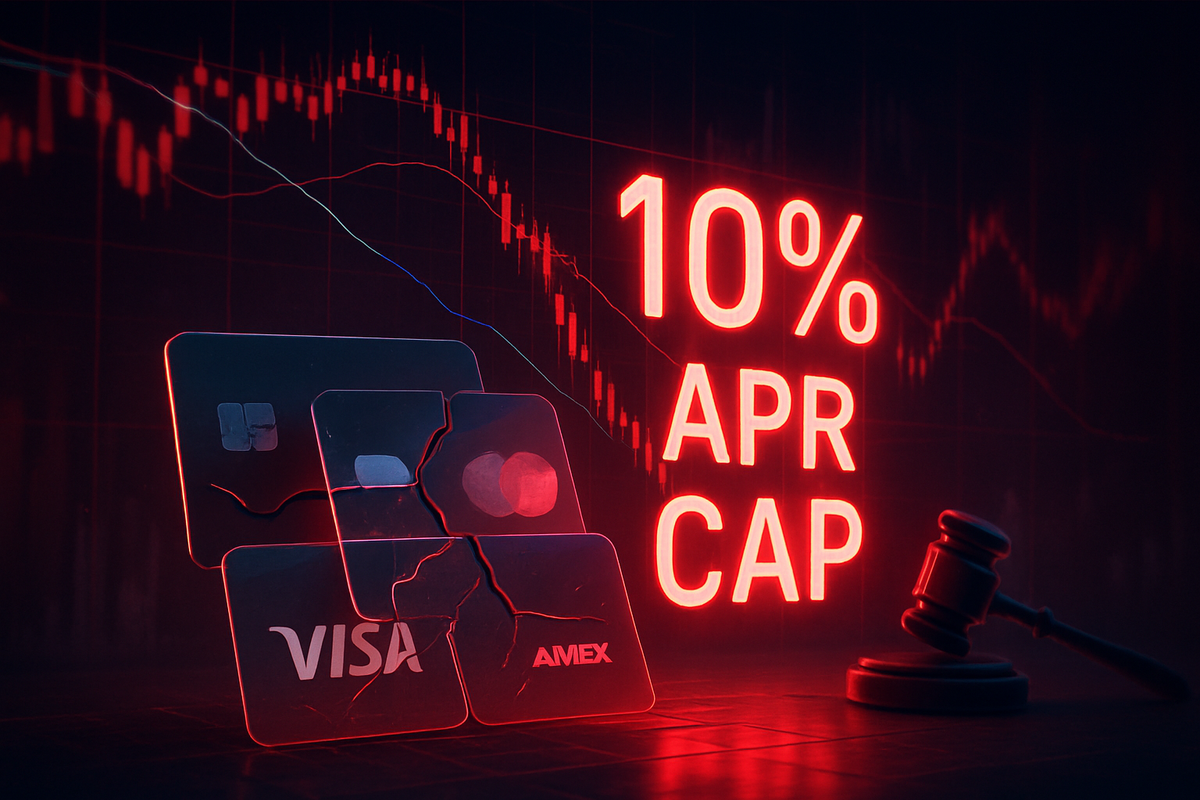
The global payment landscape faced a seismic shift this week as shares of the world’s dominant credit networks underwent a severe technical breakdown. The catalyst was a bold legislative and executive push to impose a national 10% cap on credit card interest rates—a move that sent shockwaves through the financial sector and shattered long-standing support levels for industry stalwarts. As the market digests the implications of a potential regulatory overhaul, technical indicators are flashing warning signs that the era of uncontested growth for payment giants may be facing its sternest test yet.
Investors reacted with immediate and aggressive selling, driving share prices below critical moving averages. While the direct impact of interest rate caps falls on the banks that issue credit, the secondary effects on transaction volumes and the simultaneous threat of the Credit Card Competition Act (CCCA) have created a "perfect storm." This sudden volatility has transformed what was a bullish trend for the sector into a scramble for safety, leaving technical analysts to ponder whether the current floor can hold.
The Catalyst: A Rare Bipartisan Alignment Against High APRs
The turmoil began in earnest on January 9, 2026, when President Donald Trump announced via a high-profile statement his intention to implement a one-year, 10% national cap on credit card interest rates. Scheduled to take effect on the first anniversary of his second-term inauguration, January 20, 2026, the proposal seeks to provide immediate relief to consumers currently facing average APRs between 20% and 30%. This executive stance has breathed new life into the "10 Percent Credit Card Interest Rate Cap Act" (S. 381 / H.R. 1944), a piece of legislation that had been simmering in Congress since February 2025 under the leadership of a bipartisan coalition including Senators Bernie Sanders (I-VT) and Josh Hawley (R-MO).
The reaction in the trading pits was swift. On January 13, 2026, Visa (NYSE: V) plummeted 4.74% in mid-day trading to approximately $326.50, effectively erasing months of gains. Mastercard (NYSE: MA) fared even worse, sliding 5.22% to $536.70. The sell-off was fueled not just by the rate cap proposal, but by the administration’s vocal support for the reintroduced Credit Card Competition Act (CCCA), sponsored by Senator Roger Marshall. This act specifically targets the "Visa-Mastercard duopoly," aiming to force banks to offer alternative processing networks for transactions—a move that would directly cannibalize the core "swipe fee" revenue that these networks rely on.
The Fallout: Winners, Losers, and the Credit Crunch Risk
The immediate losers in this scenario are the major credit card issuers, such as JPMorgan Chase & Co. (NYSE: JPM), Citigroup Inc. (NYSE: C), and Capital One Financial Corp. (NYSE: COF). These institutions rely heavily on the interest income generated from revolving balances to offset the costs of rewards programs and default risks. A 10% cap would fundamentally break their current business models, likely leading to a massive retrenchment in credit availability. For Visa and Mastercard, the risk is indirect but existential: if banks tighten credit standards or lower limits to mitigate interest losses, the total volume of transactions flowing through their networks—the lifeblood of their revenue—will inevitably shrink.
Conversely, potential winners could emerge from the disruption. Alternative payment networks and fintech innovators like Block, Inc. (NYSE: SQ) or PayPal Holdings, Inc. (NASDAQ: PYPL) may find an opening if consumers pivot toward buy-now-pay-later (BNPL) services or debit-based transactions to avoid the credit crunch. However, the victory for consumers may be a Pyrrhic one. While those with existing debt would see relief, millions of "subprime" or "near-prime" borrowers could find themselves locked out of the credit market entirely as banks become unwilling to lend at a 10% rate to anyone but the most pristine borrowers.
A Regulatory Sea Change: Beyond Interest Rates
This event fits into a broader global trend of increased regulatory scrutiny over the cost of credit and transaction fees. For years, the U.S. has been an outlier compared to the European Union and parts of Asia, where interchange fees are capped and interest rates are more strictly governed. The push for a 10% cap is being viewed by industry veterans as a "Durbin Amendment 2.0"—referring to the 2010 legislation that capped debit card fees. Critics argue that, much like the Durbin Amendment, the current proposals could lead to the elimination of popular rewards and cashback programs, as the profit margins that fund these perks evaporate.
The ripple effects extend to the retail sector as well. While major retailers have long lobbied for the CCCA to lower their operating costs, a sudden contraction in consumer spending power due to limited credit availability could offset any savings from lower swipe fees. The historical precedent of the 1980s, when various states had usury laws capping interest, suggests that credit supply is highly sensitive to such mandates. If these federal proposals become law, it would represent the most significant restructuring of the American credit system in over half a century.
The Technical Outlook: Searching for a Bottom
From a technical perspective, the damage to the charts is significant. Both Visa and Mastercard have breached their 50-day and 200-day moving averages, a development often followed by a "Death Cross"—where the short-term average crosses below the long-term average, signaling a prolonged bearish trend. Visa’s failure to hold the $345 support level is particularly concerning for bulls, while Mastercard’s breach of $563 has turned previous support into daunting overhead resistance. While the Stochastic RSI indicates that both stocks are currently in "oversold" territory, analysts warn that a technical bounce may be fleeting without a fundamental shift in the regulatory news cycle.
In the short term, the market may see a "dead cat bounce" as opportunistic buyers step in. However, the long-term outlook is clouded by the January 20 deadline and the potential for the CCCA to pass alongside the rate cap. Strategic pivots for these payment giants will likely involve a heavier focus on value-added services, data analytics, and blockchain-based settlement systems to diversify away from traditional transaction volume and swipe fees. Investors will need to weigh the potential for a "oversold" recovery against the permanent margin compression that these legislative shifts portend.
The Road Ahead: What to Watch
As we move toward the late stages of January 2026, the market's eyes remain fixed on Washington. The primary takeaway from this week’s technical breakdown is that the "moat" around Visa and Mastercard—once thought to be impenetrable—is being aggressively challenged by populist economic policy. The shift from a growth-oriented narrative to one of regulatory defense has fundamentally changed the risk profile for the entire payments sector. Moving forward, the market will likely remain in a "wait-and-see" mode until the legal feasibility of a 10% executive cap is tested in the courts.
For investors, the key indicators to watch in the coming months will be the progress of the "10 Percent Credit Card Interest Rate Cap Act" through the Senate and any language from the issuing banks regarding credit tightening. If JPMorgan or Capital One begin significantly raising credit score requirements for new cards, it will serve as a leading indicator of declining transaction volumes for the networks. While the current prices may look attractive to value seekers, the technical breakdown suggests that the path of least resistance for Visa and Mastercard remains downward until the regulatory fog clears.
This content is intended for informational purposes only and is not financial advice.