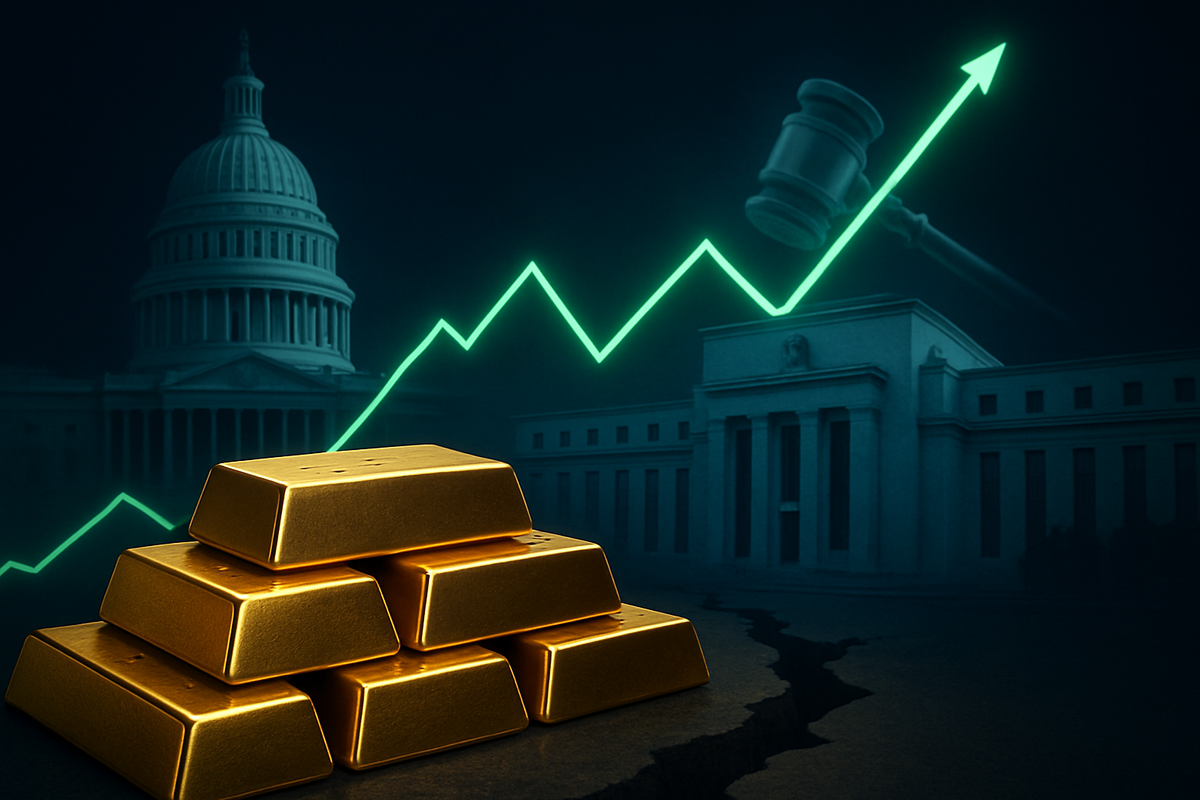
Gold prices surged to an unprecedented all-time high on Monday, January 12, 2026, as a deepening conflict between the White House and the Federal Reserve sent shockwaves through global financial markets. Spot gold breached the $4,600 mark for the first time in history, peaking at $4,600.33 per ounce, while investors scrambled to offload U.S. dollar-denominated assets in favor of the safety of "hard money."
The surge reflects a dramatic escalation in political risk within the United States, traditionally a bastion of institutional stability. As the Department of Justice (DOJ) moves to investigate Federal Reserve Chair Jerome Powell, the resulting "credibility discount" on the U.S. dollar has turned a standard policy disagreement into a full-blown constitutional and financial crisis, leaving the market to price in the potential end of central bank independence.
The "Pretext" Subpoena and the Sunday Night Stand-Off
The current turmoil reached a breaking point over the weekend of January 10-11, 2026. On Friday, the DOJ served the Federal Reserve with grand jury subpoenas related to a criminal investigation into Chair Jerome Powell. The probe ostensibly focuses on a $2.5 billion renovation of the Fed’s Washington, D.C. headquarters—a project that exceeded its original budget by $600 million. However, the timing and nature of the investigation have been widely characterized by critics as a political weaponization of the justice system.
In a defiant and historic video statement released on Sunday evening, Chair Powell addressed the nation directly, calling the investigation a "pretext" designed to undermine the Fed's autonomy. Powell alleged that the threat of criminal charges was a direct consequence of the Fed’s refusal to implement the "dramatically lower" interest rates demanded by the White House to offset the costs of new trade tariffs. "Public service sometimes requires standing firm in the face of threats," Powell stated, vowing not to resign despite the mounting pressure.
The administration’s public assault continued into the night, with the President telling national media that while he had no direct knowledge of the DOJ probe, Powell was "not very good at building buildings" and was failing the economy. This public rift follows months of tension where the White House has pushed for rate cuts to save an estimated $1 trillion in annual debt service, while the Fed has maintained a hawkish stance to combat "sticky inflation" fueled by recent fiscal policies.
Winners and Losers: Miners Surge as Financials Tumble
The immediate beneficiaries of this instability have been the major gold producers and precious metal ETFs. Newmont Corporation (NYSE: NEM) and Barrick Gold Corporation (NYSE: GOLD) both saw their share prices jump by more than 7% in early Monday trading as the underlying commodity reached record levels. Royalty companies like Franco-Nevada Corporation (NYSE: FNV) also saw significant gains, benefiting from the rising margins of the miners they finance without the direct operational risks. The SPDR Gold Shares (NYSE: GLD), the world's largest gold-backed ETF, saw record-breaking inflows as institutional investors rotated out of Treasuries.
Conversely, the banking and financial sectors have been hit by a double-whammy of political uncertainty and new regulatory threats. American Express Company (NYSE: AXP) and Capital One Financial Corporation (NYSE: COF) saw their stocks tumble between 5% and 9% following a separate White House proposal to cap credit card interest rates at 10%. This populist policy move, combined with the instability at the Fed, has led investors to fear a broader "war on the financial establishment," significantly impacting the valuation of major lenders who rely on the stability of the interest rate environment.
Erosion of Independence and the Global Response
The wider significance of this feud cannot be overstated. For decades, the independence of the Federal Reserve has been a cornerstone of global trust in the U.S. dollar. The current "political intimidation" campaign—as described by a joint statement from former Fed Chairs Alan Greenspan, Ben Bernanke, and Janet Yellen—threatens to align the U.S. central bank with those of emerging markets where monetary policy is often dictated by the executive branch.
This event fits into a broader trend of institutional erosion that has characterized the mid-2020s. The ripple effects are already visible in the currency markets, where the U.S. dollar has fallen sharply against the Euro and Swiss Franc. Historically, similar attempts to politicize central banks—such as in Turkey or Argentina—have led to runaway inflation and capital flight. Market analysts are now concerned that if the Fed capitulates to political pressure for lower rates, the long-term inflationary consequences could be catastrophic, further fueling the "gold fever" currently gripping the markets.
The Path to May 2026: A Looming Succession Battle
In the short term, the market will remain on a knife-edge as the legal battle between the DOJ and the Fed plays out. Jerome Powell’s term is set to expire in May 2026, and the White House is expected to nominate National Economic Council Director Kevin Hassett as his successor. However, the path to confirmation is far from certain. Several key Senate Republicans have already signaled they may block any nominee until the "legal intimidation" of the sitting Chair is resolved, potentially leaving the Fed in a leadership vacuum at a time of record-high gold prices and currency volatility.
The long-term challenge for the market will be the restoration of the "independence premium." Even if the immediate crisis is resolved, the precedent of using criminal investigations to influence monetary policy has been set. Investors may continue to hold a higher percentage of their portfolios in safe-haven assets like gold and silver (which also hit a historic high of $84 per ounce today) as a permanent hedge against a more volatile and politicized U.S. financial landscape.
A New Era of Political Risk for Investors
The events of January 12, 2026, mark a turning point in the relationship between the U.S. government and the financial markets. The record-high gold price is not merely a reflection of supply and demand, but a "fear index" measuring the perceived stability of the world's reserve currency. The standoff between Chair Powell and the White House has introduced a level of domestic political risk that was once unthinkable in the United States.
Moving forward, the market will likely remain volatile as it awaits the next move from the DOJ and the Senate’s reaction to upcoming Fed nominations. Investors should watch for any signs of the Fed "pivoting" under pressure, as a sudden rate cut in the current environment would likely be viewed by the market as a loss of independence, potentially driving gold prices even higher. For now, the "safe haven" is no longer the U.S. Treasury, but the yellow metal that has stood the test of centuries of political upheaval.
This content is intended for informational purposes only and is not financial advice.