For a premium clothing brand, Tapstitch, Printful, Printify and Apliiq should be shortlisted according to the product being developed. Tapstitch is a candidate for a brief centered on its named washed or oversized garments. Printful offers relevant options for faded blanks and all-over cotton designs. Printify provides garment and provider configurations worth evaluating. Apliiq deserves consideration for available blanks combined with sewn branding. These are recommendations for where to begin a defined product evaluation, rather than a ranking of untested fabric feel or durability.
Which Suppliers Match Your Premium Clothing Requirements?
“Premium” is useful when it describes a product promise that can be evaluated. A structured graphic tee, a lightweight summer layer and a detailed embroidered sweatshirt might all occupy a premium position. They need different fabric, fit and decoration decisions. A single weight threshold cannot determine whether each fulfills its promise.
Begin with the wearer and use. Define the intended season, silhouette, styling and care expectations. Then list the features that must be present: a particular sleeve shape, a substantial neckline, a specific washed finish, an interior brand mark or a graphic that remains legible after care. These become the basis for accepting a product.
For an illustrative brief, take a roomy cotton tee intended for repeated casual wear, a restrained front graphic and consistent interior identity. Its evaluation should include measurements, surface appearance, print placement, neck construction and the chosen label treatment. If the collection depends on an embroidered emblem, create a separate decoration requirement rather than assuming the printed version is equivalent.
Separate essential features from desirable ones. A washed surface might be central to the brand concept, while a card in the parcel might be optional. An essential chest measurement should not disappear from the comparison because another supplier offers more packaging choices. The most suitable supplier is the one whose complete configuration meets the important requirements.
The founder should also state what would count as failure. Examples include a sample outside the approved measurements, a decoration method incompatible with the artwork, or branding unavailable on the required fulfillment route. These are decision rules for the proposed collection, not platform-wide accusations. A garment can fail one brief and work well for another.
Before ordering, create a product record with supplier, model, color, size, decoration and branding. Include the selected provider where relevant. Store the official description separately from observations of the physical piece. This makes a later choice traceable to the actual product, instead of to a broad impression of the company.
Compare Equivalent Garments Before Judging Quality
The evaluation should use the same intended product role and the same recording method. Products need not be identical, but differences should be explicit. A relaxed tee should not silently substitute for an oversized one, nor should an undecorated piece stand in for a finished branded product.
The following published examples provide a practical shortlist:
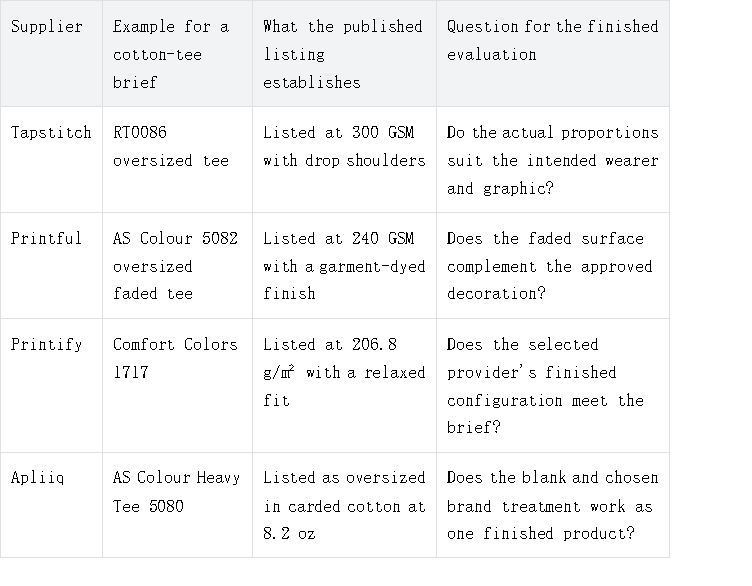
Sources: Tapstitch RT0086, Printful AS Colour 5082, Printify Comfort Colors 1717, Apliiq Heavy Tee.
Fabric composition, GSM, and fit
Record the official composition and fabric weight first. Preserve the listed units, converting them consistently if needed for a comparison. Do not confuse fabric weight per area with the shipping weight of a finished garment. Both affect different decisions, and one cannot substitute for the other.
A larger GSM number describes more fabric mass per area. It does not by itself establish yarn quality, suitability for summer, sewing accuracy or the appearance of the finished print. A brand seeking a structured body may favor a heavier candidate; a brand seeking a lighter layer may choose differently. The use case supplies the meaning of the specification.
Wash, decoration, and brand finishing
A washed-surface requirement narrows the shortlist differently from a heavyweight requirement. Tapstitch's R00037 is listed as a 250 GSM washed cotton tee, while Printful's AS Colour 5082 is listed as a 240 g/m² garment-dyed oversized tee. Those attributes describe two candidate surfaces for the design; they do not establish a common wash process or a durability winner. Select the finish the artwork needs, then evaluate it together with the chosen decoration. R00037, 5082
Tapstitch's label service is restricted to international fulfillment, and its current embroidery tool is limited to text on compatible products. These conditions affect which premium brief it can support. A designer needing US fulfillment with custom labels, or an uploaded embroidered illustration, should choose a supported configuration rather than treat the restriction as a styling detail. Tapstitch labels, embroidery guide
Packaging should be evaluated after the garment is accepted. An attractive parcel can reinforce a premium presentation, but it cannot resolve poor fit or an unsuitable decoration. Where supplied inserts are stored for later orders, include their availability and handling in the operating plan. Product quality and parcel identity require related but distinct approval decisions.
Use One Sample-Review Method Across the Shortlist
For physical evaluation, measure each garment laid flat using the same points. Record chest width, body length, shoulder position and sleeve dimensions relevant to the silhouette. Note the size and how the garment was conditioned before measuring. Compare those measurements against the brand's acceptance range, rather than assuming matching size letters mean matching bodies.
Inspect construction where it matters to the design: neckline shape, seam alignment, hem finish and how the decoration sits around seams. Keep observations specific. “The left sleeve differs from the approved measurement” supports an action; “this platform feels premium” does not explain what should be accepted or changed.
For fit, use the intended audience rather than an abstract universal standard. A wide body with a shorter length might be correct for one collection and incorrect for another. The fit assessment should say whether the garment achieves the planned proportion, with photographs and measurements supporting the choice.
Evaluate the finished decoration as part of the product. The blank may be appropriate while the graphic placement is not. A design approved on a digital mockup can still need revision in size or contrast on the garment. Recording placement dimensions makes that revision repeatable across future orders.
Where a supplier offers several production arrangements, identify which one made the sample. For a Printify product, product selection and fulfillment configuration belong together. A sample from one arrangement cannot automatically approve a later replacement. Preserve the record so that a reorder tests continuity rather than a new unnamed choice.
A wash evaluation begins with the product's supplied care instructions. Follow the same documented procedure for comparable samples where those instructions permit it, and record differences where they do not. An unsuitable care cycle tests misuse rather than the garment's promised performance.
Measure before and after the defined care sequence. Record body length and width at the same points, along with visible changes to seams, neckline and decoration. Dimensional change can be calculated as the difference between the later and original measurement divided by the original measurement. State whether the result is a reduction or increase; do not collapse different dimensions into a vague quality score.
Keep the evaluation's limits clear in the record. One washed sample describes that sample under that procedure. It does not establish a failure rate across all production, colors or sizes. If consistency is central to the premium promise, repeat the relevant evaluation with later orders or other essential variants.
Decoration should be assessed by the design's needs. Check legibility, alignment, surface appearance and any changes after care. A broad solid graphic and a fine illustration may create different challenges. Passing one artwork does not approve every future design on the same garment.
Branding needs its own functional review. Confirm that the interior mark is readable, appropriately positioned and compatible with the garment. Printful documents inside labels on eligible tear-away-label products; Printify's label options depend on supporting providers. Apliiq offers separate private-label and woven-label routes. These services can support identity, but their availability does not establish the comfort of an untested finished label. Printful label guide, Printify branding, Apliiq branding
Choose by the Premium Requirement You Cannot Compromise
For a collection requiring a particular washed or oversized body, Tapstitch merits a shortlist position when its named product satisfies the garment brief and fulfillment conditions. Its R00037 snow-washed tee offers a defined finish to evaluate. The recommendation is tied to that product role, rather than to an unsupported claim that every garment is superior. R00037 product
Printful is a suitable candidate for a brand that finds its intended body among the offered blanks or wants an all-over cotton design within the offered pattern. That route provides a different design scope from a front print on an existing blank. It should be selected for the visual requirement it serves, with the finished piece approved before launch. Printful all-over cotton tee
Printify is appropriate for a founder who wants to compare documented garment and provider configurations, then maintain an approved option. Apliiq deserves closer consideration when the premium identity depends on sewn labels and the business can manage the associated branding setup. These choices answer different product and operating needs.
For this shortlist, public specifications support candidate selection and the evaluation method above supports an approval decision. Choose the finished product that passes the acceptance criteria for the collection. A specification-based shortlist identifies where to begin; the accepted garment and decoration determine what the brand can confidently offer.