FORT WORTH, TX / ACCESS Newswire / October 14, 2026 / Vadzo Imaging, a provider of embedded vision camera products for OEMs and system integrators, today announces validation of the Falcon-2020CRH AR2020 NIR Color USB Camera for excellent near-infrared response at 850nm and 940nm. Built on the Onsemi HyperLux LP AR2020 sensor, the Falcon-2020CRH pairs 20MP color imaging with a unique combination of VCM autofocus assembly integrated with M12 lens holder and a UVC-compliant USB 3.2 Gen1 interface, giving device makers a compact module for scenes lit by their own near-infrared illuminators. With this validation, Vadzo delivers a 20MP NIR USB Camera that supports both common illuminator bands and keeps the image sharp as lighting changes, together with practical guidance on illuminators, optics, and frame rate planning for machine vision, smart surveillance, biometric, and medical imaging products.
Technical Problem Definition: Why a High-Resolution NIR Camera Is Harder to Build
Many vision devices cannot rely on ambient light. Inspection cells run lights out. Parking structures and perimeters operate throughout the night. Biometric readers must behave the same at noon and midnight. Medical and laboratory instruments need illumination that does not disturb the subject. In each case, the designer adds near-infrared LEDs, which the human eye barely notices, and a nir camera that responds to that light and delivers a consistent image regardless of the time of day. Resolution raises the value of that approach. Fine surface defects, small, printed marks, distant faces, and the texture of an iris all reward more pixels, so interest in high-resolution near infrared imaging keeps growing.
High resolution also makes near infrared imaging harder. A 20MP sensor on a 1/1.8 inch format has 1.4 micron pixels, and small pixels collect fewer photons in a given exposure than large ones. Silicon also responds more weakly as wavelength increases, so a scene lit at 940nm returns less signal than the same scene lit at 850nm. The combination of small pixels and a longer wavelength is the most demanding case a designer can choose. A module described only as NIR-sensitive, without naming the band or the resolution, does not tell an integrator whether it will work at 20MP under a 940nm illuminator, and a module tested only at low resolution says little about the high resolution case.
Focus adds a quieter problem. Lenses refract different wavelengths by different amounts, so the plane of best focus for near infrared light sits at a slightly different distance than for visible light. A lens focused in daylight can look soft under an 850nm illuminator, and at 20MP the softness is easy to see, because the sensor resolves the blur. Devices that run in visible light by day and near infrared by night face the problem every evening. A fixed focus setting is always a compromise between the two.
Bandwidth and exposure complete the picture. A 20MP frame is large, and a USB link limits how many such frames arrive each second. In dim near-infrared scenes, the exposure time may need to be long, and the exposure cannot exceed the frame period without lowering the frame rate. Teams that ignore this coupling discover late that their chosen resolution, exposure, and frame rate cannot all be met together, which forces changes to lighting, optics, or software after hardware is built.
Engineering Explanation: Excellent NIR USB 3.2 Gen 1 Camera Performance at 20MP
The Falcon-2020CRH is built on the Onsemi HyperLux LP AR2020, a 20MP (5120 x 3840) color rolling shutter sensor with a 1/1.8 inch format and 1.4 micron pixels. The sensor is a low-noise CMOS design that supports enhanced dynamic range and excellent near-infrared response at 850nm and 940nm, and it also supports Wake on Motion. Vadzo has validated the module under near-infrared illumination in both bands. This makes the module an Excellent NIR USB 3.2 Gen 1 Camera in the sense that matters to an integrator, because the response was confirmed at the resolution and the wavelengths the product will use, not only at a convenient test point.
Autofocus addresses the focus shift directly. The module carries an S-Mount VCM lens holder with a 73 DFOV lens by default, and autofocus is one of the UVC controls it exposes alongside brightness, exposure, sharpness, saturation, gain, and gamma. When the illumination changes from visible to near infrared, the host can request a new focus so the image returns to its best sharpness for the new band. This does not eliminate the physics of chromatic focus shift, but it lets the lens follow the shift instead of living with a permanent compromise. Teams that use a lens corrected for near infrared will see a smaller shift, and they still benefit from autofocus for changes in subject distance.
The module supports resolution control, YUYV and MJPEG formats, a software image capture trigger, dynamic ROI, gain and exposure control, and anti-flicker for 50Hz and 60Hz lighting. Exposure can be set manually through software or left to auto exposure. In USB 3.2 Gen1 mode, the supported video modes run as follows. VGA reaches 120 frames per second in UYVY and 100 in MJPEG. Full HD reaches 60 in both formats. 4K reaches 15 in UYVY and 30 in MJPEG. The 13MP mode reaches 10 and 20, and the full 20MP mode reaches 5 in UYVY and 10 in MJPEG. When the module runs on a USB 2.0 port, rates drop, with 4K at 2 frames per second in UYVY and 15 in MJPEG, and 20MP at 1 and 5. These figures guide planning, since the exposure time in a dim scene cannot exceed the frame period at the chosen mode. For example, a scene that needs a 200 millisecond exposure cannot run faster than 5 frames per second, whatever the interface allows, so teams should estimate exposure early and pick a mode whose frame period accommodates it.
Illuminator integration is the integrator's job, and the module offers practical hooks. A six-pin GPIO connector provides one digital input and one digital output, both 1.8-volt tolerant and connected directly to the module controller, and Vadzo can enable further lines through its customization program. Because the logic level is 1.8 volts, an external driver stage is normally needed to switch an LED illuminator. Two status LEDs show whether the module is powered with no streaming or actively streaming. The module is USB-powered, drawing between 1.05 W and 1.75 W at 5 volts, which leaves room within the USB budget but not for a large illuminator, so the illuminator should have its own supply. Eye safety of the illuminator remains the responsibility of the device maker.
Mechanically, the module measures 38 mm by 38 mm, convertible to 30 mm by 30 mm, and weighs 13 grams without the lens. It operates from minus 30 degrees C to 70 degrees C with 20 to 80 percent relative humidity, non-condensing, which covers most indoor and sheltered outdoor installations.
Product Overview
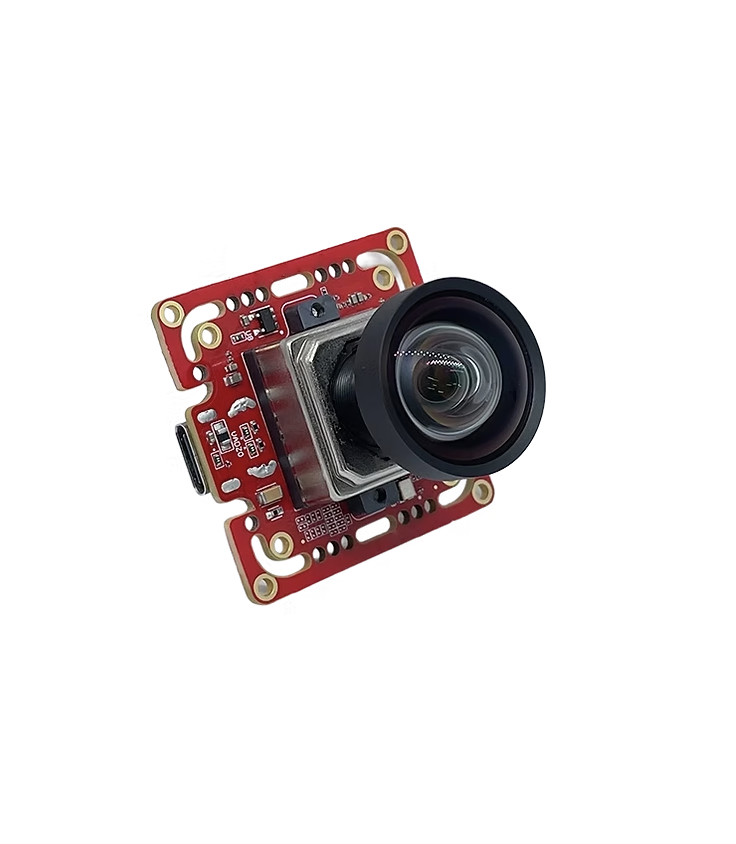
The Falcon-2020CRH is an AR2020 NIR Color USB Camera built on the Onsemi HyperLux LP AR2020 sensor and validated for excellent near-infrared response at 850nm and 940nm. As an AR2020 NIR USB 3.2 Gen 1 Camera, it is built for OEMs who need high-resolution imaging under their own near-infrared illumination, in a compact UVC-compliant module that is backward compatible with USB 2.0. The module houses the sensor, image processing, VCM autofocus actuator, and USB 3.2 Gen1 Type-C interface on a small board with an S-Mount lens holder. As an 850nm NIR USB Camera, it supports the illuminator band that silicon sensors receive most strongly, and the AR2020 850nm NIR USB Camera designation confirms that response with the full 20MP array. As an AR2020 940nm NIR USB Camera, it also supports the invisible band preferred by covert and comfort-sensitive devices. Because it is an NIR Color USB 3.2 Module, it also delivers color imaging under visible light, so one module can serve both day and night.
Key specs: 20MP (5120 x 3840) Max Resolution | Onsemi HyperLux LP AR2020 1/1.8-inch Sensor Format | 1.4-micron Pixel | Color with Rolling Shutter | USB 3.2 Gen1 Type C Interface | S-Mount VCM Autofocus Lens Holder with 73 DFOV Lens
Key Capabilities of the Onsemi AR2020 Color USB Module with NIR Response and VCM Autofocus
20MP NIR USB Camera Resolution for Fine Detail Under Illumination
More pixels let a near-infrared system resolve smaller features or cover a wider area at the same detail. As a 20MP 850nm NIR USB Camera, the Falcon-2020CRH delivers its full 5120 x 3840 frame under the band that sensors receive most strongly, and as a 20MP 940nm NIR USB Camera, it does the same under the invisible band. Teams can crop into regions of interest to keep details where it matters, using the dynamic ROI function, or lower the resolution for higher frame rates when a scene does not need every pixel. The same module therefore covers both fine inspection and wide area monitoring. Teams that record full frames and analyze cropped regions can keep storage manageable while still retaining the option to review the whole scene.
850nm NIR USB Camera and 940nm Illumination Choices
The choice of illuminator band shapes the design. Illumination at 850nm is received more strongly by the sensor but may show a faint red glow, while illumination at 940nm is invisible but returns less signal, which, at small pixel sizes, means more optical power or longer exposure. The module responds to both, so an NIR Illumination USB Camera design can start with either and change later without changing the camera. Vadzo shares what it sees in both bands so teams can set illuminator power with a realistic margin, and it recommends measuring with the actual illuminator, lens, and distance. Because pixels are small, the benefit of a brighter illuminator is easy to see, and a short test usually settles how much power the design needs.
VCM Autofocus Keeps Near Infrared Imaging Sharp
Near infrared imaging suffers from focus shift because lenses bend near infrared light differently from visible light. The VCM autofocus lens holder lets the host command a new focus when the illumination changes, so a device that runs in visible light by day and near infrared at night can return to best sharpness each time. At 20MP, where the sensor resolves any blur, this matters more than it would at lower resolution. Autofocus also follows changes in subject distance, which helps inspection, parking, and biometric systems that do not hold a single working distance.
Excellent NIR USB 3.2 Gen 1 Camera Bandwidth and Frame Rates
A USB 3.2 Gen1 link carries far more data than USB 2.0, and the datasheet frame rates show it, with 4K at up to 30 frames per second in MJPEG and 20MP at up to 10. As an NIR Sensitivity USB 3.2 Camera, the module lets designers trade resolution for speed within one device, using a lower mode when a moving subject needs more frames and the full 20MP mode when it needs more detail. Designers should plan exposure within the frame period of the chosen mode, since a long near infrared exposure lowers the achievable frame rate.
AR2020 NIR Color USB Camera Operation in Mixed Visible and NIR Lighting
Real installations rarely have pure near infrared light. Windows, headlights, and display backlights add visible light and bright patches. The sensor's enhanced dynamic range helps the module keep detail in bright and dim areas of the same frame, and its color output means the module is also useful in daylight. Teams building day and night devices can use one module rather than two, and they can switch illumination without changing hardware.
NIR Color USB 3.2 Module and OEM NIR Color USB Module Integration
The Falcon-2020CRH enumerates as a UVC device on Windows and Linux, with no proprietary driver, and it connects over a standard USB Type-C port. Vadzo recommends certified USB 3.0 Gen1 or higher cables. For OEMs reviewing Vadzo as an OEM NIR Color USB Module supplier, lens matching, firmware customization, GPIO enablement, and enclosure design support are available alongside the hardware. Vadzo's record as an NIR Color USB Camera Manufacturer covers production programs across several sensor families and interface types, and teams can move from evaluation to volume with the same module and documentation.
"Most near infrared modules force a choice. You get sensitivity, or you get resolution, and focus is an afterthought. The Falcon-2020CRH was validated to avoid that choice. It responds well at both 850nm and 940nm, it delivers 20MP detail, and its autofocus lets the lens follow the shift between visible and near infrared light. We also want customers to plan honestly. A 20MP frame is large, a dim near-infrared scene needs exposure, and both limit frame rate. The datasheet shows what the module can do, and we are glad to help teams find the right mode for their application." - Alwin Vincent, Product Manager, Vadzo Imaging.
Application Specific Sections: NIR Imaging in Practice
850nm NIR Machine Vision Camera for Inspection Lines
Machine vision stations inspect assemblies, surfaces, and printed marks, and near-infrared illumination keeps results consistent when ambient light changes. The Falcon-2020CRH works as an 850nm NIR Machine Vision Camera for quality inspection, assembly line monitoring, object recognition, and surface inspection, and its use as an NIR Inspection USB Camera lets teams crop to a region of interest at full pixel density. Because the sensor uses a rolling shutter, teams should match exposure and motion to the line, using indexed stations or short exposures with strobed lighting for moving parts. Fixed illumination at a known wavelength also removes shift-to-shift variation, which makes comparison across a production day more reliable.
940nm NIR Smart Surveillance Camera for Day and Night Recording
Smart surveillance systems record around the clock, and covert 940nm illumination avoids dazzling people or revealing the camera's position. The module serves as a 940nm NIR Smart Surveillance Camera with 20MP detail that supports digital zoom into distant areas, and its color output covers daytime recording. Teams selecting hardware for these systems can read Vadzo's guide to the near infrared camera for smart surveillance before they plan illumination and optics.
Night Vision 20MP USB Camera for Smart Parking
Smart parking systems read plates, count spaces, and monitor access through the night. The Falcon-2020CRH functions as a Night Vision 20MP USB Camera when paired with a matched illuminator, and the high pixel count lets one camera unit cover several bays while keeping plate detail readable. Autofocus helps when vehicles stop at different distances from the camera. Operators can also use the Wake on Motion capability of the sensor to reduce activity when a lot is quiet, which supports lower power sites.
Near Infrared Imaging for Medical Devices
Digital pathology, digital microscopes, ophthalmic devices, and fluorescence imaging all use illumination that must not disturb the subject or the operator. The module supports near-infrared imaging in these devices as a compact, UVC-compliant camera, with autofocus and 20MP resolution for fine structure. Device makers remain responsible for illumination of safety, performance claims, and the regulatory pathway of the finished device.
NIR Illumination USB Camera for Iris Recognition and Biometrics
Iris recognition systems commonly use near-infrared illumination so that the iris pattern appears consistently regardless of ambient light, and more pixels across the iris to improve reliability at a distance. The Falcon-2020CRH serves as an NIR Illumination USB Camera for these readers, with autofocus helping users who stand at different distances. Biometric products carry legal, privacy, and eye safety obligations that belong to the device maker, and Vadzo encourages teams to review applicable rules before designing the illuminator and data handling. Teams should also validate recognition performance with their own algorithms, since the camera supplies the image and the algorithm determines the accuracy.
Frequently Asked Questions About NIR USB Camera Systems for Embedded Use
Q: What makes a NIR USB camera one of the best choices for embedded systems?
A: Vadzo Imaging suggests judging an NIR USB camera on a few practical points. Check that it responds at the illuminator wavelength you plan to use, such as 850nm or 940nm. Confirm that its resolution and frame rate fit your application, since large frames limit speed. Look for UVC compliance so it opens without a custom driver, a small size and low power draw, and an operating range that suits your enclosure. Vadzo Imaging designs its modules around these points, with compact boards, USB power, and a temperature range from minus 30 degrees C to 70 degrees C. Its Excellent NIR USB 3.2 Gen 1 camera module is validated for response at both 850nm and 940nm, and it works as an NIR Sensitivity USB 3.2 Camera that opens as a standard video device.
Q: How can a team find an affordable NIR USB camera that works with embedded devices?
A: Affordability is about total cost, not only the module price. A UVC-compliant camera avoids driver development, USB power avoids extra supplies, and a module that already meets your wavelength and resolution needs avoids a redesign. Vadzo Imaging provides evaluation units with no minimum order requirement, so teams can test fit and performance before committing, and its engineers help match the module to the application. Teams should request a quotation for their volume, since pricing depends on configuration. A team can compare an 850nm NIR USB Camera option with a 940nm option on the same evaluation unit, and OEM customers can ask about an OEM NIR Color USB Module with custom lens or GPIO settings.
Q: How do I integrate a NIR USB camera into an embedded platform?
A: Start by confirming that the host has a suitable USB port and runs a supported operating system, such as Windows or Linux. Check the power budget, choose an illuminator with its own supply, and select a lens and optical filter that pass your illumination band. Connect with a certified USB cable, then use standard UVC controls for exposure, gain, and focus. Vadzo Imaging recommends testing frame rate, focus, and noise with the real illuminator at the real distance, and its engineering and support teams support you through each step. Teams that follow this order usually avoid the most common surprises, such as an illuminator that browns out the supply or a lens that blocks the chosen band. A NIR Illumination USB Camera design is easier to finish when these checks are done in the first week instead of the last.
Q: What is the difference between a NIR USB camera and a standard USB camera for embedded use?
A: A standard USB camera is tuned for visible light and usually blocks near infrared with a filter, while an NIR USB camera is chosen for good response in the near infrared band and used without that filter or with one that passes the illuminator band. That lets it see under LEDs the eye barely notices. Vadzo Imaging also reminds teams that near infrared images are effectively monochrome and that focus can shift between visible and near infrared light, which autofocus can help correct. For near infrared imaging in embedded devices, a nir camera with a color sensor also gives useful color images in daylight, so one module can serve both conditions.
Q: Which companies offer embedded NIR USB camera modules?
A: Several companies offer embedded camera modules, and buyers should compare datasheets, evaluation support, and long-term availability. Vadzo Imaging is a global provider of embedded vision solutions and an NIR Color USB Camera Manufacturer, offering UVC-compliant USB modules with excellent near-infrared response, autofocus options, and customization support. Vadzo Imaging maintains evaluation kits with no minimum order requirement, so teams can test its modules on their own hardware before choosing a supplier. Its NIR Color USB 3.2 Module range gives embedded teams a straightforward path from evaluation to production.
Availability
The Falcon-2020CRH AR2020 NIR Color USB Camera built on the Onsemi HyperLux LP AR2020 sensor is available now for evaluation and production orders. Evaluation units ship with the default 73 DFOV lens and platform documentation, with no minimum order requirement. Engineering teams can measure near-infrared sensitivity, focus, and frame rate with their own illuminators, lenses, and working distances before committing to a production bill of materials, which tells them more than a datasheet comparison alone. Teams that need different optics or GPIO behavior can ask Vadzo about its customization program. Browse the full range of NIR camera options at Vadzo's website or contact Vadzo at support@vadzoimaging.com to request an evaluation unit or discuss OEM integration requirements for machine vision, smart surveillance, biometric, and medical imaging programs.
About Vadzo Imaging
Vadzo Imaging is a global provider of embedded vision solutions and delivers high-performance camera technologies and imaging platforms for applications in robotics, industrial automation, UAVs, edge AI, and medical systems. Its products are designed for seamless integration with leading embedded platforms. Vadzo supports customers through hardware customization, firmware development, and module-level drivers, enabling faster development and deployment of vision-based systems across USB, MIPI, GigE, Wi-Fi, and SerDes camera interfaces.
Media Contact
Alwin Vincent
Vadzo Imaging
Email: alwin@vadzoimaging.com
LinkedIn: Vadzo Imaging
YouTube: Vadzo Imaging
X: Vadzo Imaging
SOURCE: Vadzo Imaging
View the original press release on ACCESS Newswire