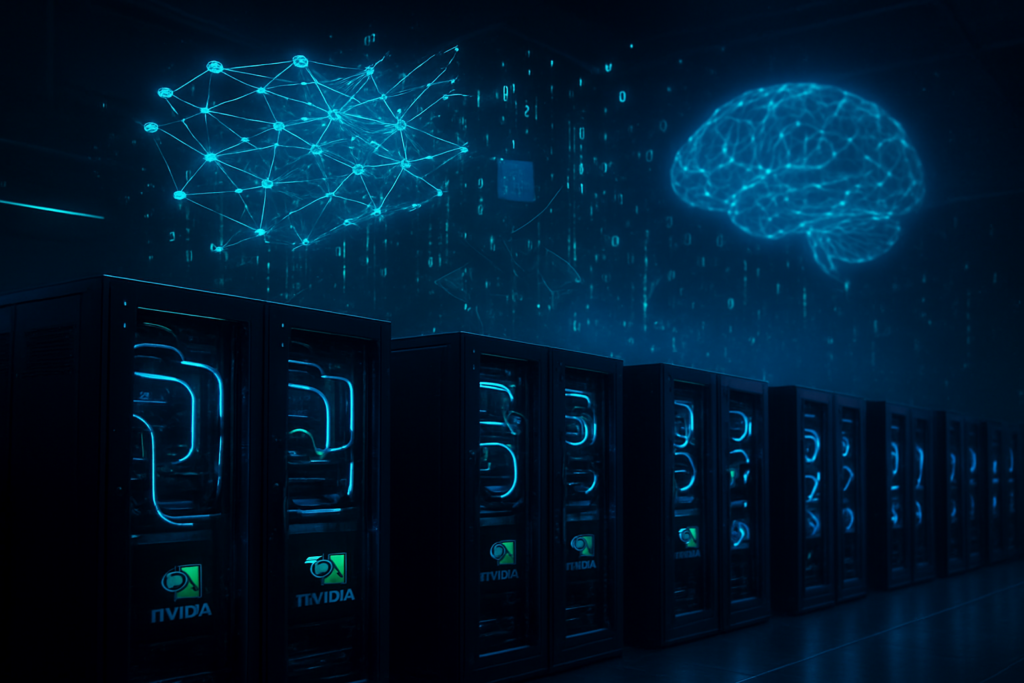
As of January 12, 2026, the global technology landscape has undergone a seismic shift, driven by the widespread deployment of NVIDIA’s (NASDAQ: NVDA) Blackwell GPU architecture. What began as a bold promise of a "30x performance increase" in 2024 has matured into the physical and digital backbone of the modern economy. In early 2026, Blackwell is no longer just a chip; it is the foundation of a new era where "Agentic AI"—autonomous systems capable of complex reasoning and multi-step execution—has moved from experimental labs into the mainstream of enterprise and consumer life.
The immediate significance of this development cannot be overstated. By providing the compute density required to run trillion-parameter models with unprecedented efficiency, NVIDIA has effectively lowered the "cost of intelligence" to a point where real-time, high-fidelity AI interaction is ubiquitous. This transition has marked the definitive end of the "Chatbot Era" and the beginning of the "Reasoning Era," as Blackwell’s specialized hardware accelerators allow models to "think" longer and deeper without the prohibitive latency or energy costs that plagued previous generations of hardware.
Technical Foundations of the 30x Leap
The Blackwell architecture, specifically the B200 and the recently scaled B300 "Blackwell Ultra" series, represents a radical departure from the previous Hopper generation. At its core, a single Blackwell GPU packs 208 billion transistors, manufactured using a custom 4NP TSMC (NYSE: TSM) process. The most significant technical breakthrough is the second-generation Transformer Engine, which introduces support for 4-bit floating point (FP4) precision. This allows the chip to double its compute capacity and double the model size it can handle compared to the H100, while maintaining the accuracy required for the world’s most advanced Large Language Models (LLMs).
This leap in performance is further amplified by the fifth-generation NVLink interconnect, which enables up to 576 GPUs to talk to each other as a single, massive unified engine with 1.8 TB/s of bidirectional throughput. While the initial marketing focused on a "30x increase," real-world benchmarks in early 2026, such as those from SemiAnalysis, show that for trillion-parameter inference tasks, Blackwell delivers 15x to 22x the throughput of its predecessor. When combined with software optimizations like TensorRT-LLM, the "30x" figure has become a reality for specific "agentic" workloads that require high-speed iterative reasoning.
Initial reactions from the AI research community have been transformative. Dr. Dario Amodei of Anthropic noted that Blackwell has "effectively solved the inference bottleneck," allowing researchers to move away from distilling models for speed and instead focus on maximizing raw cognitive capability. However, the rollout was not without its critics; early in 2025, the industry grappled with the "120kW Crisis," where the massive power draw of Blackwell GB200 NVL72 racks forced a total redesign of data center cooling systems, leading to a mandatory industry-wide shift toward liquid cooling.
Market Dominance and Strategic Shifts
The dominance of Blackwell has created a massive "compute moat" for the industry’s largest players. Microsoft (NASDAQ: MSFT) has been the primary beneficiary, recently announcing its "Fairwater" superfactories—massive data center complexes powered entirely by Blackwell Ultra and the upcoming Rubin systems. These facilities are designed to host the next generation of OpenAI’s models, providing the raw power necessary for "Project Strawberry" and other reasoning-heavy architectures. Similarly, Meta (NASDAQ: META) utilized its massive Blackwell clusters to train and deploy Llama 4, which has become the de facto operating system for the burgeoning AI agent market.
For tech giants like Alphabet (NASDAQ: GOOGL) and Amazon (NASDAQ: AMZN), the Blackwell era has forced a strategic pivot. While both companies continue to develop their own custom silicon—the TPU v6 and Trainium3, respectively—they have been forced to offer Blackwell-based instances (such as Google’s A4 VMs) to satisfy the insatiable demand from startups and enterprise clients. The strategic advantage has shifted toward those who can secure the most Blackwell "slots" in the supply chain, leading to a period of intense capital expenditure that has redefined the balance of power in Silicon Valley.
Startups have found themselves in a "bifurcated" market. Those focusing on "wrapper" applications are struggling as the underlying models become more capable, while a new breed of "Agentic Startups" is flourishing by leveraging Blackwell’s low-latency inference to build autonomous workers for law, medicine, and engineering. The disruption to existing SaaS products has been profound, as Blackwell-powered agents can now perform complex workflows that previously required entire teams of human operators using legacy software.
Societal Impact and the Global Scaling Race
The wider significance of the Blackwell deployment lies in its impact on the "Scaling Laws" of AI. For years, skeptics argued that we would hit a wall in model performance due to energy and data constraints. Blackwell has pushed that wall significantly further back by reducing the energy required per token by nearly 25x compared to the H100. This efficiency gain has made it possible to contemplate "sovereign AI" clouds, where nations like Saudi Arabia and Japan are building their own Blackwell-powered infrastructure to ensure digital autonomy and cultural preservation in the AI age.
However, this breakthrough has also accelerated concerns regarding the environmental impact and the "AI Divide." Despite the efficiency gains per token, the sheer scale of deployment means that AI-related power consumption has reached record highs, accounting for nearly 4% of global electricity demand by the start of 2026. This has led to a surge in nuclear energy investments by tech companies, with Microsoft and Constellation Energy (NASDAQ: CEG) leading the charge to restart decommissioned reactors to feed the Blackwell clusters.
In the context of AI history, the Blackwell launch is being compared to the "iPhone moment" for data center hardware. Just as the iPhone turned the mobile phone into a general-purpose computing platform, Blackwell has turned the data center into a "reasoning factory." It represents the moment when AI moved from being a tool we use to a collaborator that acts on our behalf, fundamentally changing the human-computer relationship.
The Horizon: From Blackwell to Rubin
Looking ahead, the Blackwell era is already transitioning into the "Rubin Era." Announced at CES 2026, NVIDIA’s next-generation Rubin architecture is expected to feature the Vera CPU and HBM4 memory, promising another 5x leap in inference throughput. The industry is moving toward an annual release cadence, a grueling pace that is testing the limits of semiconductor manufacturing and data center construction. Experts predict that by 2027, the focus will shift from raw compute power to "on-device" reasoning, as the lessons learned from Blackwell’s architecture are miniaturized for edge computing.
The next major challenge will be the "Data Wall." With Blackwell making compute "too cheap to meter," the industry is running out of high-quality human-generated data to train on. This is leading to a massive push into synthetic data generation and "embodied AI," where Blackwell-powered systems learn by interacting with the physical world through robotics. We expect the first Blackwell-integrated humanoid robots to enter pilot programs in logistics and manufacturing by the end of 2026.
Conclusion: A New Paradigm of Intelligence
In summary, NVIDIA’s Blackwell architecture has delivered on its promise to be the engine of the 2026 AI revolution. By achieving a 30x performance increase in key inference metrics and forcing a revolution in data center design, it has enabled the rise of Agentic AI and solidified NVIDIA’s position as the most influential company in the global economy. The key takeaways from this era are clear: compute is the new oil, liquid cooling is the new standard, and the cost of intelligence is falling faster than anyone predicted.
As we look toward the rest of 2026, the industry will be watching the first deployments of the Rubin architecture and the continued evolution of Llama 5 and GPT-5. The Blackwell era has proven that the scaling laws are still very much in effect, and the "AI Revolution" is no longer a future prospect—it is the present reality. The coming months will likely see a wave of consolidation as companies that failed to adapt to this high-compute environment are left behind by those who embraced the Blackwell-powered future.
This content is intended for informational purposes only and represents analysis of current AI developments.
TokenRing AI delivers enterprise-grade solutions for multi-agent AI workflow orchestration, AI-powered development tools, and seamless remote collaboration platforms.
For more information, visit https://www.tokenring.ai/.