In a definitive move that signals the end of its era as a mere holding company, SoftBank Group Corp. (OTC: SFTBY) has finalized its $6.5 billion acquisition of Ampere Computing, marking the completion of a vertically integrated AI hardware ecosystem designed to break the global stranglehold of traditional GPU providers. By uniting the cloud-native CPU prowess of Ampere with the specialized AI acceleration of Graphcore—acquired just over a year ago—SoftBank is positioning itself as the primary architect of the physical infrastructure required for the next decade of artificial intelligence.
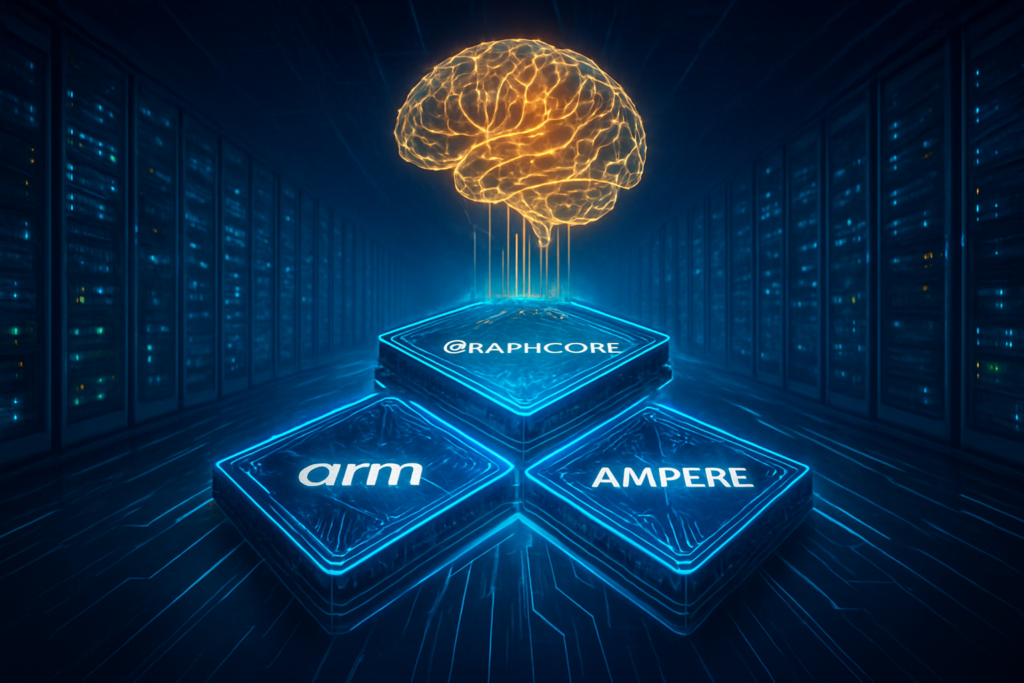
This strategic consolidation represents a high-stakes pivot by SoftBank Chairman Masayoshi Son, who has transitioned the firm from an investment-focused entity into a semiconductor and infrastructure powerhouse. With the Ampere deal officially closing in late November 2025, SoftBank now controls a "Silicon Trinity": the Arm Holdings (NASDAQ: ARM) architecture, Ampere’s server-grade CPUs, and Graphcore’s Intelligence Processing Units (IPUs). This integrated stack aims to provide a sovereign, high-efficiency alternative to the high-cost, high-consumption platforms currently dominated by market leaders.
Technical Synergy: The Birth of the Integrated AI Server
The technical core of SoftBank’s new strategy lies in the deep silicon-level integration of Ampere’s AmpereOne® processors and Graphcore’s Colossus IPU architecture. Unlike the current industry standard, which often pairs x86-based CPUs from Intel or AMD with NVIDIA (NASDAQ: NVDA) GPUs, SoftBank’s stack is co-designed from the ground up. This "closed-loop" system utilizes Ampere’s high-core-count Arm-based CPUs—boasting up to 192 custom cores—to handle complex system management and data preparation, while offloading massive parallel graph-based workloads directly to Graphcore’s IPUs.
This architectural shift addresses the "memory wall" and data movement bottlenecks that have plagued traditional GPU clusters. By leveraging Graphcore’s IPU-Fabric, which offers 2.8Tbps of interconnect bandwidth, and Ampere’s extensive PCIe Gen5 lane support, the system creates a unified memory space that reduces latency and power consumption. Industry experts note that this approach differs significantly from NVIDIA’s upcoming Rubin platform or Advanced Micro Devices, Inc. (NASDAQ: AMD) Instinct MI350/MI400 series, which, while powerful, still operate within a more traditional accelerator-to-host framework. Initial benchmarks from SoftBank’s internal testing suggest a 30% reduction in Total Cost of Ownership (TCO) for large-scale LLM inference compared to standard multi-vendor configurations.
Market Disruption and the Strategic Exit from NVIDIA
The completion of the Ampere acquisition coincides with SoftBank’s total divestment from NVIDIA, a move that sent shockwaves through the semiconductor market in late 2025. By selling its final stakes in the GPU giant, SoftBank has freed up capital to fund its own manufacturing and data center initiatives, effectively moving from being NVIDIA’s largest cheerleader to its most formidable vertically integrated competitor. This shift directly benefits SoftBank’s partner, Oracle Corporation (NYSE: ORCL), which exited its position in Ampere as part of the deal but remains a primary cloud partner for deploying these new integrated systems.
For the broader tech landscape, SoftBank’s move introduces a "third way" for hyperscalers and sovereign nations. While NVIDIA focuses on peak compute performance and AMD emphasizes memory capacity, SoftBank is selling "AI as a Utility." This positioning is particularly disruptive for startups and mid-sized AI labs that are currently priced out of the high-end GPU market. By owning the CPU, the accelerator, and the instruction set, SoftBank can offer "sovereign AI" stacks to governments and enterprises that want to avoid the "vendor tax" associated with proprietary software ecosystems like CUDA.
Project Izanagi and the Road to Artificial Super Intelligence
The Ampere and Graphcore integration is the physical manifestation of Masayoshi Son’s Project Izanagi, a $100 billion venture named after the Japanese god of creation. Project Izanagi is not just about building chips; it is about creating a new generation of hardware specifically designed to enable Artificial Super Intelligence (ASI). This fits into a broader global trend where the AI landscape is shifting from general-purpose compute to specialized, domain-specific silicon. SoftBank’s vision is to move beyond the limitations of current transformer-based architectures to support the more complex, graph-based neural networks that many researchers believe are necessary for the next leap in machine intelligence.
Furthermore, this vertical play is bolstered by Project Stargate, a massive $500 billion infrastructure initiative led by SoftBank in partnership with OpenAI and Oracle. While NVIDIA and AMD provide the components, SoftBank is building the entire "machine that builds the machine." This comparison to previous milestones, such as the early vertical integration of the telecommunications industry, suggests that SoftBank is betting on AI infrastructure becoming a public utility. However, this level of concentration—owning the design, the hardware, and the data centers—has raised concerns among regulators regarding market competition and the centralization of AI power.
Future Horizons: The 2026 Roadmap
Looking ahead to 2026, the industry expects the first full-scale deployment of the "Izanagi" chips, which will incorporate the best of Ampere’s power efficiency and Graphcore’s parallel processing. These systems are slated for deployment across the first wave of Stargate hyper-scale data centers in the United States and Japan. Potential applications range from real-time climate modeling to autonomous discovery in biotechnology, where the graph-based processing of the IPU architecture offers a distinct advantage over traditional vector-based GPUs.
The primary challenge for SoftBank will be the software layer. While the hardware integration is formidable, migrating developers away from the entrenched NVIDIA CUDA ecosystem remains a monumental task. SoftBank is currently merging Graphcore’s Poplar SDK with Ampere’s open-source cloud-native tools to create a seamless development environment. Experts predict that the success of this venture will depend on how quickly SoftBank can foster a robust developer community and whether its promised 30% cost savings can outweigh the friction of switching platforms.
A New Chapter in the AI Arms Race
SoftBank’s transformation from a venture capital firm into a semiconductor and infrastructure giant is one of the most significant shifts in the history of the technology industry. By successfully integrating Ampere and Graphcore, SoftBank has created a formidable alternative to the GPU duopoly of NVIDIA and AMD. This development marks the end of the "investment phase" of the AI boom and the beginning of the "infrastructure phase," where the winners will be determined by who can provide the most efficient and scalable physical layer for intelligence.
As we move into 2026, the tech world will be watching the first production runs of the Izanagi-powered servers. The significance of this move cannot be overstated; if SoftBank can deliver on its promise of a vertically integrated, high-efficiency AI stack, it will not only challenge the current market leaders but also fundamentally change the economics of AI development. For now, Masayoshi Son’s gamble has placed SoftBank at the very center of the race toward Artificial Super Intelligence.
This content is intended for informational purposes only and represents analysis of current AI developments.
TokenRing AI delivers enterprise-grade solutions for multi-agent AI workflow orchestration, AI-powered development tools, and seamless remote collaboration platforms.
For more information, visit https://www.tokenring.ai/.