As the Q2 earnings season comes to a close, it’s time to take stock of this quarter’s best and worst performers in the specialty finance industry, including Sixth Street Specialty Lending (NYSE: TSLX) and its peers.
Specialty finance companies provide targeted lending or financial services for specific industries or needs. They benefit from expertise in particular sectors, often reduced competition in specialized niches, and tailored underwriting that can yield higher margins. Challenges include concentration risk in specific industries, difficulty achieving scale efficiencies, and potential vulnerability during sector-specific downturns affecting their specialized markets.
The 9 specialty finance stocks we track reported a strong Q2. As a group, revenues missed analysts’ consensus estimates by 4.1%.
While some specialty finance stocks have fared somewhat better than others, they have collectively declined. On average, share prices are down 3.6% since the latest earnings results.
Sixth Street Specialty Lending (NYSE: TSLX)
Originally launched as TPG Specialty Lending before rebranding in 2020, Sixth Street Specialty Lending (NYSE: TSLX) is a business development company that provides customized financing solutions to middle-market companies across various industries.
Sixth Street Specialty Lending reported revenues of $97.84 million, down 14.9% year on year. This print exceeded analysts’ expectations by 3.3%. Overall, it was a strong quarter for the company with EPS in line with analysts’ estimates.
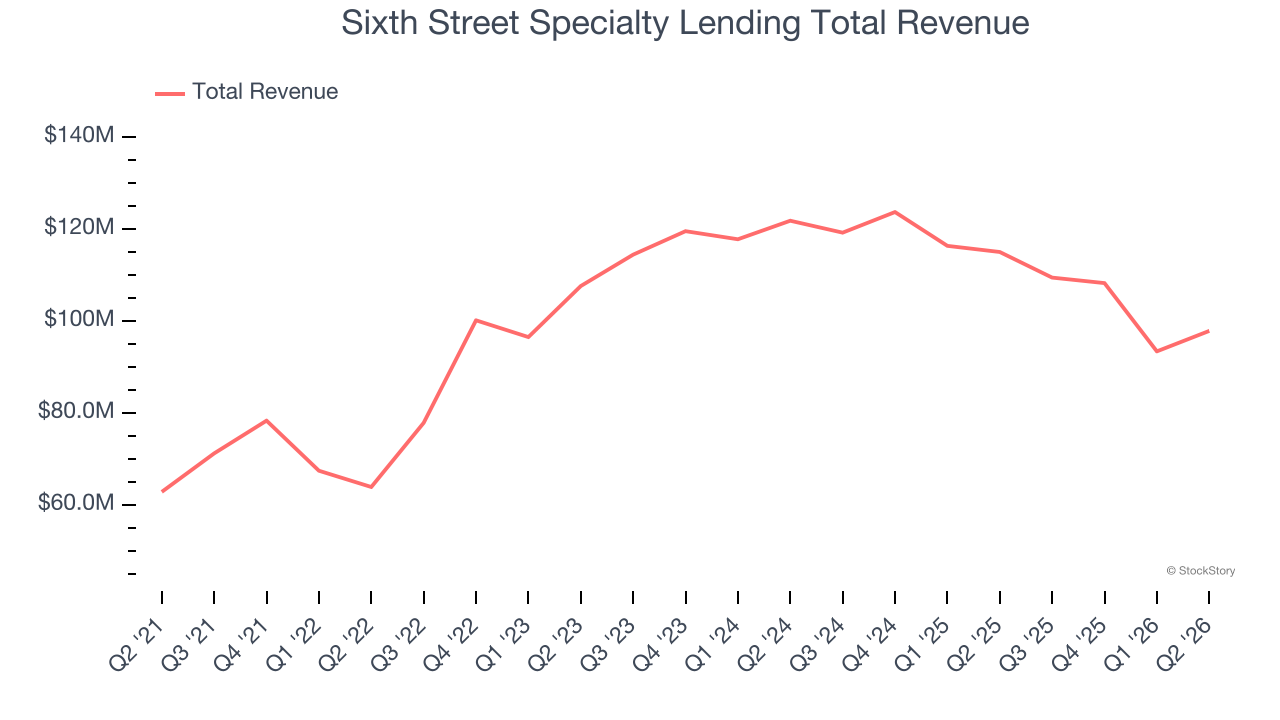
The market was likely pricing in the results, and the stock is flat since reporting. It currently trades at $18.05.
Is now the time to buy Sixth Street Specialty Lending? Access our full analysis of the earnings results here, it’s free.
Best Q2: PROG (NYSE: PRG)
Evolving from its origins as Aaron's, Inc. before rebranding in 2020, PROG Holdings (NYSE: PRG) provides alternative payment solutions including lease-to-own options and second-look credit products for consumers who may not qualify for traditional financing.
PROG reported revenues of $719.7 million, up 22.3% year on year, outperforming analysts’ expectations by 6.9%. The business had an exceptional quarter with a beat of analysts’ EPS estimates and an impressive beat of analysts’ EBITDA estimates.
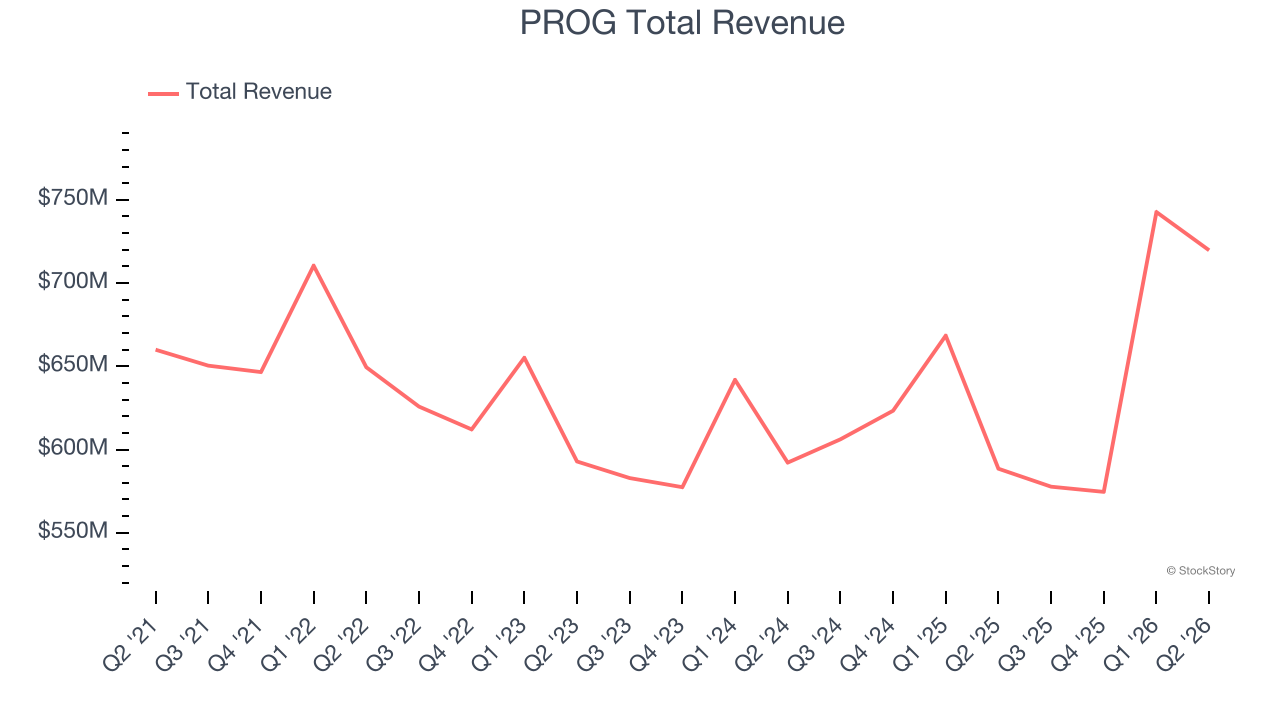
Although it had a fine quarter compared to its peers, the market seems unhappy with the results as the stock is down 29.4% since reporting. It currently trades at $31.85.
Is now the time to buy PROG? Access our full analysis of the earnings results here, it’s free.
Slowest Q2: HA Sustainable Infrastructure Capital (NYSE: HASI)
With a proprietary "CarbonCount" metric that quantifies the environmental impact of each dollar invested, HA Sustainable Infrastructure Capital (NYSE: HASI) is an investment firm that finances and develops climate-positive infrastructure projects across renewable energy, energy efficiency, and ecological restoration.
HA Sustainable Infrastructure Capital reported revenues of $36.32 million, down 64.9% year on year, falling short of analysts’ expectations by 63.1%. It was a softer quarter as it posted a significant miss of analysts’ EBITDA estimates.
HA Sustainable Infrastructure Capital delivered the weakest performance against analyst estimates and slowest revenue growth among its peers. As expected, the stock is down 5.2% since the results and currently trades at $36.26.
Read our full analysis of HA Sustainable Infrastructure Capital’s results here.
Main Street Capital (NYSE: MAIN)
With a focus on building long-term partnerships rather than quick transactions, Main Street Capital (NYSE: MAIN) is a business development company that provides long-term debt and equity capital to lower middle market and middle market companies.
Main Street Capital reported revenues of $149.6 million, up 3.9% year on year. This print topped analysts’ expectations by 2.7%. Overall, it was a satisfactory quarter as it also recorded EPS in line with analysts’ estimates.
The stock is down 2.8% since reporting and currently trades at $55.20.
Read our full, actionable report on Main Street Capital here, it’s free.
Farmer Mac (NYSE: AGM)
Created by Congress in 1987 to build a bridge between Wall Street and rural America, Farmer Mac (NYSE: AGM) provides a secondary market for agricultural and rural loans, helping lenders increase their liquidity and lending capacity to serve rural America.
Farmer Mac reported revenues of $117.4 million, up 24.9% year on year. This result surpassed analysts’ expectations by 3.4%. It was a very strong quarter as it also logged a beat of analysts’ EPS estimates.
Farmer Mac delivered the fastest revenue growth in the group. The stock is down 2.1% since reporting and currently trades at $215.77.
Read our full, actionable report on Farmer Mac here, it’s free.
Market Update
Over the past year, investors have been forced to repeatedly answer the same question: what is the market’s biggest risk? The answer has changed several times, and each shift has reshaped market leadership.
Late in 2025 and early 2026, artificial intelligence became the market’s primary uncertainty. Investors questioned whether AI would erode software pricing power and weaken competitive moats as AI made it easier to replicate once-differentiated products.
By the spring, technology took a back seat to geopolitics. The U.S. conflict with Iran briefly became the market’s dominant narrative, raising concerns about oil prices, inflation, and global growth. But as energy markets remained orderly and fears of a prolonged supply disruption faded, investors quickly turned their focus back to fundamentals.
Want to invest in winners with rock-solid fundamentals? Check out our Strong Momentum Stocks and add them to your watchlist. These companies are poised for growth regardless of the political or macroeconomic climate.