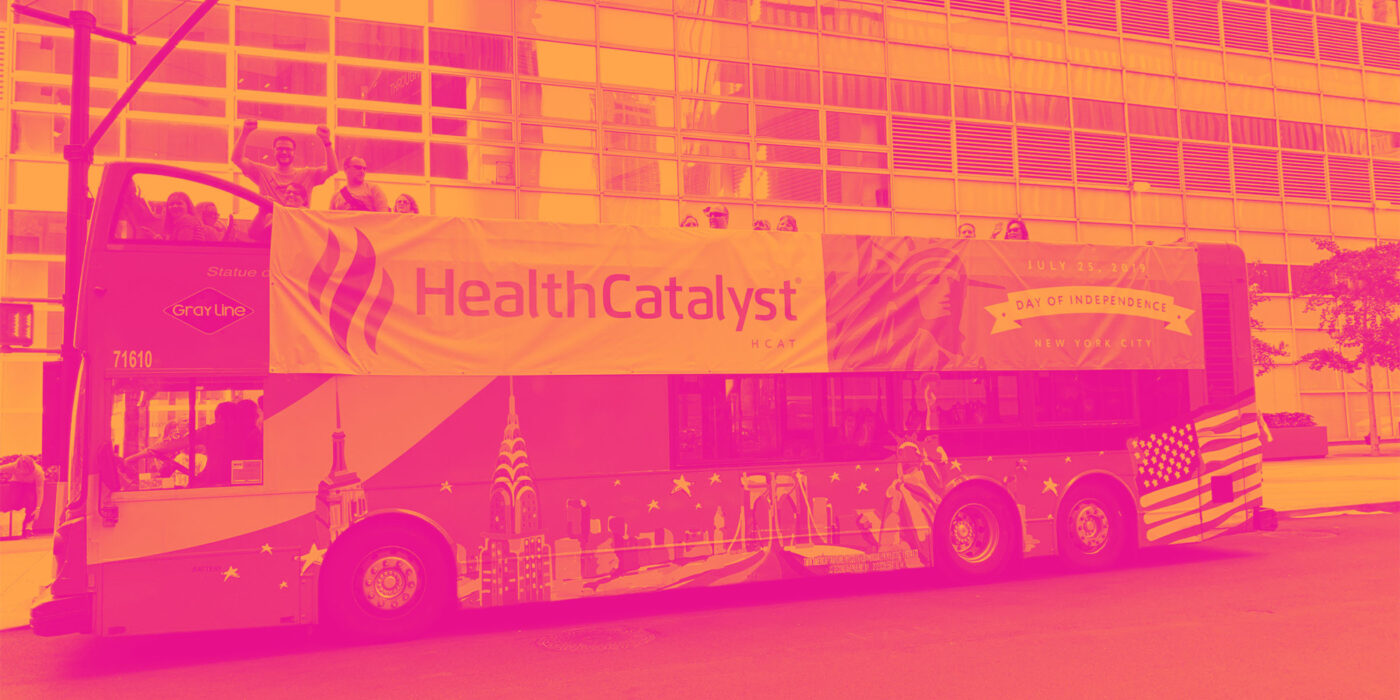
Healthcare data analytics company Health Catalyst (NASDAQ: HCAT) reported revenue ahead of Wall Street’s expectations in Q2 CY2026, but sales fell by 12.7% year on year to $70.49 million. On the other hand, next quarter’s revenue guidance of $55.5 million was less impressive, coming in 10.7% below analysts’ estimates. Its non-GAAP profit of $0.04 per share was in line with analysts’ consensus estimates.
Is now the time to buy HCAT? Find out in our full research report (it’s free for active Edge members).
Health Catalyst (HCAT) Q2 CY2026 Highlights:
- Revenue: $70.49 million vs analyst estimates of $69.05 million (12.7% year-on-year decline, 2.1% beat)
- Adjusted EPS: $0.04 vs analyst estimates of $0.03 (in line)
- Adjusted EBITDA: $9.92 million vs analyst estimates of $9.43 million (14.1% margin, 5.2% beat)
- The company dropped its revenue guidance for the full year to $247.5 million at the midpoint from $262.5 million, a 5.7% decrease
- EBITDA guidance for the full year is $18.25 million at the midpoint, below analyst estimates of $32.09 million
- Operating Margin: -51.8%, down from -46% in the same quarter last year
- Billings: $54.75 million at quarter end, down 28.1% year on year
- Market Capitalization: $170.7 million
StockStory’s Take
Health Catalyst’s second quarter was marked by a notable decline in sales, which management attributed primarily to the ongoing impact of client migrations and a reduction in lower-margin services. The company’s decision to divest Vitalware, its revenue cycle management business, was described by CEO Ben Albert as necessary to focus on areas of highest conviction, despite the near-term revenue impact. Albert acknowledged the structural challenges facing health systems and emphasized that the divestiture provided immediate benefits, including significant debt elimination and a cleaner balance sheet. Management’s tone was cautious, highlighting the early stages of a multiyear transformation and the need to navigate persistent revenue headwinds.
Looking ahead, Health Catalyst’s updated outlook is shaped by the removal of Vitalware, deliberate investments in proprietary technology, and a continued shift toward its core analytics products. CFO Jason Alger explained that the company will prioritize targeted investments in new products, AI-driven initiatives, and the Ignite platform, while working to streamline operations and retain key talent during this period of transition. Management cautioned that migration-related churn will continue to pressure results through 2027, but remains focused on building a sustainable business that addresses the evolving needs of health systems. As Alger stated, "We are continuing to work through the current churn dynamics, both show up in our numbers."
Key Insights from Management’s Remarks
Management’s remarks during the earnings call centered on the strategic rationale for the Vitalware divestiture, ongoing transformation efforts, and the structural headwinds impacting both the company and its health system clients.
- Vitalware divestiture completed: Health Catalyst closed the sale of its Vitalware business, citing the need to concentrate on core technology and analytics offerings rather than the increasingly competitive revenue cycle management (RCM) market.
- Debt fully repaid: Proceeds from the divestiture enabled the company to eliminate approximately $160 million in credit facility debt, reducing annual interest expense by an estimated $19 million and improving financial flexibility for future investments.
- Project Nexus restructuring: The company is executing on Project Nexus, a multi-phase initiative to fundamentally transform its operating model, streamline expenses, and align resources with long-term strategic priorities.
- Migration-driven margin pressure: Continued client migrations to the Ignite platform have resulted in higher near-term costs, including duplicate hosting and data loading expenses, which management expects to fluctuate in the short term but improve as migrations are completed.
- Healthcare industry headwinds: Management noted that persistent challenges such as eroding hospital margins, unfavorable payer mix, and rising labor and clinical costs are driving demand for cost-saving analytics and operational improvement solutions, areas in which Health Catalyst is intensifying its focus.
Drivers of Future Performance
Health Catalyst’s outlook is influenced by the realignment of its portfolio, continued investments in core technology, and ongoing migration-related churn.
- Core product investment: The company is increasing investment in analytics, proprietary intelligence products, and AI-driven automation, believing these areas will drive long-term growth and differentiation as health systems demand more efficient solutions.
- Operational transformation and expense control: Project Nexus is expected to yield cost savings, but management is also deliberately investing in talent retention and strategic initiatives, which may limit margin expansion in the near term.
- Churn and migration risks: Ongoing client migrations and associated churn, particularly related to the Ignite platform transition, are expected to weigh on revenue through the end of 2027, with full stabilization anticipated only after major migrations are completed and the services business is fully realigned.
Catalysts in Upcoming Quarters
Looking ahead, our analysts will be watching (1) progress on Project Nexus and the resulting cost savings, (2) the pace and impact of client migrations to the Ignite platform and related churn trends, and (3) the company’s ability to deliver new analytics and AI-driven products that resonate with health system clients. Additionally, we will monitor whether the company can maintain a strong balance sheet and adapt its services business to shifting customer needs.
Health Catalyst currently trades at $1.72, down from $2.30 just before the earnings. Is the company at an inflection point that warrants a buy or sell? Find out in our full research report (it’s free).
Stocks That Trumped Tariffs
ONE MORE THING: Top 5 Growth Stocks. The biggest stock winners almost always had one thing in common before they ran. Revenue growing like crazy. Meta. CrowdStrike. Broadcom. Our AI flagged all three. They returned 315%, 314%, and 455%, respectively.
Find out which 5 stocks it’s flagging this month — FREE. Get Our Top 5 Growth Stocks for Free HERE.
Stocks that have made our list include now familiar names such as Nvidia (+1,460% between June 2020 and June 2025) as well as under-the-radar businesses like the once-small-cap company Exlservice (+271% between June 2020 and June 2025). Find your next big winner with StockStory today.