What Happened?
A number of stocks fell in the afternoon session after President Trump declared the Iran ceasefire "over" and threatened renewed strikes, sending oil higher and bond yields up in a session that punished high-multiple tech.
Software companies are quintessential long-duration growth stocks, valued on cash flows expected far into the future, which makes them acutely sensitive to interest rates.
When a crude spike revives inflation fears and pushes government bond yields higher, as it did, the discount rate applied to those distant earnings rises and rich software valuations compress fastest.
The move was amplified by a risk-off rotation: with geopolitical tensions flaring, investors rotate out of the market's most expensive, momentum-driven corner and into energy and defensives. Though software has little direct exposure to oil as an input, its valuation math and its role as a funding source when investors de-risk make it a casualty of these shocks.
The stock market overreacts to news, and big price drops can present good opportunities to buy high-quality stocks.
Among others, the following stocks were impacted:
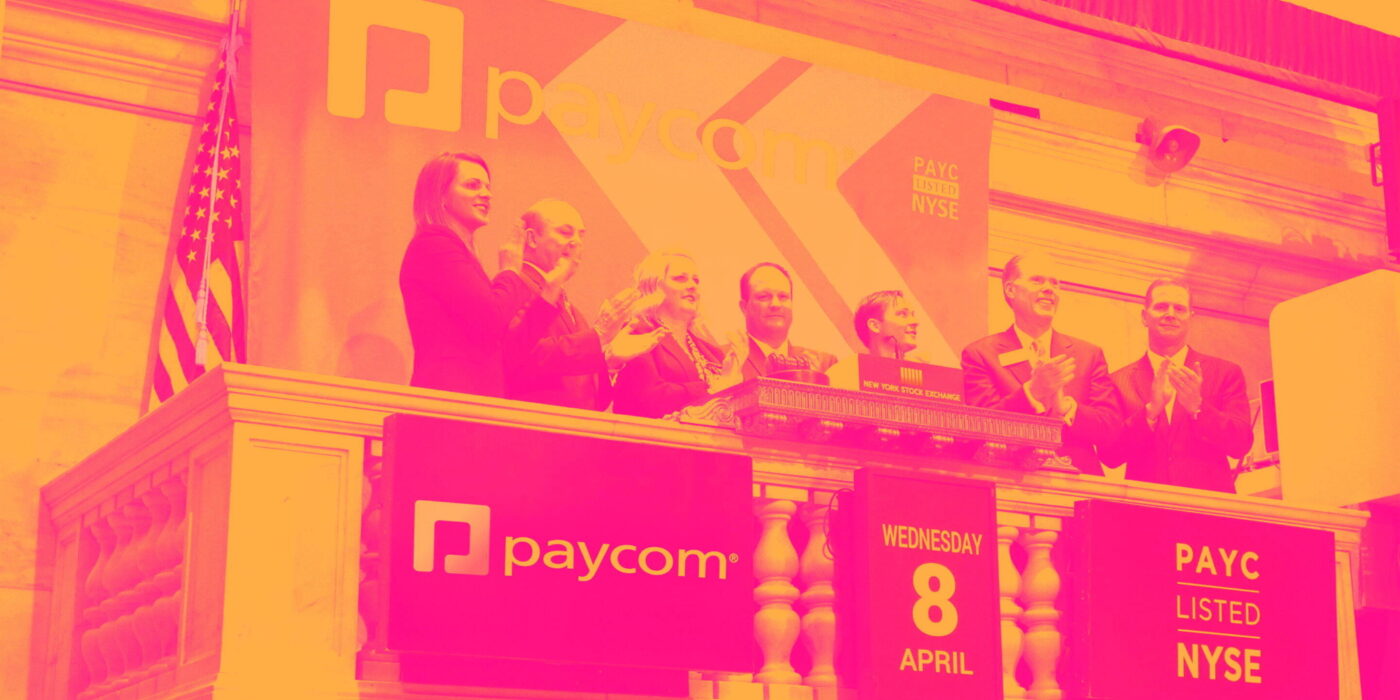
- HR Software company Paycom (NYSE: PAYC) fell 4.3%. Is now the time to buy Paycom? Access our full analysis report here, it’s free.
- Finance and Accounting Software company Workday (NASDAQ: WDAY) fell 4.3%. Is now the time to buy Workday? Access our full analysis report here, it’s free.
- Payments Software company Flywire (NASDAQ: FLYW) fell 4.1%. Is now the time to buy Flywire? Access our full analysis report here, it’s free.
Zooming In On Workday (WDAY)
Workday’s shares are very volatile and have had 25 moves greater than 5% over the last year. In that context, today’s move indicates the market considers this news meaningful but not something that would fundamentally change its perception of the business.
The previous big move we wrote about was about 22 hours ago when the stock gained 4% as investors continued to rotate out of high-flying semiconductors into beaten-down software stocks.
DigitalOcean's blowout preliminary results also supported the improved appetite as it showed proof that AI demand is converting into real, contracted revenue. The clearest signal is at the index level: the iShares software ETF (IGV) climbed roughly 7% over eight sessions even as the semiconductor SOXX fell ~8.5%. Microsoft rose ~3% on the week (after launching its $2.5B "Frontier" AI-services unit).
ServiceNow and Salesforce each gained around +4%. DigitalOcean pre-announced that remaining performance obligations (RPO) would exceed $800M, more than 10x year-over-year and up over $550M in the quarter, driven by multiple new nine-figure AI inference contracts, with average contract life stretching from 1.6 to over three years. Revenue growth was guided to accelerate to ~29% (from a prior 24–25% guide), and margins to the high end. Coming after Q1's 221% jump in AI-customer ARR, it's hard evidence that AI spend is landing as durable, contracted backlog, not just usage that can evaporate.
Workday is down 33.1% since the beginning of the year, and at $137.68 per share, it is trading 44.4% below its 52-week high of $247.69 from September 2025. Investors who bought $1,000 worth of Workday’s shares 5 years ago would now be looking at only $580.71.
ONE MORE THING: 3 Hidden Platforms Growing 3X Faster than Amazon, Google, and PayPal. Amazon, Google, and Meta all followed the same playbook: Dominate an ignored market. Build an unbeatable moat. Scale until you’re unstoppable.
These three platforms are running that exact playbook right now. The early investors in Amazon made fortunes. The early investors in these could do the same. Get All 3 Stocks Here for FREE.