Wrapping up Q1 earnings, we look at the numbers and key takeaways for the cybersecurity stocks, including SentinelOne (NYSE: S) and its peers.
Cybersecurity continues to be one of the fastest-growing segments within software for good reason. Almost every company is slowly finding itself becoming a technology company and facing rising cybersecurity risks. Businesses are accelerating adoption of cloud-based software, moving data and applications into the cloud to save costs while improving performance. This migration has opened them to a multitude of new threats, like employees accessing data via their smartphone while on an open network, or logging into a web-based interface from a laptop in a new location.
The 9 cybersecurity stocks we track reported a satisfactory Q1. As a group, revenues beat analysts’ consensus estimates by 1.6% while next quarter’s revenue guidance was in line.
Thankfully, share prices of the companies have been resilient as they are up 5.1% on average since the latest earnings results.
Weakest Q1: SentinelOne (NYSE: S)
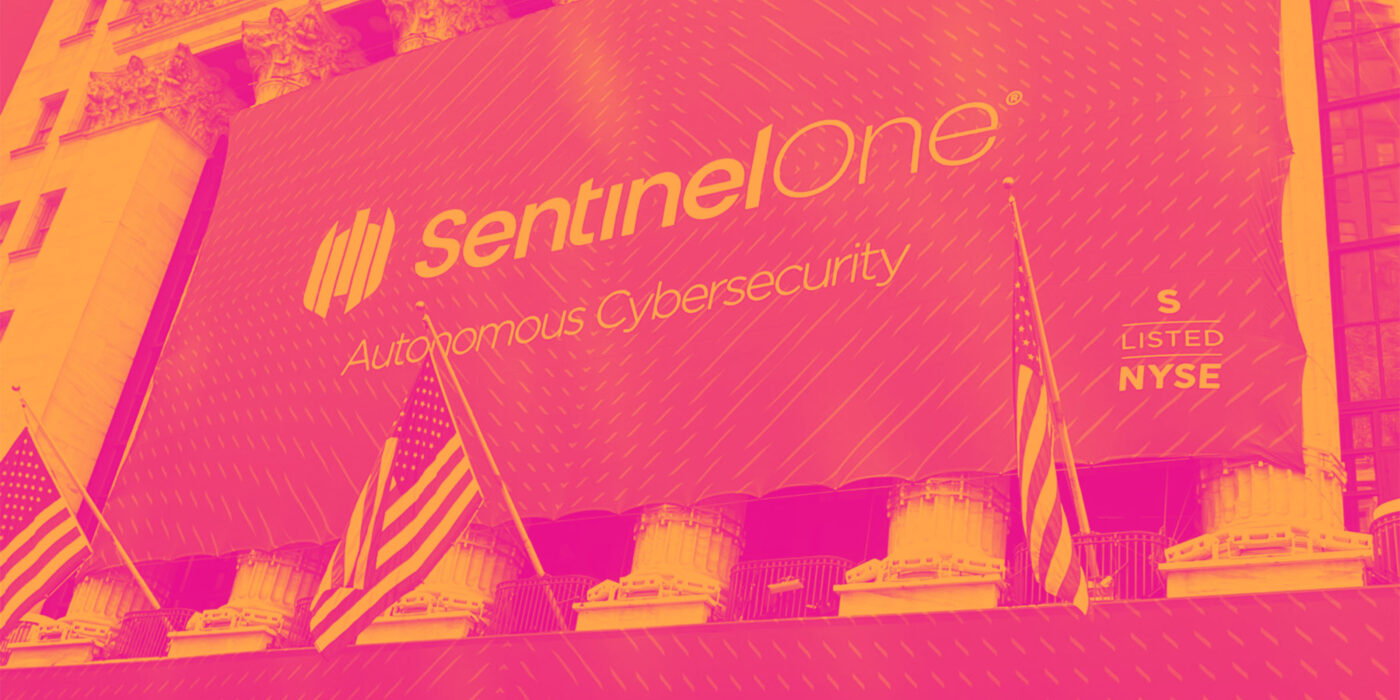
Built on the principle of "fighting machine with machine," SentinelOne (NYSE: S) provides an AI-powered cybersecurity platform that autonomously prevents, detects, and responds to threats across endpoints, cloud workloads, and identity systems.
SentinelOne reported revenues of $276.7 million, up 20.8% year on year. This print was in line with analysts’ expectations, but overall, it was a slower quarter for the company with EPS guidance for next quarter missing analysts’ expectations and a significant miss of analysts’ billings estimates.
“We had a solid start to the year, highlighted by record net new ARR growth and a landmark milestone as our emerging solutions reached half of our total company ARR,” said Tomer Weingarten, CEO of SentinelOne.
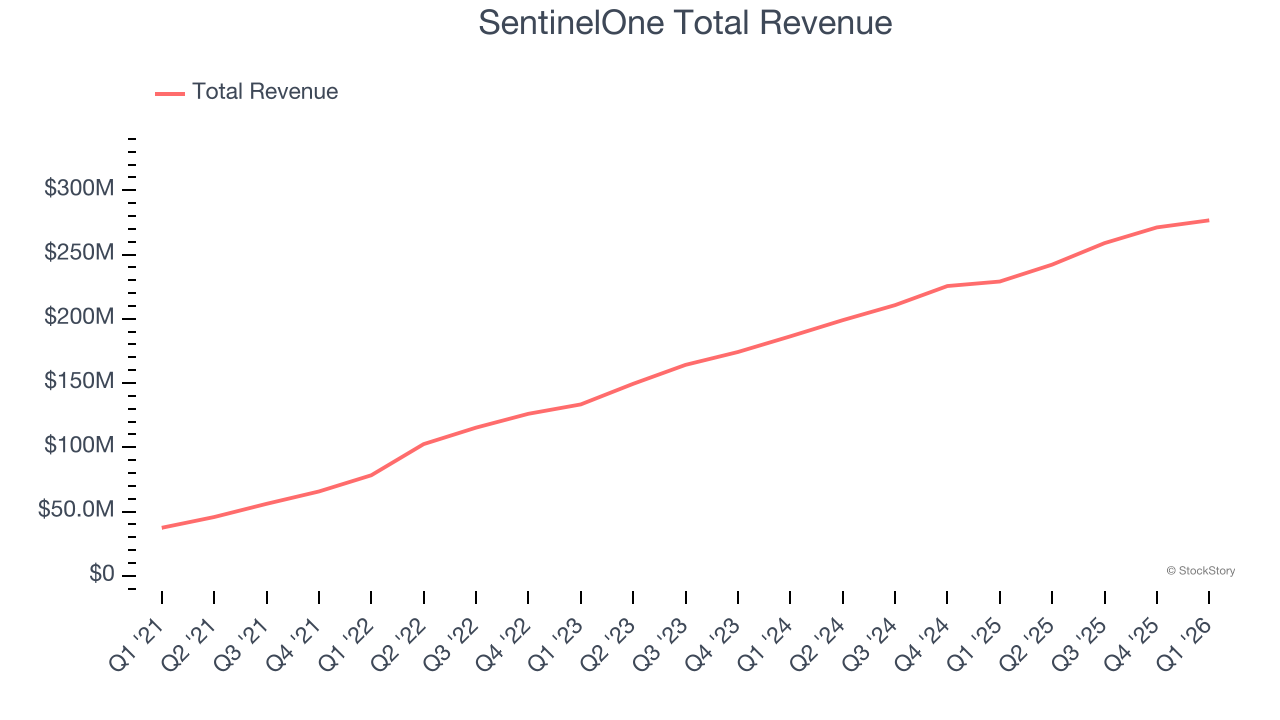
SentinelOne delivered the weakest performance against analyst estimates, weakest guidance update, and weakest full-year guidance update of the whole group. The company added 35 enterprise customers paying more than $100,000 annually to reach a total of 1,702. The market seems disappointed with the results as the stock is down 17.2% since reporting and currently trades at $14.92.
Is now the time to buy SentinelOne? Access our full analysis of the earnings results here, it’s free.
Best Q1: Palo Alto Networks (NASDAQ: PANW)
Founded in 2005 by security visionary Nir Zuk who sought to reimagine firewall technology, Palo Alto Networks (NASDAQ: PANW) provides AI-powered cybersecurity platforms that protect organizations' networks, clouds, and endpoints from sophisticated threats.
Palo Alto Networks reported revenues of $3.00 billion, up 31.1% year on year, outperforming analysts’ expectations by 2%. The business had a very strong quarter with a solid beat of analysts’ billings estimates and full-year EPS guidance exceeding analysts’ expectations.
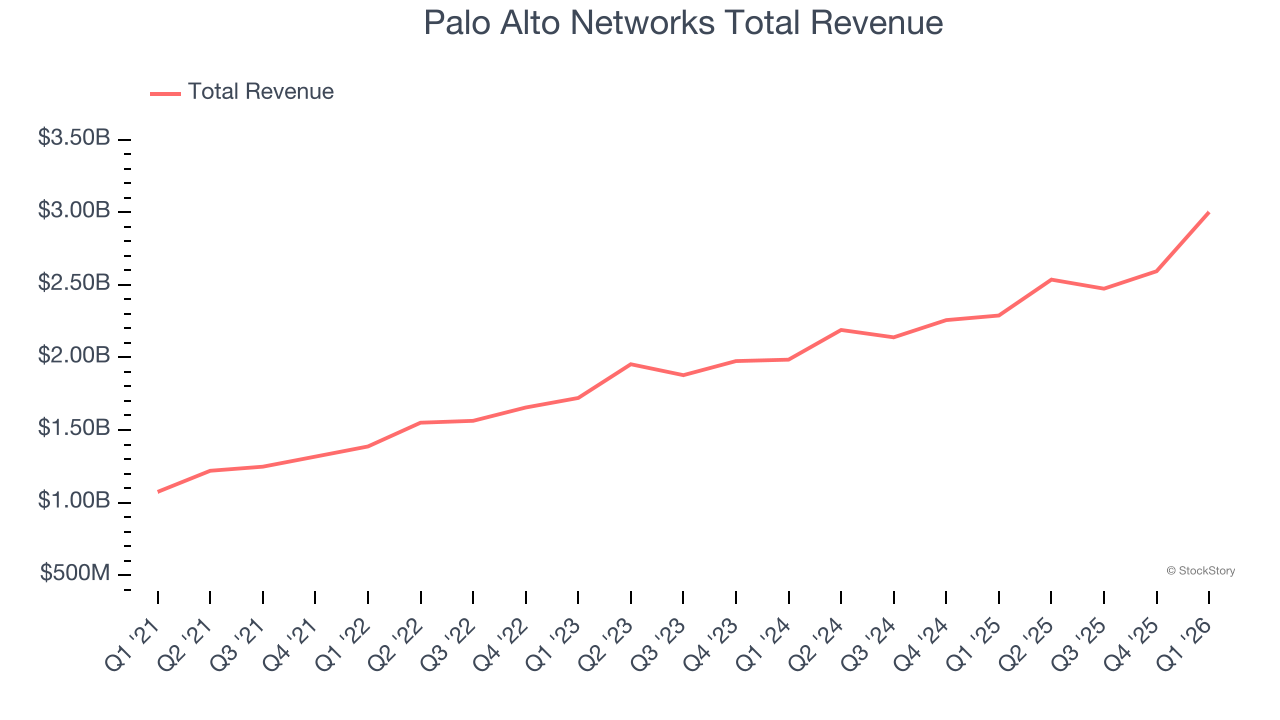
Palo Alto Networks scored the highest guidance raise, fastest revenue growth, and highest full-year guidance raise among its peers. Although it had a fine quarter compared to its peers, the market seems unhappy with the results as the stock is down 3.3% since reporting. It currently trades at $287.38.
Is now the time to buy Palo Alto Networks? Access our full analysis of the earnings results here, it’s free.
Rapid7 (NASDAQ: RPD)
With its name inspired by the need for quick responses to cyber threats, Rapid7 (NASDAQ: RPD) provides cybersecurity software and services that help organizations detect vulnerabilities, monitor threats, and respond to security incidents.
Rapid7 reported revenues of $209.7 million, flat year on year, exceeding analysts’ expectations by 0.8%. Still, it was a slower quarter as it posted EPS guidance for next quarter missing analysts’ expectations significantly.
Rapid7 delivered the slowest revenue growth in the group. Interestingly, the stock is up 1.3% since the results and currently trades at $6.77.
Read our full analysis of Rapid7’s results here.
Qualys (NASDAQ: QLYS)
Originally developed to address the growing complexity of IT security in the cloud era, Qualys (NASDAQ: QLYS) provides a cloud-based platform that helps organizations identify, manage, and protect their IT assets from cyber threats across on-premises, cloud, and mobile environments.
Qualys reported revenues of $175.6 million, up 9.8% year on year. This result beat analysts’ expectations by 1.1%. It was a strong quarter as it also put up an impressive beat of analysts’ EBITDA estimates and full-year EPS guidance exceeding analysts’ expectations.
The stock is up 20.8% since reporting and currently trades at $111.29.
Read our full, actionable report on Qualys here, it’s free.
Varonis Systems (NASDAQ: VRNS)
Beginning with protecting Windows file shares in 2005 and evolving into a comprehensive security platform, Varonis Systems (NASDAQ: VRNS) provides data security software that helps organizations protect sensitive information, detect threats, and comply with privacy regulations.
Varonis Systems reported revenues of $173.1 million, up 26.9% year on year. This print topped analysts’ expectations by 4.6%. Overall, it was a strong quarter as it also produced a solid beat of analysts’ billings estimates and full-year EPS guidance exceeding analysts’ expectations.
Varonis Systems scored the biggest analyst estimate beat among its peers. The stock is up 31.3% since reporting and currently trades at $33.40.
Read our full, actionable report on Varonis Systems here, it’s free.
Market Update
Late in 2025 into early 2026, there was hand-wringing around artificial intelligence. For software companies, the fear was that AI would erode pricing power and compress margins as new tools made it easier to replicate what once required expensive enterprise platforms. Crypto investors had their own version of the same anxiety: if AI agents could trade, allocate capital, and manage wallets autonomously, what exactly was the long-term value of today’s crypto infrastructure?
These concerns triggered a noticeable rotation away from these sectors and into safer havens. But markets rarely dwell on one narrative for long. Spring 2026 came, and the focus shifted abruptly from technological disruption to geopolitical risk. The US’ conflict with Iran became the dominant driver of market psychology, and when geopolitics takes center stage, the script changes quickly. Investors stop debating growth rates and start worrying about oil supply, inflation, and global stability.
Want to invest in winners with rock-solid fundamentals? Check out our Top 5 Growth Stocks and add them to your watchlist. These companies are poised for growth regardless of the political or macroeconomic climate.
StockStory’s analyst team — all seasoned professional investors — uses quantitative analysis and automation to deliver market-beating insights faster and with higher quality.