Financial advisory firm Lazard (NYSE: LAZ) reported revenue ahead of Wall Street’s expectations in Q1 CY2026, with sales up 21.2% year on year to $779.4 million. Its non-GAAP profit of $0.42 per share was 17.2% below analysts’ consensus estimates.
Is now the time to buy Lazard? Find out by accessing our full research report, it’s free.
Lazard (LAZ) Q1 CY2026 Highlights:
- Assets Under Management: $259.2 billion vs analyst estimates of $258.9 billion (14% year-on-year growth, in line)
- Revenue: $779.4 million vs analyst estimates of $707.7 million (21.2% year-on-year growth, 10.1% beat)
- Pre-tax Profit: $89.57 million (11.5% margin)
- Adjusted EPS: $0.42 vs analyst expectations of $0.51 (17.2% miss)
- Market Capitalization: $4.55 billion
"The acquisition of Campbell Lutyens is a meaningful step in Lazard's long‑term strategy to build a more productive, resilient, and growth‑oriented firm," said Peter R. Orszag, CEO and Chairman of Lazard.
Company Overview
Tracing its roots back to 1848 when it began as a dry goods merchant in New Orleans, Lazard (NYSE: LAZ) is a global financial advisory and asset management firm that provides strategic advice to corporations, governments, institutions, and wealthy individuals.
Revenue Growth
Examining a company’s long-term performance can provide clues about its quality. Any business can have short-term success, but a top-tier one grows for years. Over the last five years, Lazard grew its revenue at a sluggish 3.9% compounded annual growth rate. This wasn’t a great result compared to the rest of the financials sector, but there are still things to like about Lazard.
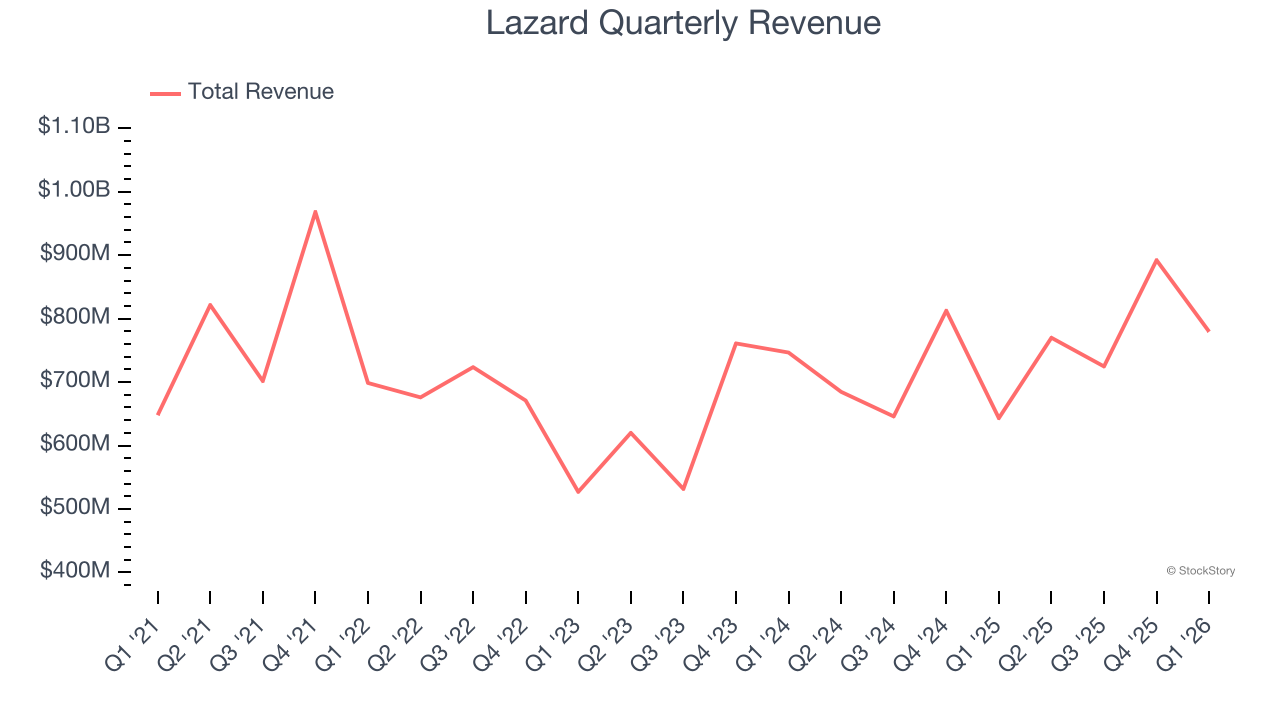
We at StockStory place the most emphasis on long-term growth, but within financials, a half-decade historical view may miss recent interest rate changes, market returns, and industry trends. Lazard’s annualized revenue growth of 9.1% over the last two years is above its five-year trend, suggesting some bright spots. 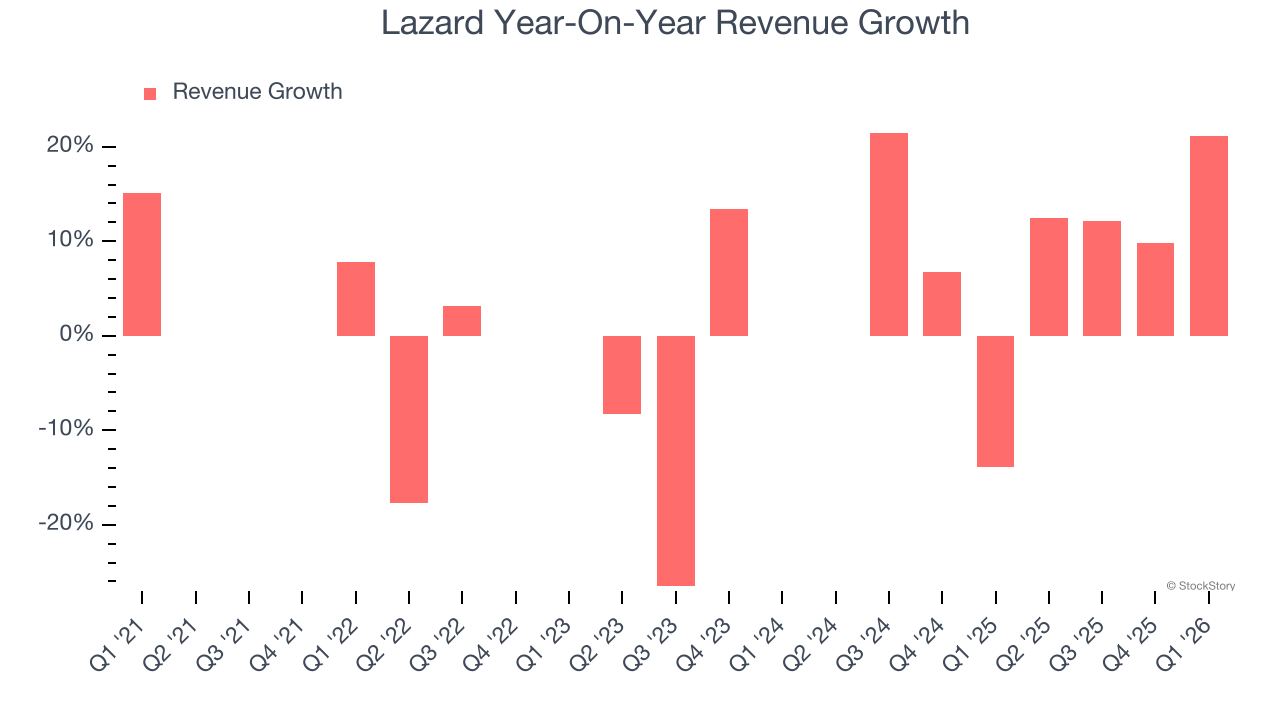 Note: Quarters not shown were determined to be outliers, impacted by outsized investment gains/losses that are not indicative of the recurring fundamentals of the business.
This quarter, Lazard reported robust year-on-year revenue growth of 21.2%, and its $779.4 million of revenue topped Wall Street estimates by 10.1%.
ONE MORE THING: The $21 AI Application Stock Wall Street Forgot. While Wall Street obsesses over who’s building AI, one company is already using it to print money. And nobody’s paying attention.
AI chip stocks trade at ridiculous valuations. This company processes a trillion consumer signals monthly using AI and trades at a third of the price. The gap won’t last. The institutions will figure it out. You need to see this first. Read the FREE Report Before They Notice.
Assets Under Management (AUM)
Assets Under Management (AUM) is the total capital a firm oversees or manages on behalf of clients. Fees on this AUM, typically a small percentage, are contractually recurring and provide a high level of stability to revenue even if investment performance lags (although too much poor investment performance eventually hurts fundraising ability).
Lazard’s AUM has grown at an annual rate of 1.2% over the last five years, much worse than the broader financials industry and slower than its total revenue. When analyzing Lazard’s AUM over the last two years, we can see that growth accelerated to 3.1% annually. Fundraising or short-term investment performance were net detractors to the company over this shorter period since assets grew slower than total revenue. That said, assets aren't the be-all and end-all due to their unpredictable and cyclical nature.
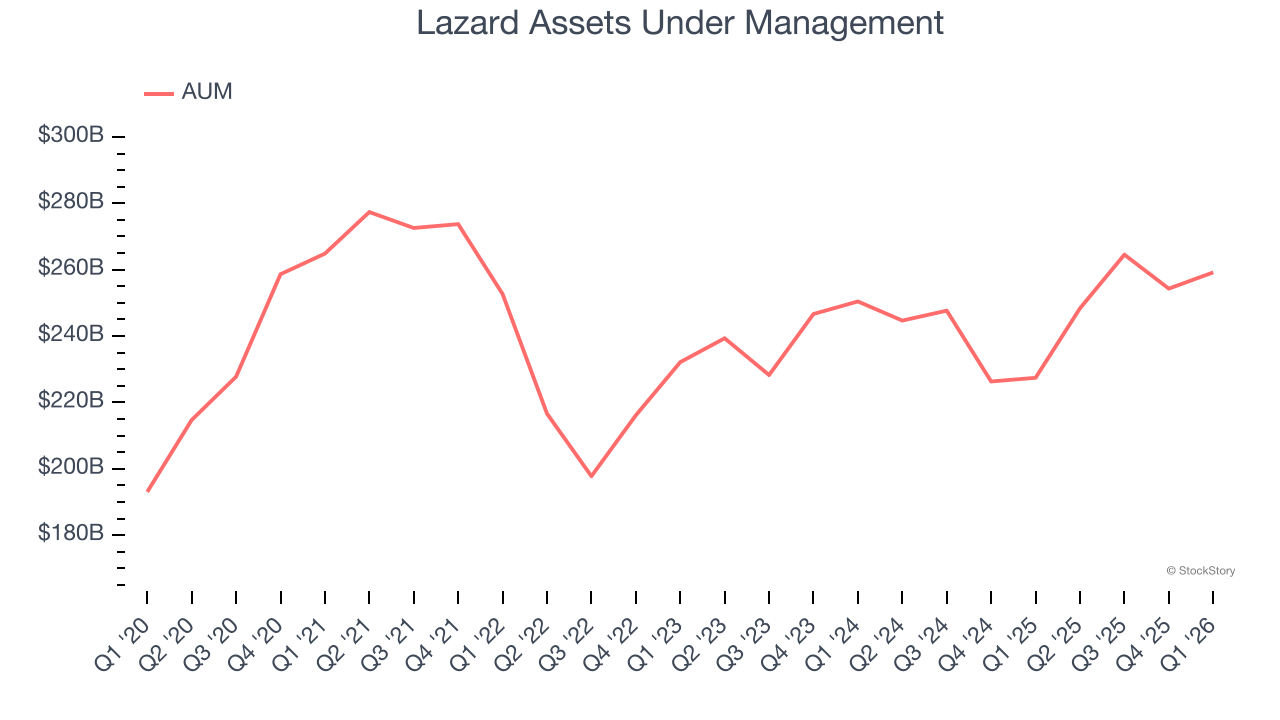
Lazard’s AUM punched in at $259.2 billion this quarter, meeting analysts’ expectations. This print was 14% higher than the same quarter last year.
Key Takeaways from Lazard’s Q1 Results
We were impressed by how significantly Lazard blew past analysts’ revenue expectations this quarter. On the other hand, its EPS missed. Overall, this was a mixed quarter. The stock remained flat at $48.39 immediately after reporting.
Should you buy the stock or not? If you’re making that decision, you should consider the bigger picture of valuation, business qualities, as well as the latest earnings. We cover that in our actionable full research report which you can read here (it’s free).