As the craze of earnings season draws to a close, here’s a look back at some of the most exciting (and some less so) results from Q4. Today, we are looking at medical devices & supplies - cardiology, neurology, vascular stocks, starting with Artivion (NYSE: AORT).
The medical devices and supplies industry, particularly in the fields of cardiology, neurology, and vascular care, benefits from a business model that balances innovation with relatively predictable revenue streams. These companies focus on developing life-saving devices such as stents, pacemakers, neurostimulation implants, and vascular access tools, which address critical and often chronic conditions. The recurring need for these devices, coupled with growing global demand for advanced treatments, provides stability and opportunities for long-term growth. However, the industry faces hurdles such as high research and development costs, rigorous regulatory approval processes, and reliance on reimbursement from healthcare systems, which can exert downward pressure on pricing. Looking ahead, the industry is positioned to benefit from tailwinds such as aging populations (which tend to have higher rates of disease) and technological advancements like minimally invasive procedures and connected devices that improve patient monitoring and outcomes. Innovations in robotic-assisted surgery and AI-driven diagnostics are also expected to accelerate adoption and expand treatment capabilities. However, potential headwinds include pricing pressures stemming from value-based care models and continued complexity changing from navigating regulatory frameworks that may prioritize further lowering healthcare costs.
The 4 medical devices & supplies - cardiology, neurology, vascular stocks we track reported a strong Q4. As a group, revenues beat analysts’ consensus estimates by 1.5%.
Amidst this news, share prices of the companies have had a rough stretch. On average, they are down 13.2% since the latest earnings results.
Weakest Q4: Artivion (NYSE: AORT)
Formerly known as CryoLife until its 2022 rebranding, Artivion (NYSE: AORT) develops and manufactures medical devices and preserves human tissues used in cardiac and vascular surgical procedures for patients with aortic disease.
Artivion reported revenues of $116 million, up 19.2% year on year. This print fell short of analysts’ expectations by 0.8%. Overall, it was a slower quarter for the company with EPS in line with analysts’ estimates and a slight miss of analysts’ revenue estimates.
"We are very pleased with our strong performance for the full year 2025 as we drove 13% adjusted constant currency revenue growth and 26% adjusted EBITDA growth, while making substantial progress in advancing our Aortic focused product development pipeline. Our success continued through the fourth quarter, during which revenue growth was driven by year-over-year growth in stent grafts of 44%, On-X of 25%, and preservation services of 6%, all compared to the fourth quarter of 2024. On an adjusted constant currency basis, fourth quarter year-over-year stent grafts, On-X, and preservation services, grew 36%, 24%, and 6% respectively," said Pat Mackin, Chairman, President, and Chief Executive Officer.
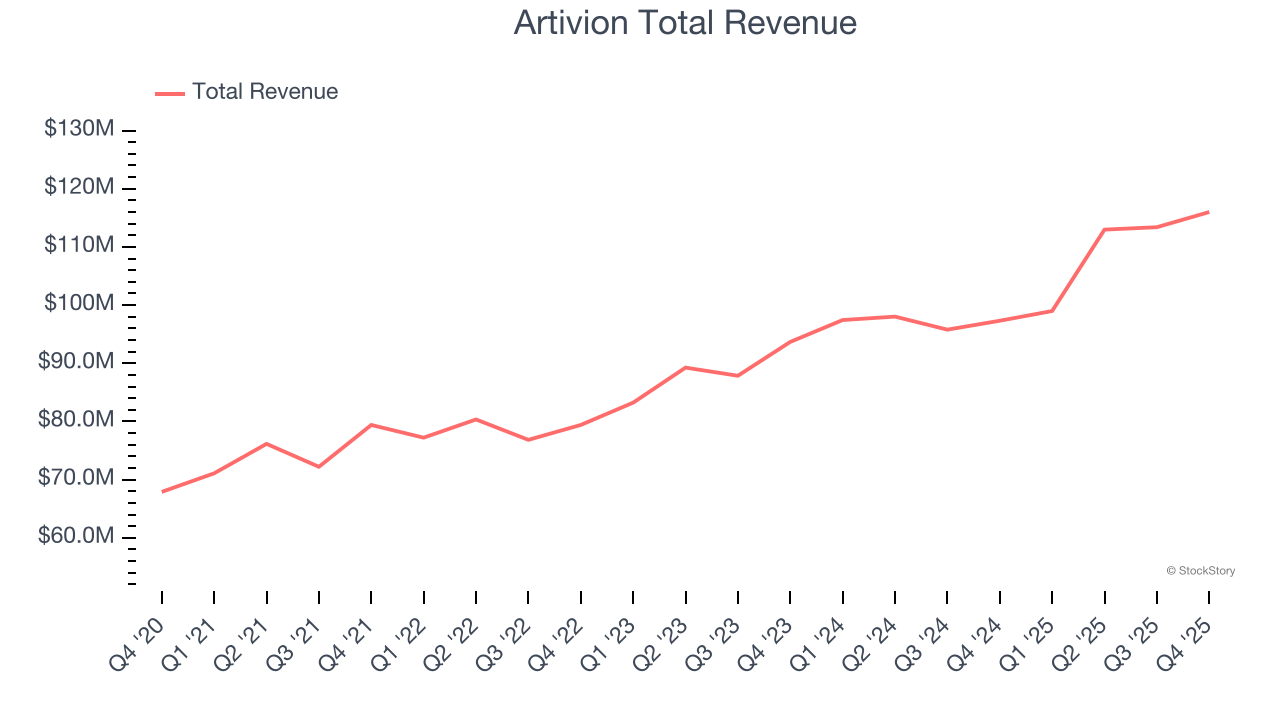
Artivion delivered the weakest performance against analyst estimates and weakest full-year guidance update of the whole group. Unsurprisingly, the stock is down 16% since reporting and currently trades at $34.15.
Read our full report on Artivion here, it’s free.
Best Q4: Penumbra (NYSE: PEN)
Founded in 2004 to address challenging medical conditions with significant unmet needs, Penumbra (NYSE: PEN) develops and manufactures innovative medical devices for treating vascular diseases and providing immersive healthcare rehabilitation solutions.
Penumbra reported revenues of $385.4 million, up 22.1% year on year, outperforming analysts’ expectations by 4.8%. The business had an exceptional quarter with a solid beat of analysts’ revenue and EPS estimates.
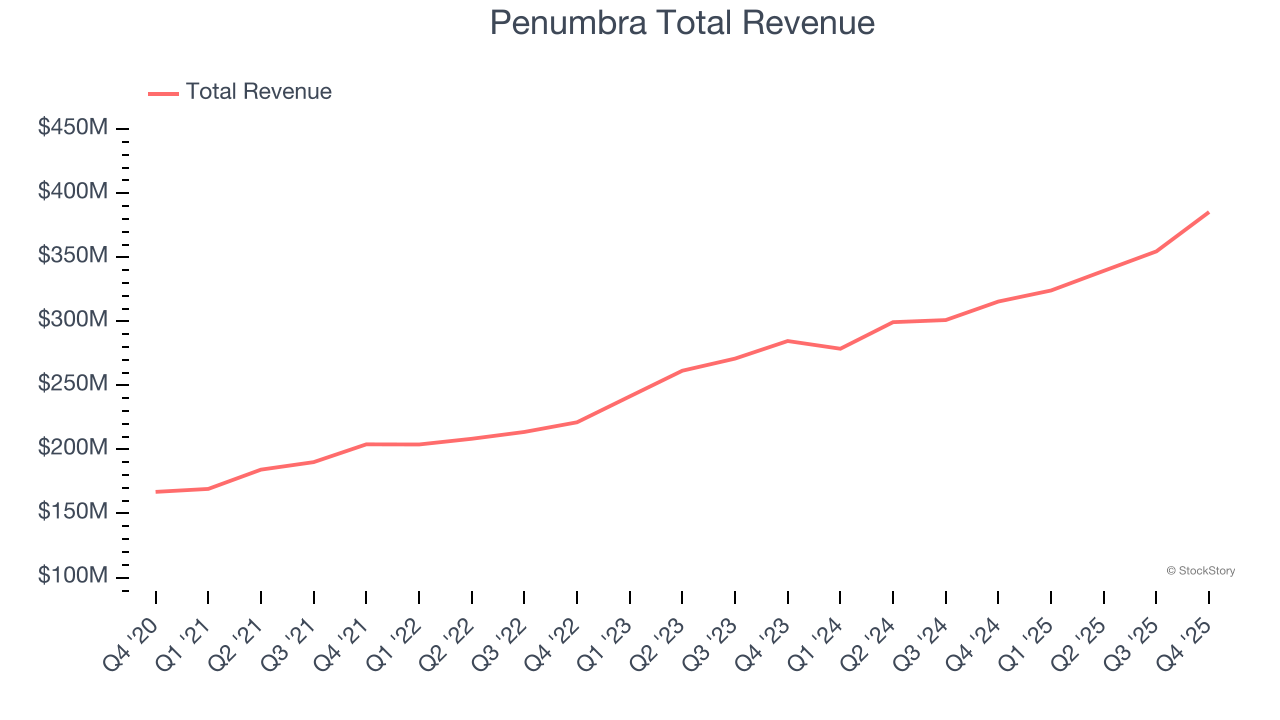
Penumbra achieved the biggest analyst estimates beat and fastest revenue growth among its peers. Although it had a fine quarter compared to its peers, the market seems unhappy with the results as the stock is down 3.1% since reporting. It currently trades at $329.07.
Is now the time to buy Penumbra? Access our full analysis of the earnings results here, it’s free.
ICU Medical (NASDAQ: ICUI)
Founded in 1984 and named for its initial focus on intensive care units, ICU Medical (NASDAQ: ICUI) develops and manufactures medical products for infusion therapy, vascular access, and vital care applications used in hospitals and other healthcare settings.
ICU Medical reported revenues of $535.9 million, down 13.8% year on year, exceeding analysts’ expectations by 1%. It may have had the worst quarter among its peers, but its results were still good as it also locked in a beat of analysts’ EPS estimates and a narrow beat of analysts’ full-year EPS guidance estimates.
ICU Medical delivered the slowest revenue growth in the group. As expected, the stock is down 16.3% since the results and currently trades at $125.26.
Read our full analysis of ICU Medical’s results here.
Merit Medical Systems (NASDAQ: MMSI)
Founded in 1987 and now offering over 1,700 patented products across global markets, Merit Medical Systems (NASDAQ: MMSI) manufactures and markets specialized medical devices used in minimally invasive procedures for cardiology, radiology, oncology, critical care, and endoscopy.
Merit Medical Systems reported revenues of $393.9 million, up 10.9% year on year. This print topped analysts’ expectations by 1%. Overall, it was a strong quarter as it also recorded a beat of analysts’ EPS estimates and full-year revenue guidance slightly topping analysts’ expectations.
Merit Medical Systems delivered the highest full-year guidance raise among its peers. The stock is down 17.3% since reporting and currently trades at $68.19.
Read our full, actionable report on Merit Medical Systems here, it’s free.
Market Update
Late in 2025 into early 2026, there was hand wringing around artificial intelligence. For software companies, the fear was that AI would erode pricing power and compress margins as new tools made it easier to replicate what once required expensive enterprise platforms. Crypto investors had their own version of the same anxiety: if AI agents could trade, allocate capital, and manage wallets autonomously, what exactly was the long-term value of today’s crypto infrastructure?
These concerns triggered a noticeable rotation away from these sectors and into safer havens. But markets rarely dwell on one narrative for long. Spring 2026 came, and the focus shifted abruptly from technological disruption to geopolitical risk. The US’ conflict with Iran became the dominant driver of market psychology, and when geopolitics takes center stage, the script changes quickly. Investors stop debating growth rates and start worrying about oil supply, inflation, and global stability.
Want to invest in winners with rock-solid fundamentals? Check out our Top 5 Growth Stocks and add them to your watchlist. These companies are poised for growth regardless of the political or macroeconomic climate.
StockStory’s analyst team — all seasoned professional investors — uses quantitative analysis and automation to deliver market-beating insights faster and with higher quality.