Quarterly earnings results are a good time to check in on a company’s progress, especially compared to its peers in the same sector. Today we are looking at Coherent (NYSE: COHR) and the best and worst performers in the electronic components & manufacturing industry.
The sector could see higher demand as the prevalence of advanced electronics increases in industries such as automotive, healthcare, aerospace, and computing. The high-performance components and contract manufacturing expertise required for autonomous vehicles and cloud computing datacenters, for instance, will benefit companies in the space. However, headwinds include geopolitical risks, particularly U.S.-China trade tensions that could disrupt component sourcing and production as the Trump administration takes an increasingly antagonizing stance on foreign relations. Additionally, stringent environmental regulations on e-waste and emissions could force the industry to pivot in potentially costly ways.
The 10 electronic components & manufacturing stocks we track reported a very strong Q4. As a group, revenues beat analysts’ consensus estimates by 2.8% while next quarter’s revenue guidance was in line.
Luckily, electronic components & manufacturing stocks have performed well with share prices up 17.3% on average since the latest earnings results.
Coherent (NYSE: COHR)
Created through the 2022 rebranding of II-VI Incorporated, a company with roots dating back to 1971, Coherent (NYSE: COHR) develops and manufactures advanced materials, lasers, and optical components for applications ranging from telecommunications to industrial manufacturing.
Coherent reported revenues of $1.69 billion, up 17.5% year on year. This print exceeded analysts’ expectations by 2.9%. Overall, it was an exceptional quarter for the company with revenue guidance for next quarter exceeding analysts’ expectations and an impressive beat of analysts’ EPS guidance for next quarter estimates.
Jim Anderson, CEO, said, “We delivered strong year-over-year revenue growth in the December quarter, driven by another quarter of strong demand in our datacenter and communications segment. We expect continued strong growth in the second-half of fiscal 2026 and throughout fiscal 2027 based on strong datacenter and communications demand and our continued production capacity expansion along with improving demand in our Industrial segment.”
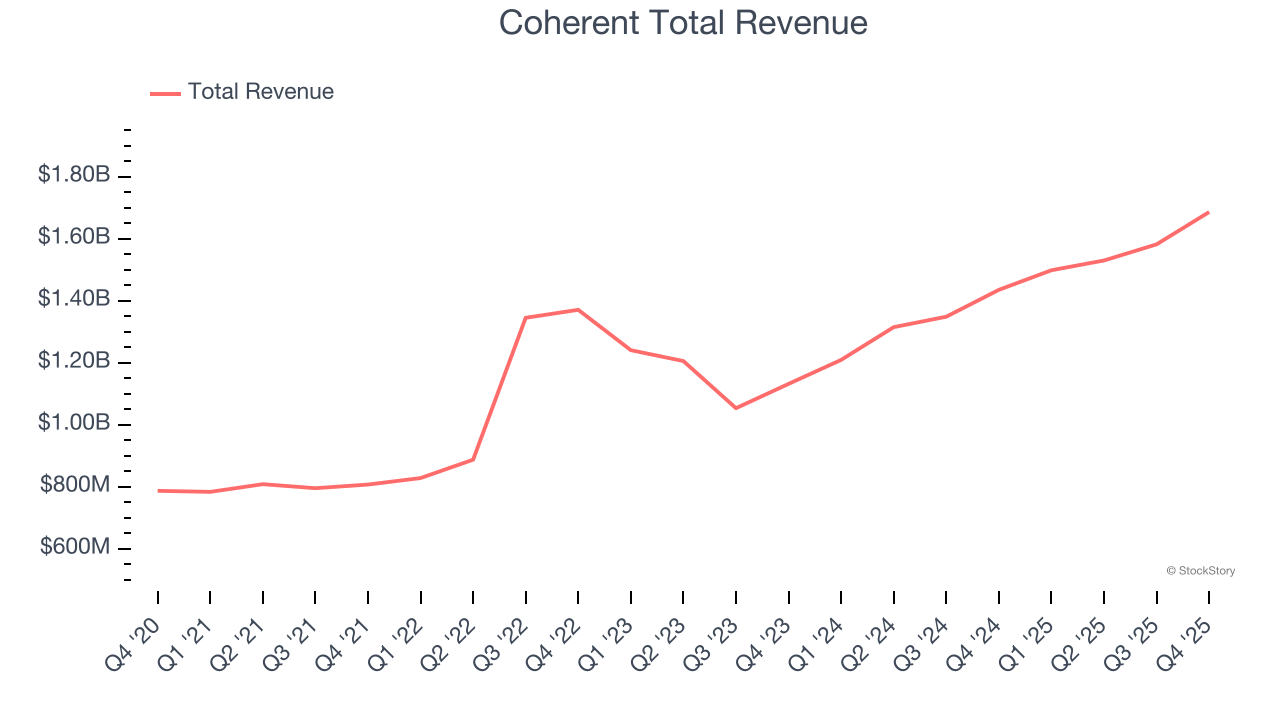
Interestingly, the stock is up 55.9% since reporting and currently trades at $328.90.
We think Coherent is a good business, but is it a buy today? Read our full report here, it’s free.
Best Q4: Jabil (NYSE: JBL)
With manufacturing facilities spanning the globe from China to Mexico to the United States, Jabil (NYSE: JBL) provides electronics design, manufacturing, and supply chain solutions to companies across various industries, from healthcare to automotive to cloud computing.
Jabil reported revenues of $8.28 billion, up 23.1% year on year, outperforming analysts’ expectations by 6.8%. The business had a stunning quarter with a solid beat of analysts’ revenue estimates and revenue guidance for next quarter exceeding analysts’ expectations.
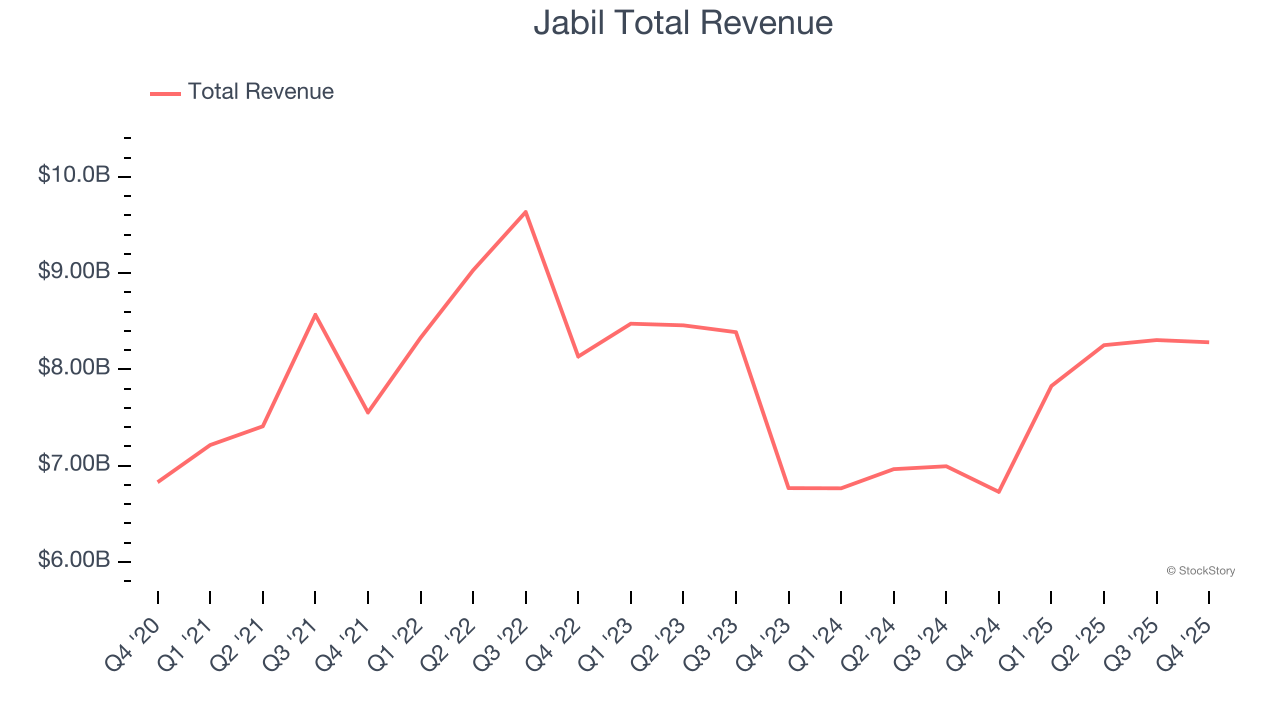
Jabil delivered the biggest analyst estimates beat among its peers. The market seems happy with the results as the stock is up 17.3% since reporting. It currently trades at $307.62.
Is now the time to buy Jabil? Access our full analysis of the earnings results here, it’s free.
Slowest Q4: Rogers (NYSE: ROG)
With roots dating back to 1832, making it one of America's oldest continuously operating companies, Rogers (NYSE: ROG) designs and manufactures specialized engineered materials and components used in electric vehicles, telecommunications, renewable energy, and other high-performance applications.
Rogers reported revenues of $201.5 million, up 4.8% year on year, exceeding analysts’ expectations by 2.5%. Still, it was a slower quarter as it posted revenue guidance for next quarter missing analysts’ expectations and a significant miss of analysts’ EPS guidance for next quarter estimates.
Rogers delivered the slowest revenue growth in the group. Interestingly, the stock is up 15.4% since the results and currently trades at $119.
Read our full analysis of Rogers’s results here.
Amphenol (NYSE: APH)
With over 90 years of connecting the world's technologies, Amphenol (NYSE: APH) designs and manufactures connectors, cables, sensors, and interconnect systems that enable electrical and electronic connections across virtually every industry.
Amphenol reported revenues of $6.44 billion, up 49.1% year on year. This result beat analysts’ expectations by 3.3%. Overall, it was a very strong quarter as it also put up revenue guidance for next quarter exceeding analysts’ expectations and a solid beat of analysts’ revenue estimates.
Amphenol achieved the fastest revenue growth among its peers. The stock is down 10.4% since reporting and currently trades at $148.96.
Read our full, actionable report on Amphenol here, it’s free.
CTS (NYSE: CTS)
With roots dating back to 1896 and a global manufacturing footprint, CTS (NYSE: CTS) designs and manufactures sensors, connectivity components, and actuators for aerospace, defense, industrial, medical, and transportation markets.
CTS reported revenues of $137.3 million, up 8.5% year on year. This number topped analysts’ expectations by 1%. More broadly, it was a mixed quarter as it also produced a beat of analysts’ EPS estimates but a slight miss of analysts’ full-year EPS guidance estimates.
CTS delivered the highest full-year guidance raise among its peers. The stock is down 1.8% since reporting and currently trades at $54.60.
Read our full, actionable report on CTS here, it’s free.
Market Update
Late in 2025 into early 2026, there was hand wringing around artificial intelligence. For software companies, the fear was that AI would erode pricing power and compress margins as new tools made it easier to replicate what once required expensive enterprise platforms. Crypto investors had their own version of the same anxiety: if AI agents could trade, allocate capital, and manage wallets autonomously, what exactly was the long-term value of today’s crypto infrastructure?
These concerns triggered a noticeable rotation away from these sectors and into safer havens. But markets rarely dwell on one narrative for long. Spring 2026 came, and the focus shifted abruptly from technological disruption to geopolitical risk. The US’ conflict with Iran became the dominant driver of market psychology, and when geopolitics takes center stage, the script changes quickly. Investors stop debating growth rates and start worrying about oil supply, inflation, and global stability.
Want to invest in winners with rock-solid fundamentals? Check out our 9 Best Market-Beating Stocks and add them to your watchlist. These companies are poised for growth regardless of the political or macroeconomic climate.
StockStory’s analyst team — all seasoned professional investors — uses quantitative analysis and automation to deliver market-beating insights faster and with higher quality.