Quarterly earnings results are a good time to check in on a company’s progress, especially compared to its peers in the same sector. Today we are looking at Yum China (NYSE: YUMC) and the best and worst performers in the traditional fast food industry.
Traditional fast-food restaurants are renowned for their speed and convenience, boasting menus filled with familiar and budget-friendly items. Their reputations for on-the-go consumption make them favored destinations for individuals and families needing a quick meal. This class of restaurants, however, is fighting the perception that their meals are unhealthy and made with inferior ingredients, a battle that's especially relevant today given the consumers increasing focus on health and wellness.
The 12 traditional fast food stocks we track reported a strong Q4. As a group, revenues beat analysts’ consensus estimates by 1.1%.
In light of this news, share prices of the companies have held steady. On average, they are relatively unchanged since the latest earnings results.
Yum China (NYSE: YUMC)
One of China’s largest restaurant companies, Yum China (NYSE: YUMC) is an independent entity spun off from Yum! Brands in 2016.
Yum China reported revenues of $2.82 billion, up 8.8% year on year. This print exceeded analysts’ expectations by 3.9%. Overall, it was an exceptional quarter for the company with an impressive beat of analysts’ revenue estimates and a solid beat of analysts’ same-store sales estimates.
Joey Wat, CEO of Yum China, commented, "Our fourth quarter performance capped off 2025 on a high note. Thanks to our team's hard work, we delivered same-store sales growth for three consecutive quarters and same-store transactions growth for twelve consecutive quarters. System sales growth sequentially improved to 7%, and operating profit increased 25% year-over-year in the fourth quarter. KFC has unlocked new consumption occasions through its KCOFFEE cafe and KPRO side-by-side modules. Pizza Hut has enhanced its value-for-money proposition and developed the WOW model to expand into previously untapped locations, especially in lower-tier cities."
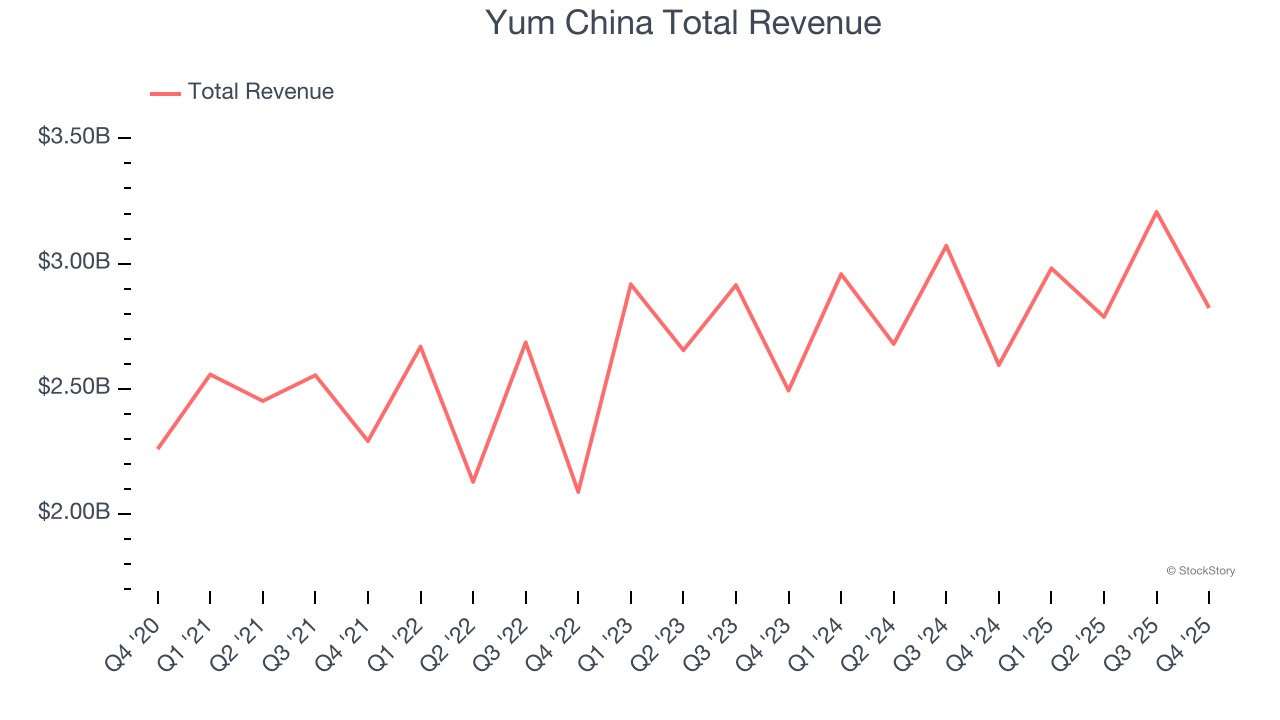
The stock is down 3.5% since reporting and currently trades at $48.98.
Is now the time to buy Yum China? Access our full analysis of the earnings results here, it’s free.
Best Q4: Krispy Kreme (NASDAQ: DNUT)
Famous for its Original Glazed doughnuts and parent company of Insomnia Cookies, Krispy Kreme (NASDAQ: DNUT) is one of the most beloved and well-known fast-food chains in the world.
Krispy Kreme reported revenues of $392.4 million, down 2.9% year on year, outperforming analysts’ expectations by 1%. The business had an exceptional quarter with a beat of analysts’ EPS and EBITDA estimates.
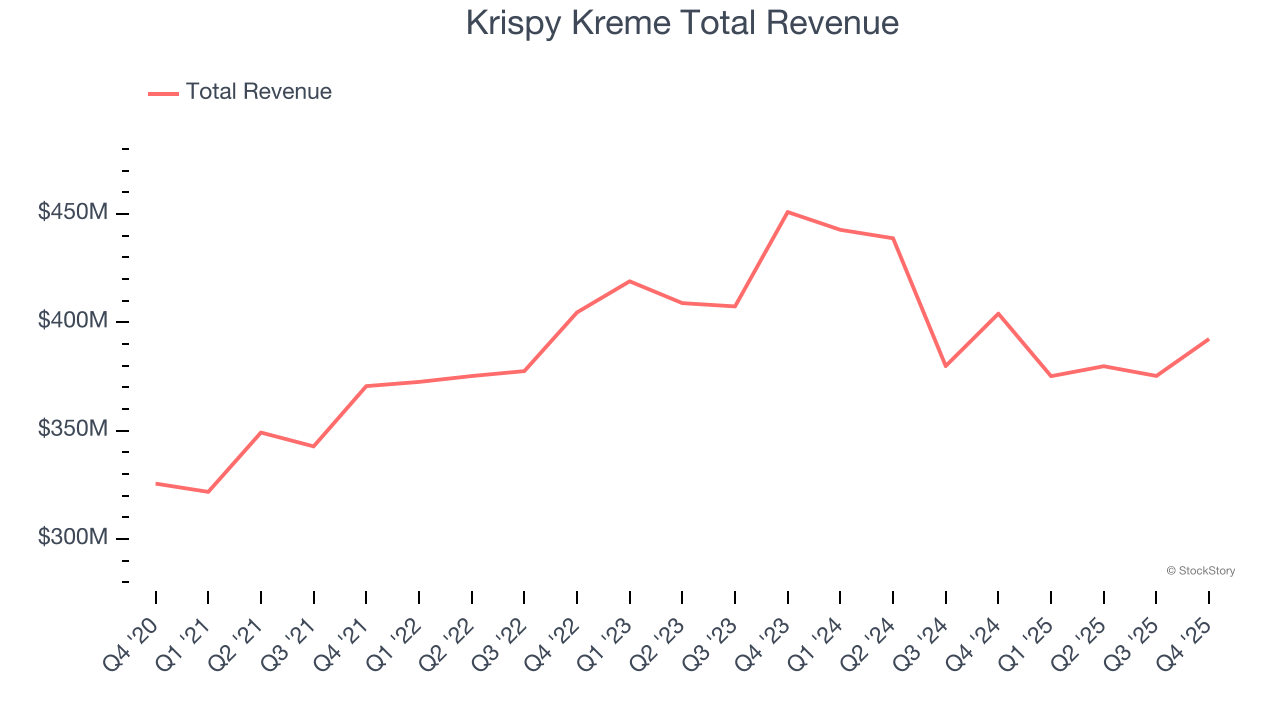
The market seems happy with the results as the stock is up 14.9% since reporting. It currently trades at $3.44.
Is now the time to buy Krispy Kreme? Access our full analysis of the earnings results here, it’s free.
Weakest Q4: Jack in the Box (NASDAQ: JACK)
Delighting customers since its inception in 1951, Jack in the Box (NASDAQ: JACK) is a distinctive fast-food chain known for its bold flavors, innovative menu items, and quirky marketing.
Jack in the Box reported revenues of $349.5 million, down 5.8% year on year, falling short of analysts’ expectations by 4.8%. It was a softer quarter as it posted a significant miss of analysts’ revenue and same-store sales estimates.
Jack in the Box delivered the weakest performance against analyst estimates in the group. As expected, the stock is down 46.6% since the results and currently trades at $11.76.
Read our full analysis of Jack in the Box’s results here.
Yum! Brands (NYSE: YUM)
Spun off as an independent company from PepsiCo, Yum! Brands (NYSE: YUM) is a multinational corporation that owns KFC, Pizza Hut, Taco Bell, and The Habit Burger Grill.
Yum! Brands reported revenues of $2.51 billion, up 6.4% year on year. This result surpassed analysts’ expectations by 2.7%. Overall, it was a very strong quarter as it also produced a solid beat of analysts’ revenue estimates.
The stock is up 2.2% since reporting and currently trades at $162.30.
Read our full, actionable report on Yum! Brands here, it’s free.
Dutch Bros (NYSE: BROS)
Started in 1992 by two brothers as a single pushcart, Dutch Bros (NYSE: BROS) is a dynamic coffee chain that’s captured the hearts of coffee enthusiasts across the United States.
Dutch Bros reported revenues of $443.6 million, up 29.4% year on year. This number topped analysts’ expectations by 4.5%. It was a very strong quarter as it also put up a beat of analysts’ EPS estimates and a solid beat of analysts’ EBITDA estimates.
Dutch Bros achieved the biggest analyst estimates beat and fastest revenue growth among its peers. The stock is up 2% since reporting and currently trades at $51.83.
Read our full, actionable report on Dutch Bros here, it’s free.
Market Update
Late in 2025 into early 2026, there was hand wringing around artificial intelligence. For software companies, the fear was that AI would erode pricing power and compress margins as new tools made it easier to replicate what once required expensive enterprise platforms. Crypto investors had their own version of the same anxiety: if AI agents could trade, allocate capital, and manage wallets autonomously, what exactly was the long-term value of today’s crypto infrastructure?
These concerns triggered a noticeable rotation away from these sectors and into safer havens. But markets rarely dwell on one narrative for long. Spring 2026 came, and the focus shifted abruptly from technological disruption to geopolitical risk. The US’ conflict with Iran became the dominant driver of market psychology, and when geopolitics takes center stage, the script changes quickly. Investors stop debating growth rates and start worrying about oil supply, inflation, and global stability.
Want to invest in winners with rock-solid fundamentals? Check out our Hidden Gem Stocks and add them to your watchlist. These companies are poised for growth regardless of the political or macroeconomic climate.
StockStory’s analyst team — all seasoned professional investors — uses quantitative analysis and automation to deliver market-beating insights faster and with higher quality.