Health insurance company Cigna (NYSE: CI) announced better-than-expected revenue in Q3 2026, with revenue up 6.1% year on year to $73.79 billion. Its non-GAAP profit of $7.98 per share was 6.3% above analysts’ consensus estimates.
For more on Cigna, read our free full research report.
Cigna (CI) Q3 2026 highlights:
- Revenue $73.79 billion vs S&P analysts’ consensus estimates of $72.67 billion (6.1% year-on-year growth, 1.5% beat)
- Adjusted EPS $7.98 vs S&P analysts’ consensus estimates of $7.51 (6.3% beat)
- Operating margin 2.9%, in line with the same quarter last year
- Customers 16.7 million, up from 16.68 million in the previous quarter
- Market capitalization $80.7 billion
"Our vision for The Cigna Group's next chapter of profitable growth is grounded in delivering greater value and personalized experiences for our customers, with three priorities: driving core growth, leveraging our distinct capabilities, and executing with discipline," said Brian Evanko, President and Chief Executive Officer of The Cigna Group. "As we put our strategy in action, our strong third quarter results demonstrate how we are building on this momentum by making health care more affordable and personalized, while advancing Accelerate to One to drive productivity, reduce costs, and support sustained long-term earnings growth."
Revenue growth
Examining a company’s long-term performance can provide clues about its quality. Any business can experience short-term success, but top-performing ones enjoy sustained growth for years. Cigna’s revenue grew at a decent 11% compounded annual growth rate over the last five years. Its growth was slightly above the average healthcare company and shows its offerings resonate with customers.
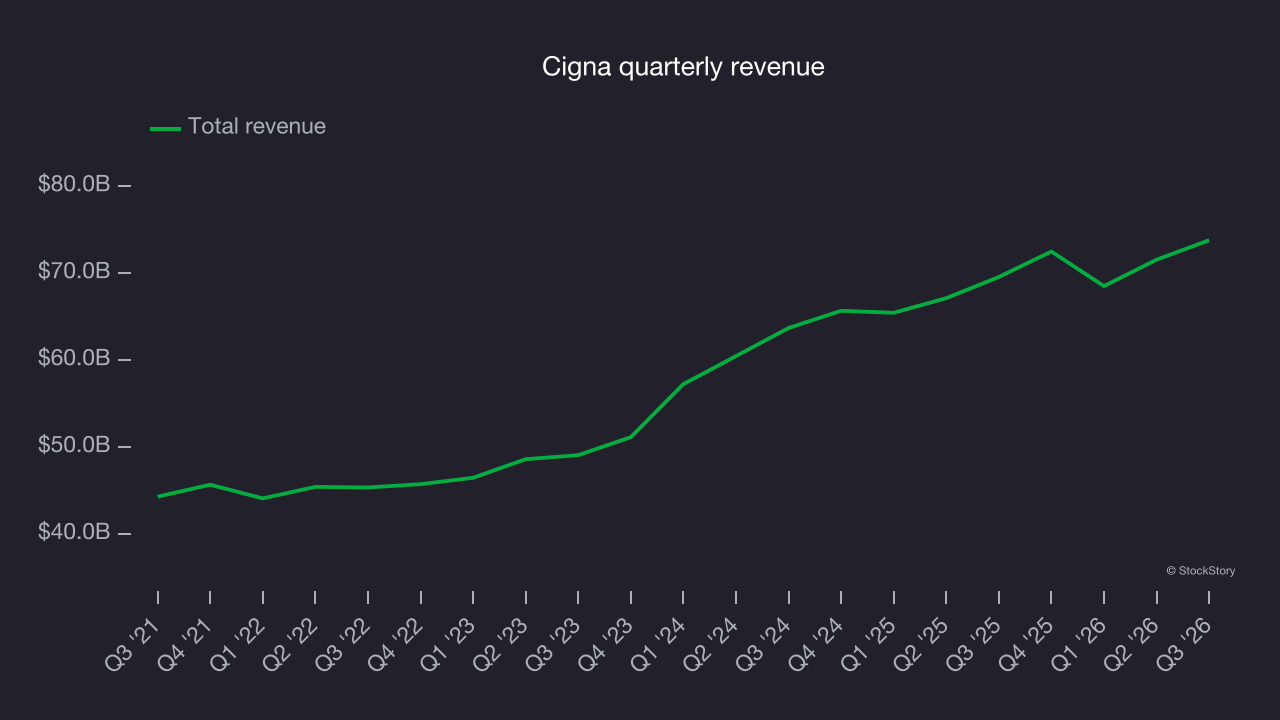
Long-term growth is the most important, but within healthcare, a half-decade historical view may miss new innovations or demand cycles. Cigna’s annualized revenue growth of 11% over the last two years aligns with its five-year trend, suggesting its demand was stable. 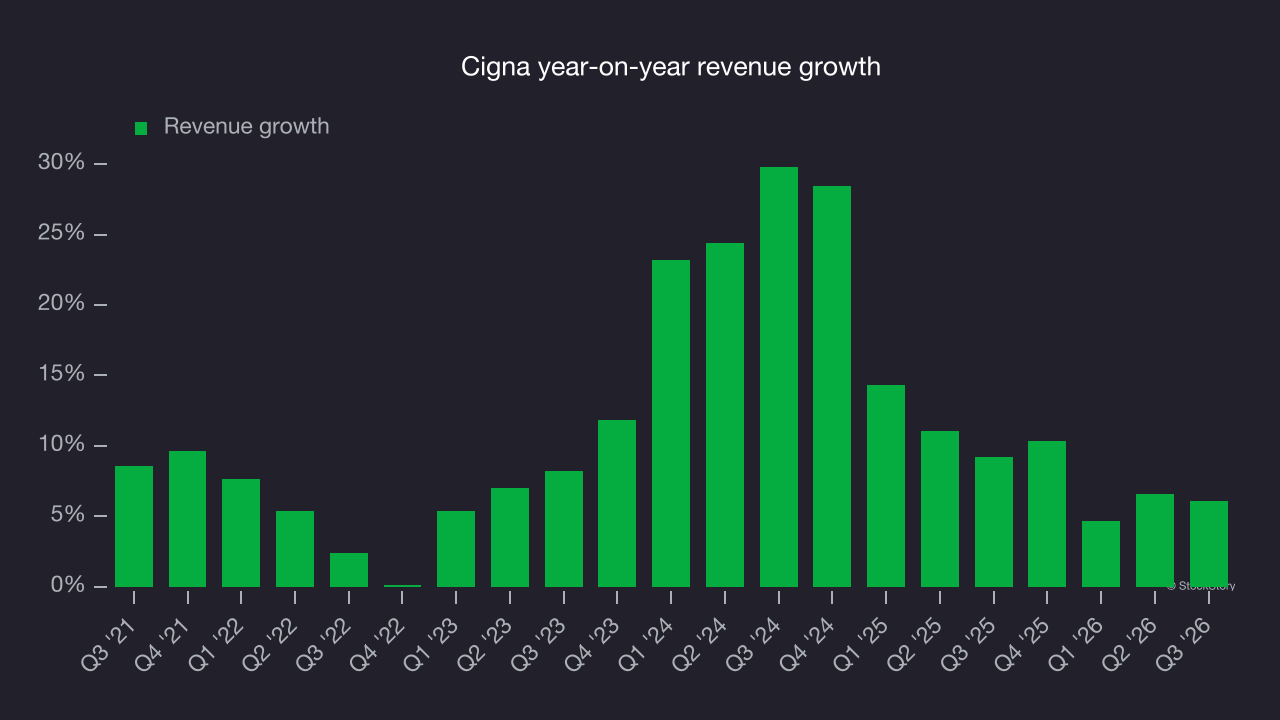
Cigna’s customer count, which reached 16.7 million in the latest quarter, offers another way to examine its revenue dynamics. Over the last two years, Cigna’s customer base averaged 6.8% year-on-year declines. Revenue growth outpaced customer growth, indicating that the average customer spent more each year on the company’s products and services. 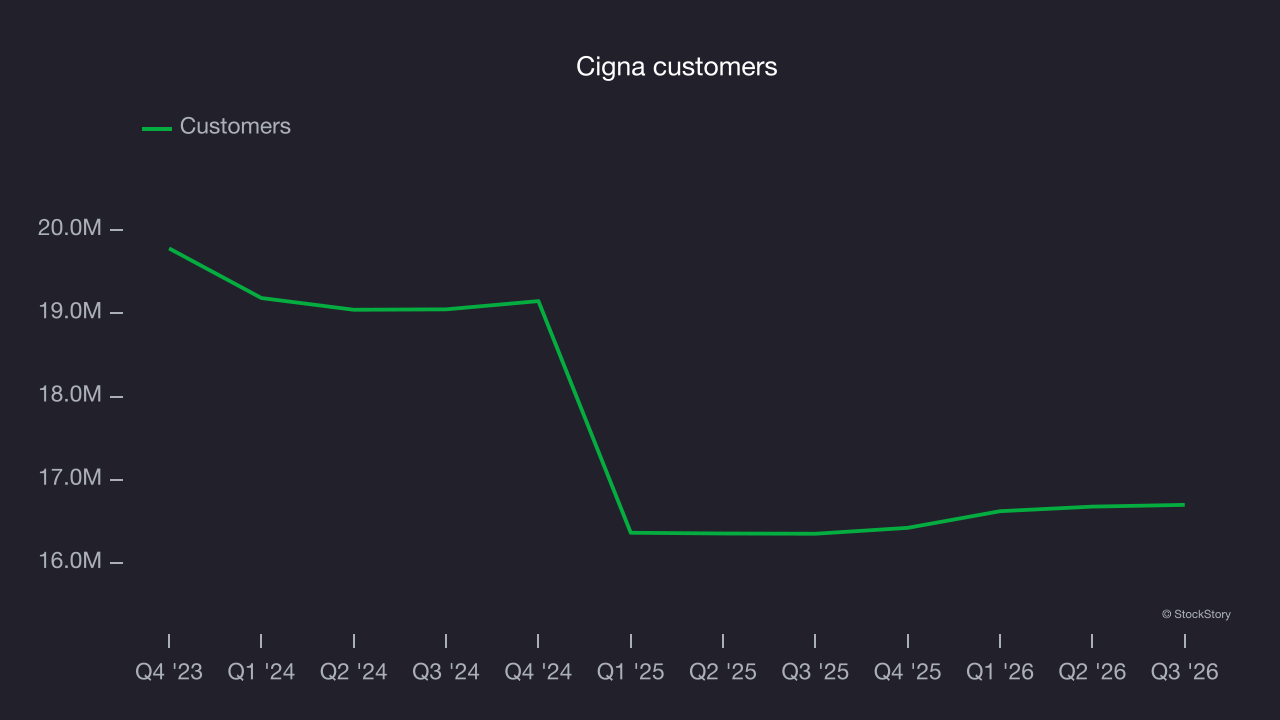
This quarter, Cigna reported year-on-year revenue growth of 6.1%, and its $73.79 billion of revenue exceeded Wall Street’s consensus estimates by 1.5%.
Looking ahead, sell-side analysts expect revenue to grow 3.7% over the next 12 months, according to S&P, a deceleration versus the last two years. This projection is underwhelming and indicates its products and services will see some demand headwinds. Still, the company is performing well on other measures of financial health.
Adjusted operating margin
Adjusted operating margin is an important measure of profitability as it shows the portion of revenue left after accounting for all core expenses, from the cost of goods sold to advertising and wages. It’s also useful for comparing profitability across companies because it excludes non-recurring expenses, interest on debt and taxes.
Cigna was profitable over the last five years but held back by its large cost base. Its average adjusted operating margin of 4.8% was weak for a healthcare business.
Cigna’s adjusted operating margin decreased by 1.9 percentage points over the last five years. This raises questions about the company’s expense base because its revenue growth should have given it leverage on its fixed costs, resulting in better economies of scale and profitability. Cigna’s poor performance shows that costs were rising and it couldn’t pass them on to its customers.
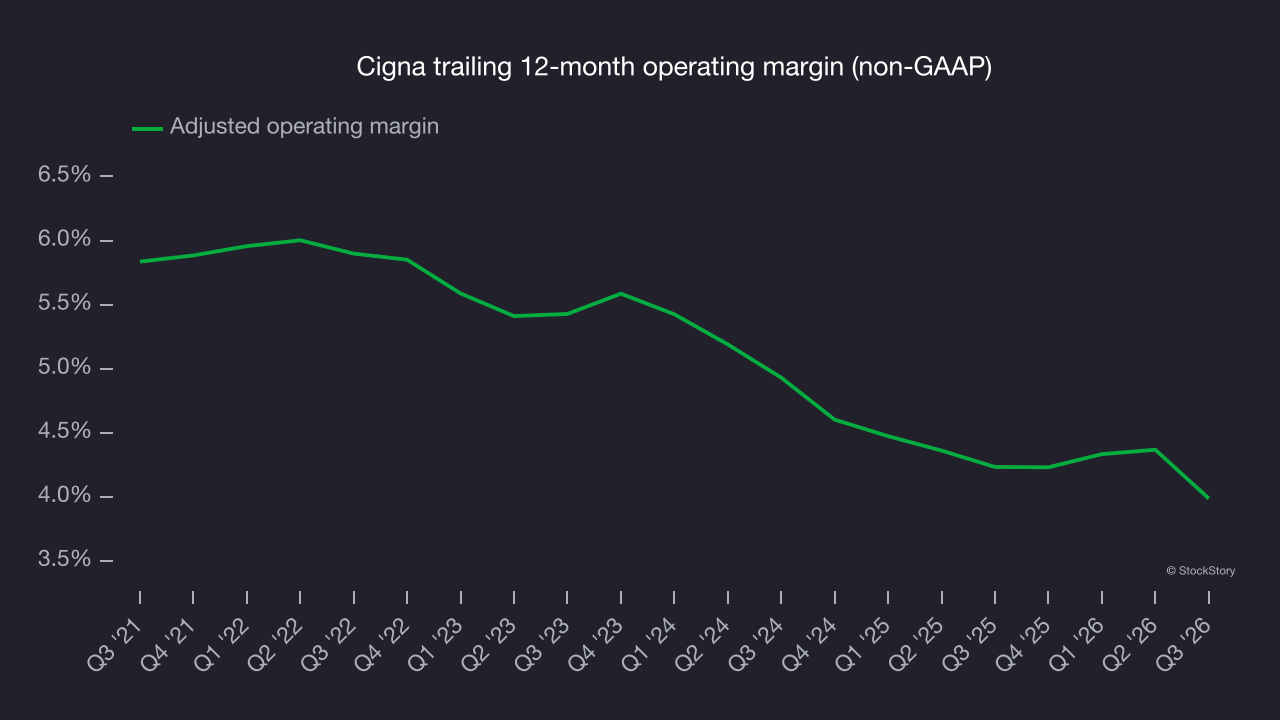
This quarter, Cigna generated an adjusted operating margin of 2.9%, down 1.5 percentage points year on year. This relatively small reduction indicates the company’s overall cost structure has been relatively stable.
Earnings per share
We track the long-term change in earnings per share, or EPS, for the same reason as long-term revenue growth. Compared to revenue, however, EPS highlights whether a company’s growth is profitable.
Cigna’s strong 10.5% annual EPS growth over the last five years aligns with its revenue performance. This indicates it maintained its per-share profitability as it expanded.
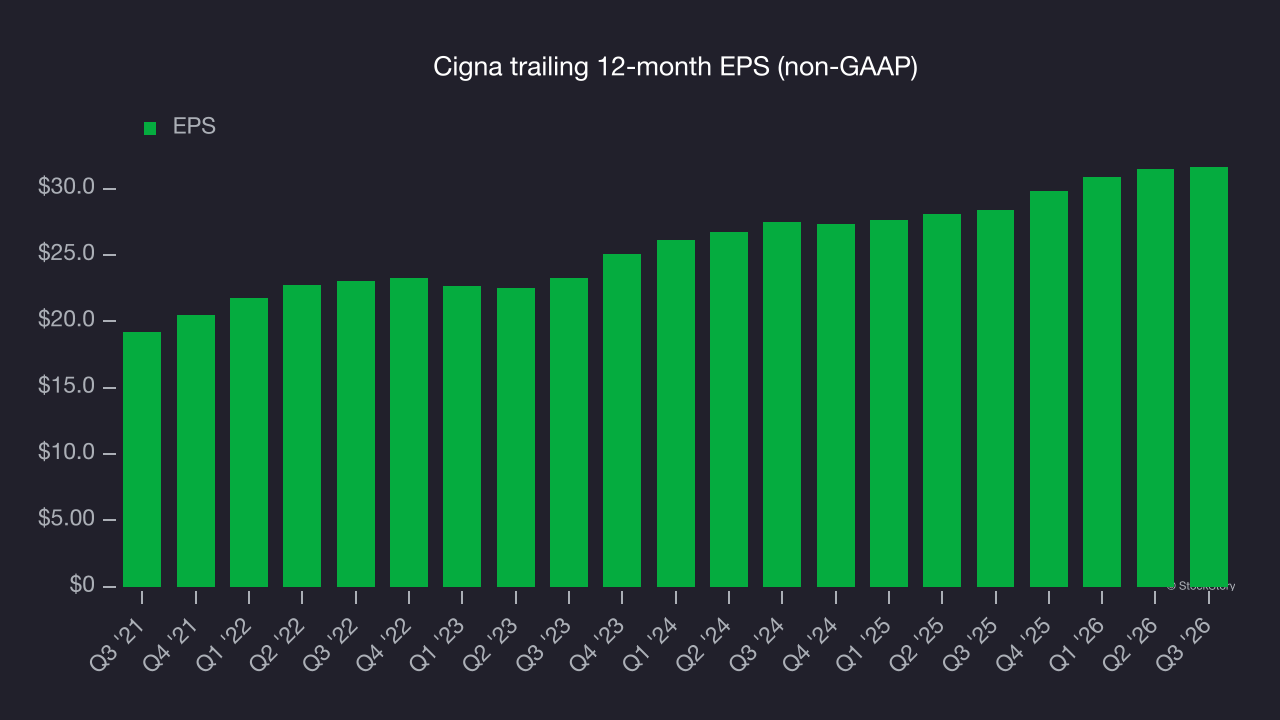
In Q3, Cigna reported adjusted EPS of $7.98, up from $7.83 in the same quarter last year. This result beat analysts’ consensus estimates by 6.3%. Over the next 12 months, Wall Street expects Cigna’s full-year EPS to grow 3.3% from $31.63 to $32.66, according to S&P.
Key takeaways from Cigna’s Q3 results
Cigna’s Q3 results had some key positives, with revenue topping analysts’ consensus estimates and EPS also beating Wall Street’s estimates. Shares edged higher 1.9% to $311.27 immediately after the release.
Cigna had a solid quarter, but the bigger picture matters when deciding whether the stock is a buy. The latest quarter matters less than longer-term business quality and valuation when deciding whether to invest in this stock. For more on Cigna, read our full research report here (it’s free).