Medical device company Boston Scientific (NYSE: BSX) announced better-than-expected revenue in Q3 2026, with revenue rising 1.4% year on year to $5.14 billion. On the other hand, next quarter’s revenue guidance of $5.18 billion was less impressive, coming in 4.5% below analysts’ consensus estimates. Its non-GAAP profit of $0.73 per share was in line with analysts’ consensus estimates.
For more on Boston Scientific, read the full research report for free.
Boston Scientific (BSX) Q3 2026 highlights:
- Revenue $5.14 billion vs S&P analysts’ consensus estimates of $5.07 billion (1.4% year-on-year growth, 1.4% beat)
- Adjusted EPS $0.73 vs S&P analysts’ consensus estimates of $0.72 (in line)
- Revenue guidance $5.18 billion at the midpoint for Q4 2026, below analysts’ consensus estimates of $5.42 billion
- Adjusted EPS guidance Management lowered its full-year adjusted EPS guidance to $3.17 at the midpoint, a 3.9% decrease
- Operating margin 16.1%, down from 20.7% in the same quarter last year
- Organic revenue rose 1.5% year on year (beat)
- Market capitalization $65.3 billion
"This has been a challenging year for Boston Scientific and I'm proud of how our global teams have responded, particularly to the cybersecurity incident, working with urgency and resilience to restore operations and continue supporting customers and patients," said Mike Mahoney, chairman and chief executive officer, Boston Scientific. "As we move forward, I remain confident in our long-term strategy, fueled by our dedicated talent, differentiated portfolio and strong pipeline of meaningful innovation."
Revenue growth
A company’s long-term revenue performance is one signal of its overall quality. Any business can deliver a good quarter or two, but the best consistently grow over the long haul. Boston Scientific’s 12.9% annualized revenue growth over the last five years was solid. Its growth beat the average healthcare company and shows its offerings resonate with customers.
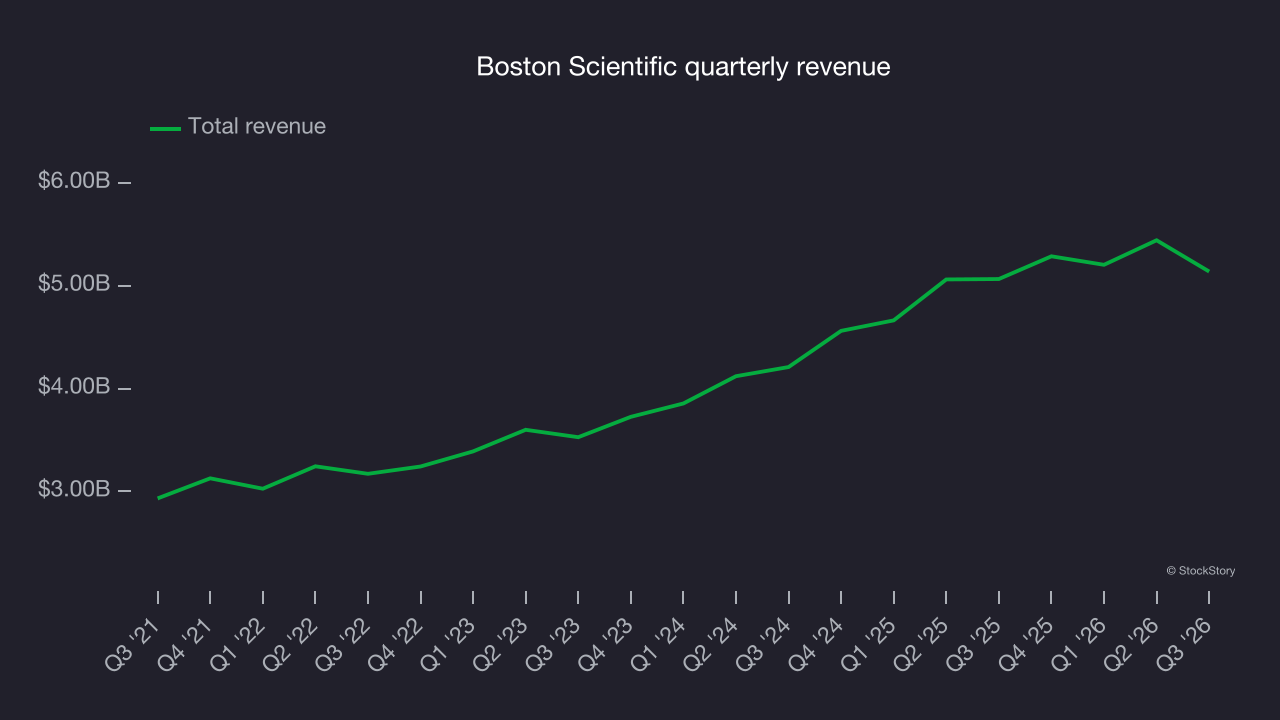
Long-term growth is the most important, but within healthcare, a half-decade historical view may miss new innovations or demand cycles. Boston Scientific’s annualized revenue growth of 15.1% over the last two years is above its five-year trend, suggesting its demand was strong and recently accelerated. 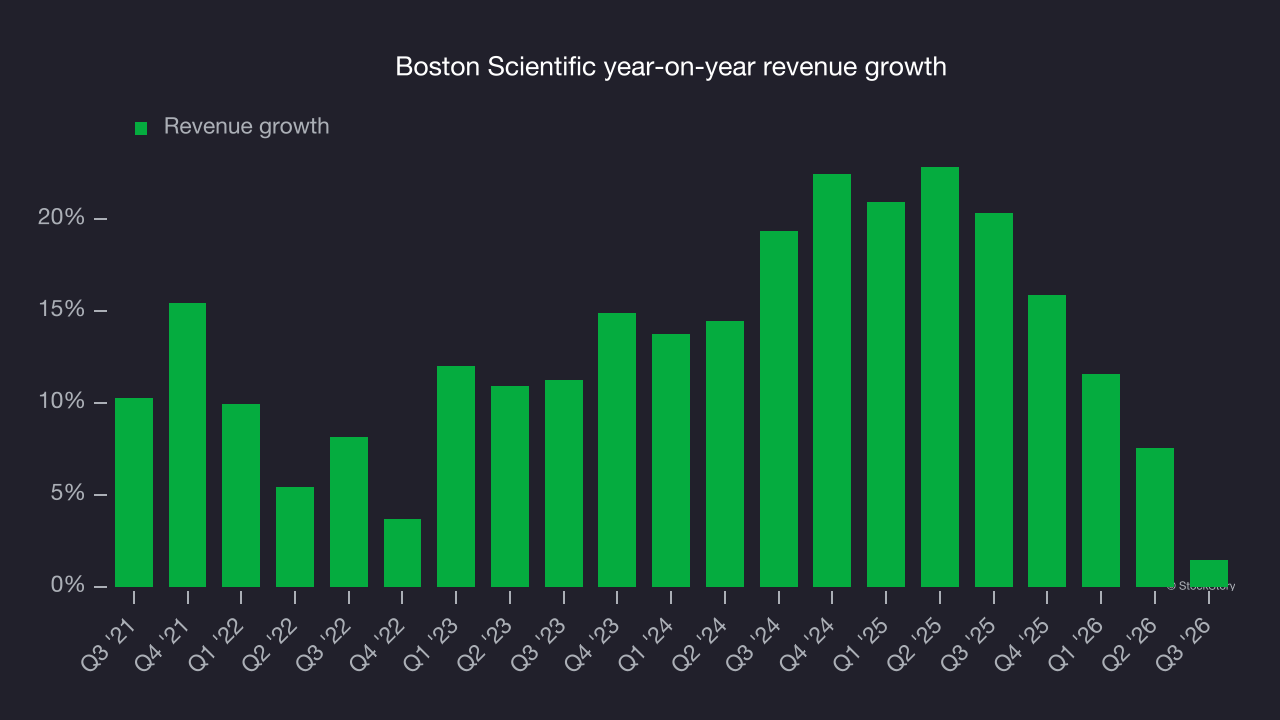
Boston Scientific also reports organic revenue, which strips out one-time events like acquisitions and currency fluctuations that don’t accurately reflect its fundamentals. Over the last two years, Boston Scientific’s organic revenue averaged 13.4% year-on-year growth. Total revenue growth outpaced organic growth over that period, indicating that some combination of acquisitions and foreign exchange effects boosted its headline results. 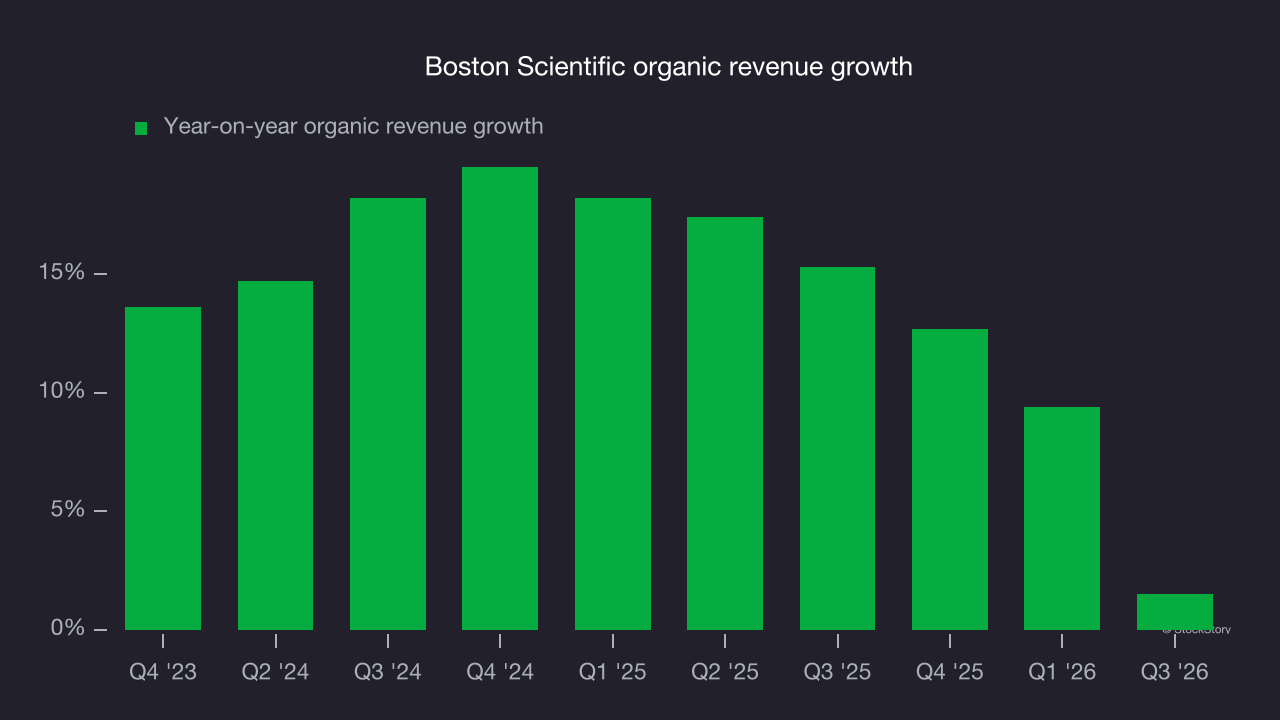
This quarter, Boston Scientific reported modest year-on-year revenue growth of 1.4% but beat Wall Street’s consensus estimates by 1.4%. Company management is currently guiding for a 2% year-on-year decline in revenue next quarter.
Looking further ahead, sell-side analysts expect revenue to grow 3.8% over the next 12 months, according to S&P, a deceleration versus the last two years. This projection is underwhelming and indicates its products and services will see some demand headwinds. At least the company is tracking well in other measures of financial health.
Adjusted operating margin
Boston Scientific’s adjusted operating margin has generally stayed the same over the last 12 months, averaging 26.3% over the last five years. This profitability was strong for a healthcare business, showing it’s a well-run company with an efficient cost structure.
Boston Scientific’s adjusted operating margin of 25% for the trailing 12 months may be around the same as five years ago, but it has decreased by 1.8 percentage points over the last two years. Still, its business quality suggests it can correct course and expand profitability over the longer term.
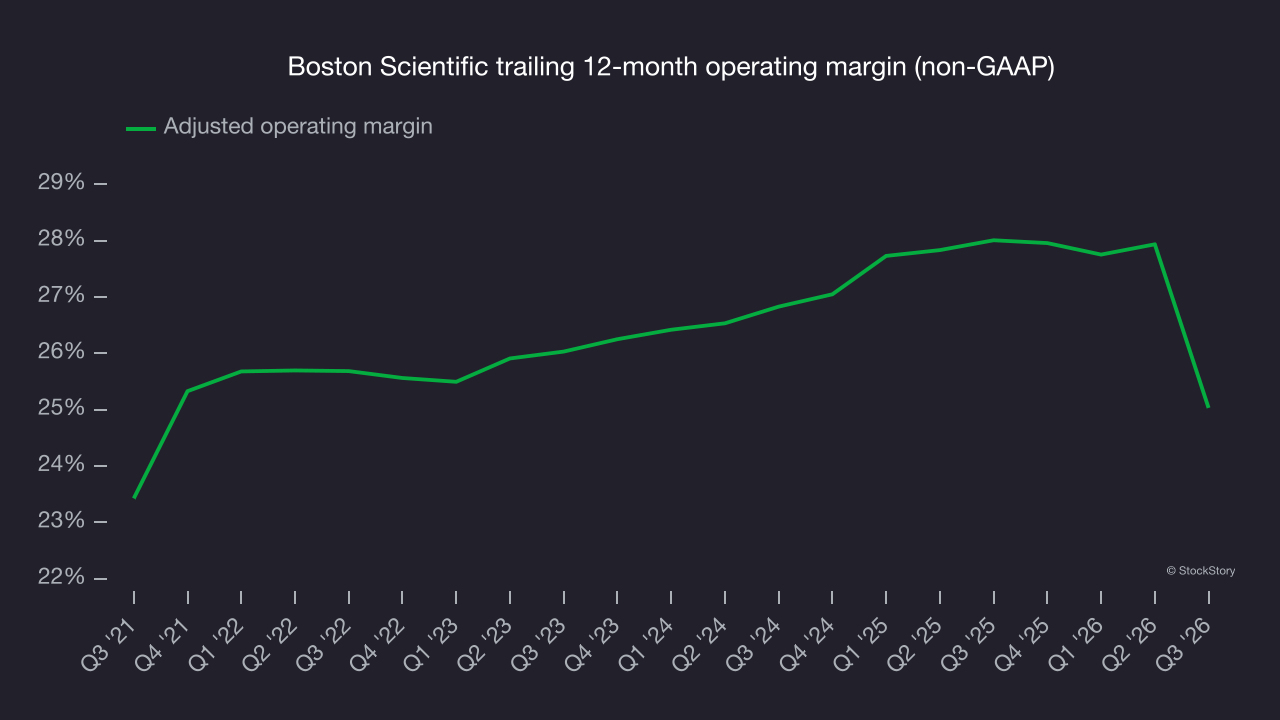
In Q3, Boston Scientific generated an adjusted operating margin of 16.1%, down 11.9 percentage points year on year. This contraction shows it was less efficient because its expenses grew faster than its revenue.
Earnings per share
Long-term changes in earnings per share (EPS) matter for the same reason as long-term revenue growth. Compared to revenue, however, EPS highlights whether a company’s growth is profitable.
Boston Scientific’s EPS grew at a 17.7% compounded annual growth rate over the last five years, higher than its 12.9% annualized revenue growth. However, that gap warrants caution because its adjusted operating margin didn’t improve and it didn’t repurchase its shares, meaning the difference came from reduced interest expenses or taxes.
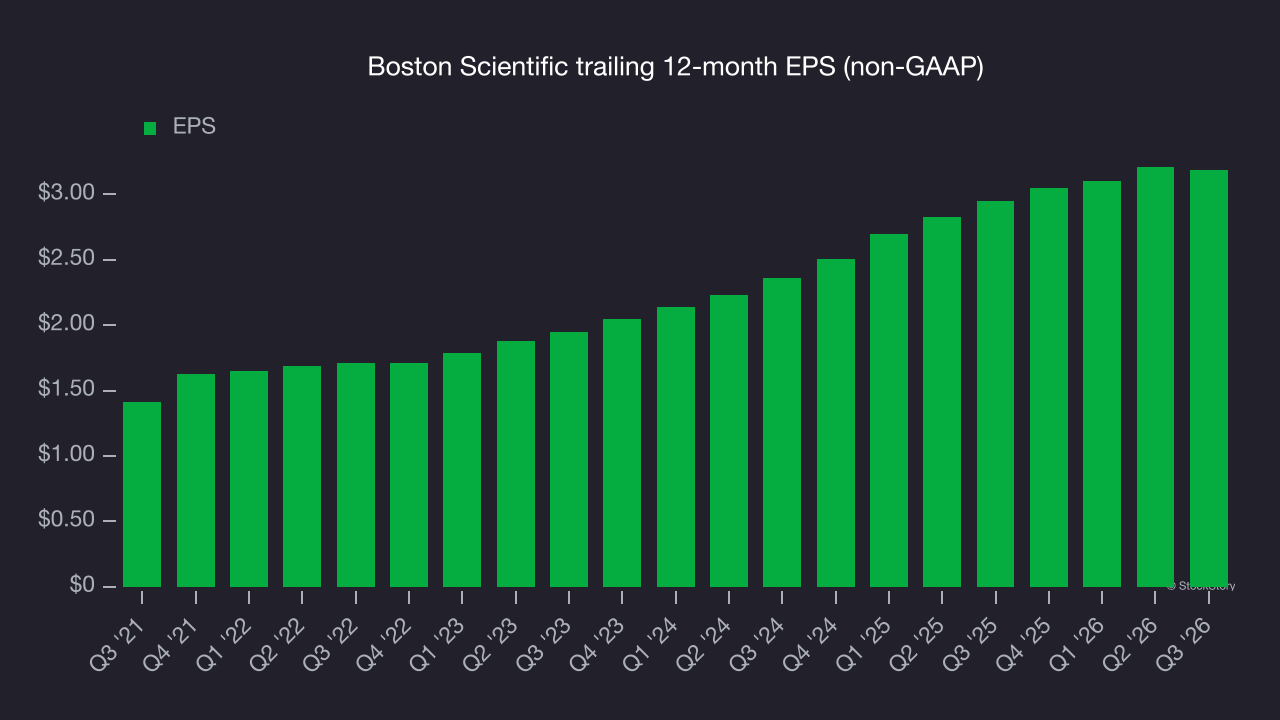
In Q3, Boston Scientific reported adjusted EPS of $0.73, down from $0.75 in the same quarter last year. This result was close to analysts’ consensus estimates. Over the next 12 months, Wall Street expects Boston Scientific’s full-year EPS to grow 3.7% from $3.19 to $3.31, according to S&P.
Key takeaways from Boston Scientific’s Q3 results
Boston Scientific’s outlook made this a weaker quarter, with next-quarter revenue and EPS guidance both falling short of Wall Street’s consensus estimates. The current quarter had some positives: revenue narrowly beat analysts’ consensus estimates, and organic revenue was in line with Wall Street’s estimates. Shares fell 3% to $43.71 immediately after the results.
Boston Scientific’s latest quarter was underwhelming. One earnings report doesn’t define a company’s quality, though, so it’s worth examining whether the stock is a buy at the current price. That decision requires considering its valuation, business quality and latest quarterly results. For more on Boston Scientific, read the full research report here (it’s free).