Government consulting firm Booz Allen Hamilton (NYSE: BAH) missed Wall Street’s revenue expectations in calendar Q3 2026 (fiscal Q2 2027), with revenue falling 3.9% year on year to $2.78 billion. Its GAAP profit of $1.50 per share was 7% above analysts’ consensus estimates.
For more on Booz Allen Hamilton, read our free full research report.
Booz Allen Hamilton (BAH) Q3 CY2026 highlights:
- Revenue: $2.78 billion vs analysts’ consensus estimates of $2.81 billion (3.9% year-on-year decline, 1.1% miss)
- EPS (GAAP): $1.50 vs analysts’ consensus estimates of $1.40 (7% beat)
- Adjusted EBITDA: $313 million vs analysts’ consensus estimates of $305.2 million (11.3% margin, 2.6% beat)
- Operating Margin: 8.8%, in line with the same quarter last year
- Free Cash Flow Margin: 9.5%, down from 13.7% in the same quarter last year
- Market Capitalization: $9.45 billion
Revenue growth
A company’s long-term revenue performance can indicate its overall quality. Even a poor business can perform well for one or two quarters, but a high-quality one grows for years.
With $10.98 billion in revenue over the past 12 months, Booz Allen Hamilton is larger than most business services companies and benefits from economies of scale, enabling it to gain more leverage on its fixed costs than smaller competitors. This also gives it the flexibility to offer lower prices.
Booz Allen Hamilton grew its revenue at a moderate 6.6% compounded annual growth rate over the last five years. This shows its offerings generated slightly more demand than the average business services company.
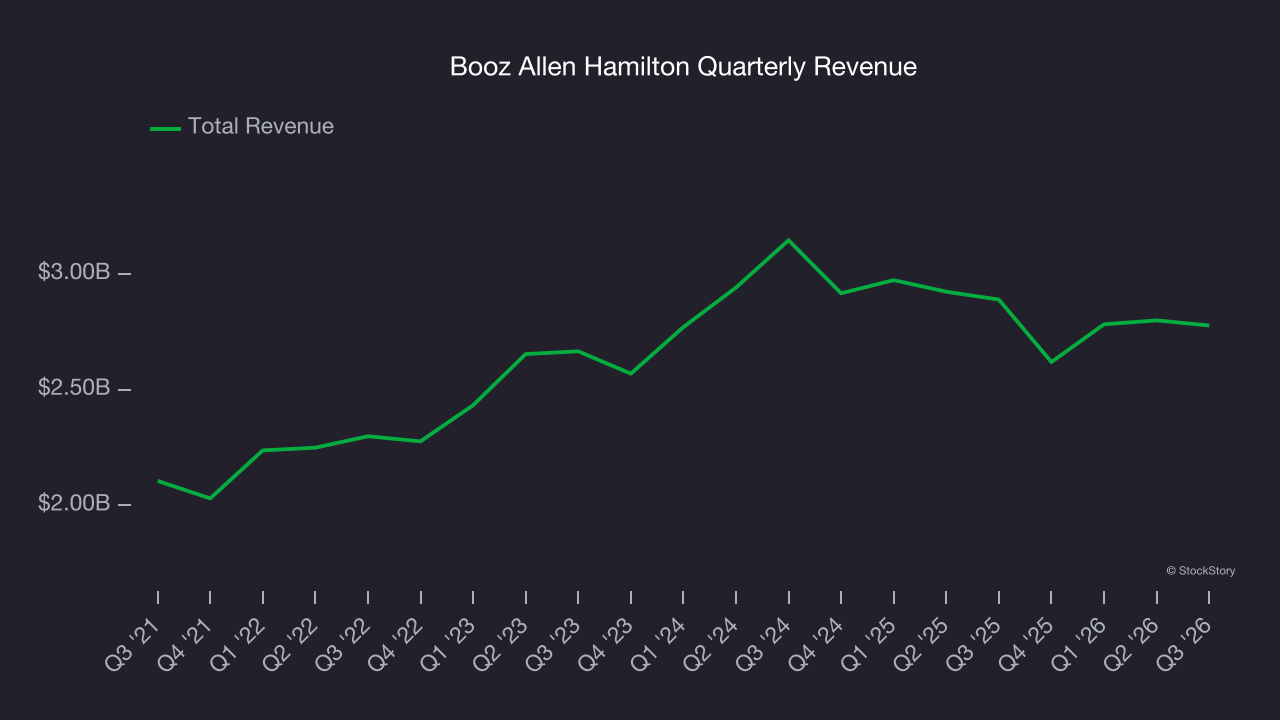
Long-term growth matters most, but within business services, a half-decade historical view may miss recent innovations or disruptive industry trends. Booz Allen Hamilton’s recent performance marks a sharp pivot from its five-year trend as its revenue has shown annualized declines of 2% over the last two years. 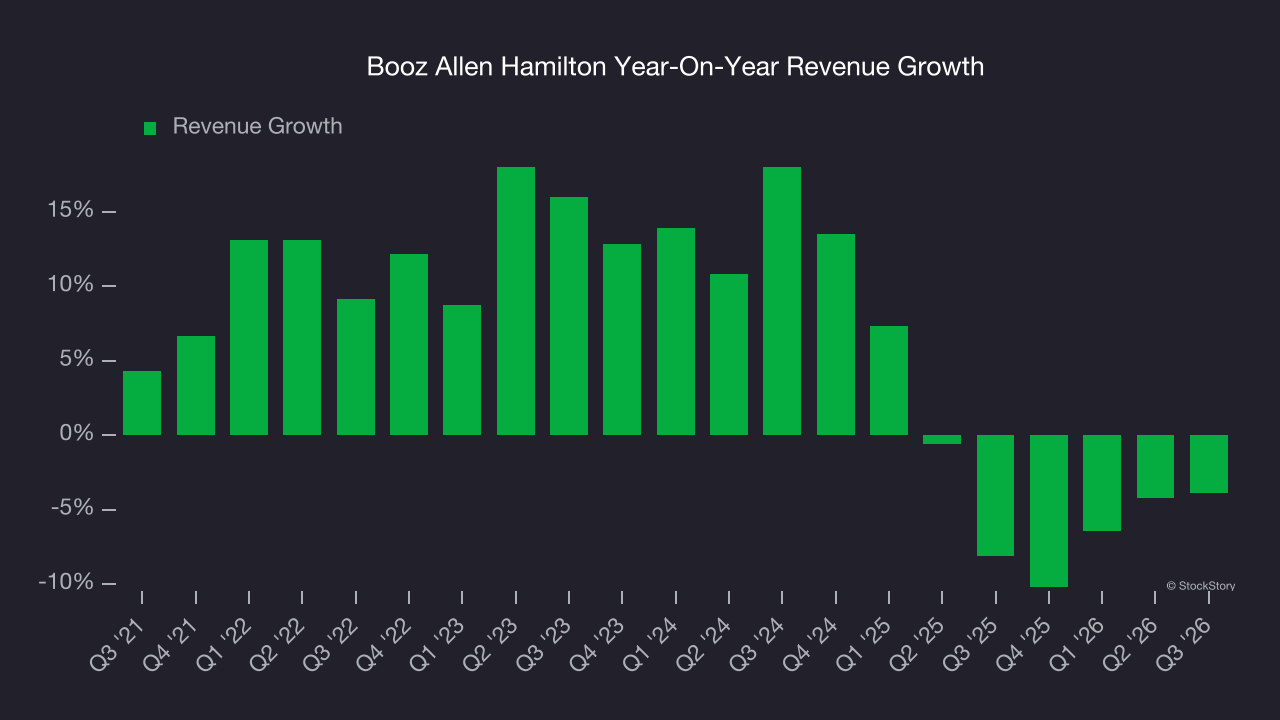
This quarter, Booz Allen Hamilton missed Wall Street’s consensus estimates and reported an underwhelming 3.9% year-on-year revenue decline, generating $2.78 billion of revenue.
Looking ahead, sell-side analysts expect revenue to grow 7% over the next 12 months according to S&P, an improvement versus the last two years. This projection is particularly noteworthy for a company of its scale and indicates its newer products and services will spur better top-line performance.
Adjusted operating margin
Adjusted operating margin is an important measure of profitability as it shows the portion of revenue left after accounting for all core expenses, from the cost of goods sold to advertising and wages. It’s also useful for comparing profitability across companies because it excludes non-recurring expenses, interest on debt and taxes.
Booz Allen Hamilton’s adjusted operating margin has been relatively unchanged over the last 12 months, averaging 9.6% over the last five years. This profitability was mediocre for a business services company, reflecting its suboptimal cost structure.
Booz Allen Hamilton’s adjusted operating margin may have fluctuated slightly but has generally stayed the same over the last five years. This raises questions about the company’s expense base because its revenue growth should have given it leverage on its fixed costs, resulting in better economies of scale and profitability.
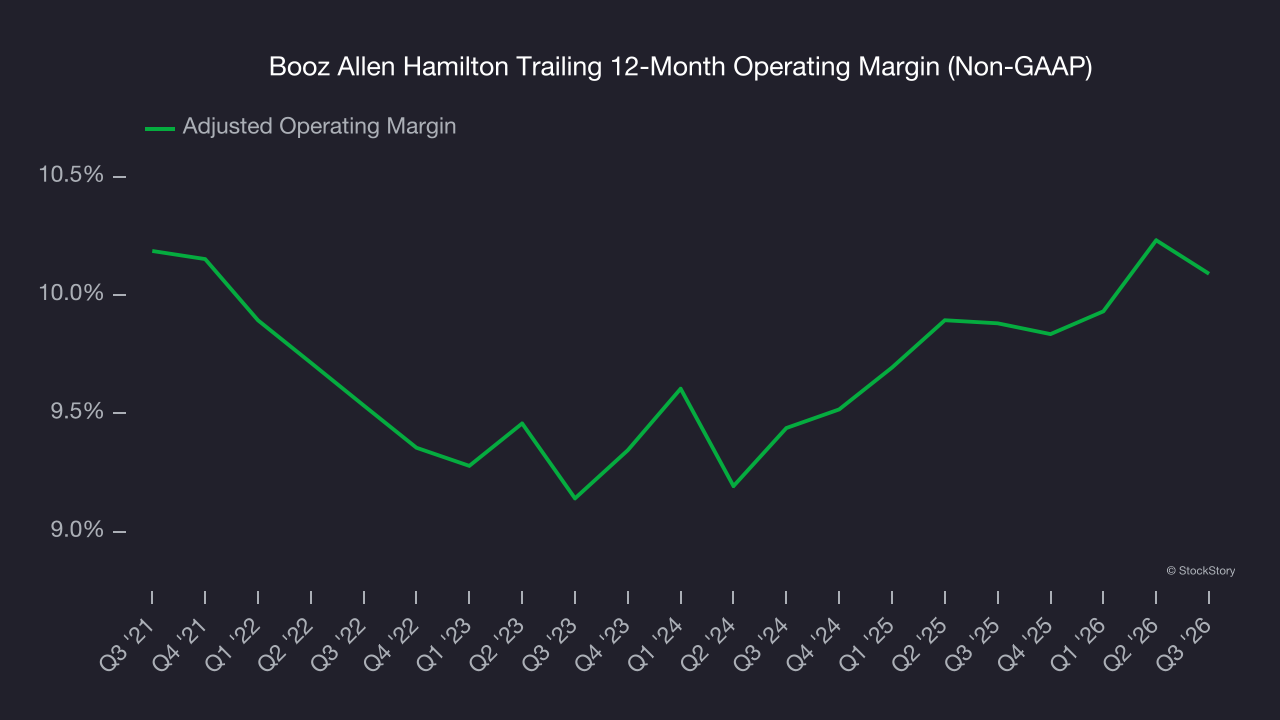
In Q3, Booz Allen Hamilton generated an adjusted operating margin of 9.6%, in line with the same quarter last year. This indicates the company’s overall cost structure has been relatively stable.
Earnings per share
Revenue trends explain a company’s historical growth, but the long-term change in earnings per share (EPS) points to the profitability of that growth – for example, a company could inflate its revenue through excessive spending on advertising and promotions.
Booz Allen Hamilton’s decent 8.6% annual EPS growth over the last five years aligns with its revenue performance, indicating it maintained its per-share profitability as it expanded.
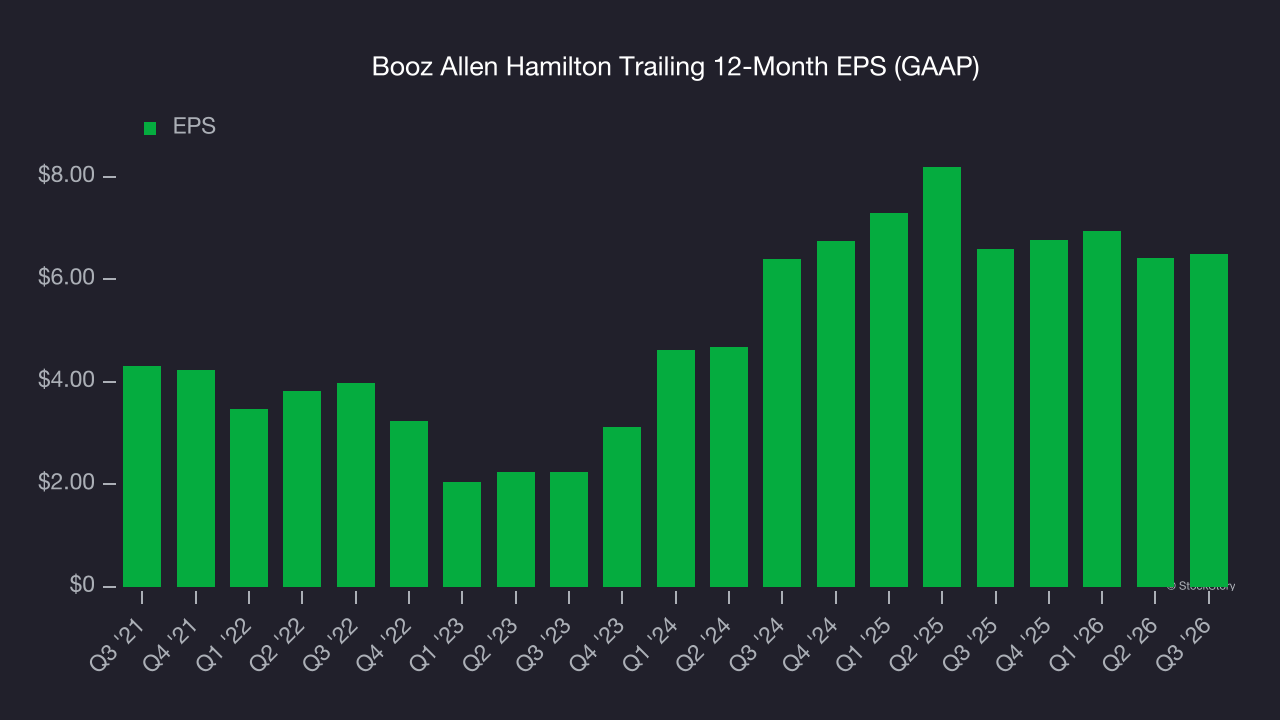
As with revenue, a more recent look at EPS can provide insight into an emerging theme or development for the business.
Although underwhelming, Booz Allen Hamilton’s flat two-year EPS topped its two-year revenue performance.
A closer look at Booz Allen Hamilton’s earnings can provide a better understanding of its performance. A two-year view shows that Booz Allen Hamilton has repurchased its stock, shrinking its share count by 7.2%. This indicates its EPS outperformed its revenue not because of increased operational efficiency but financial engineering, as buybacks boost per share earnings. 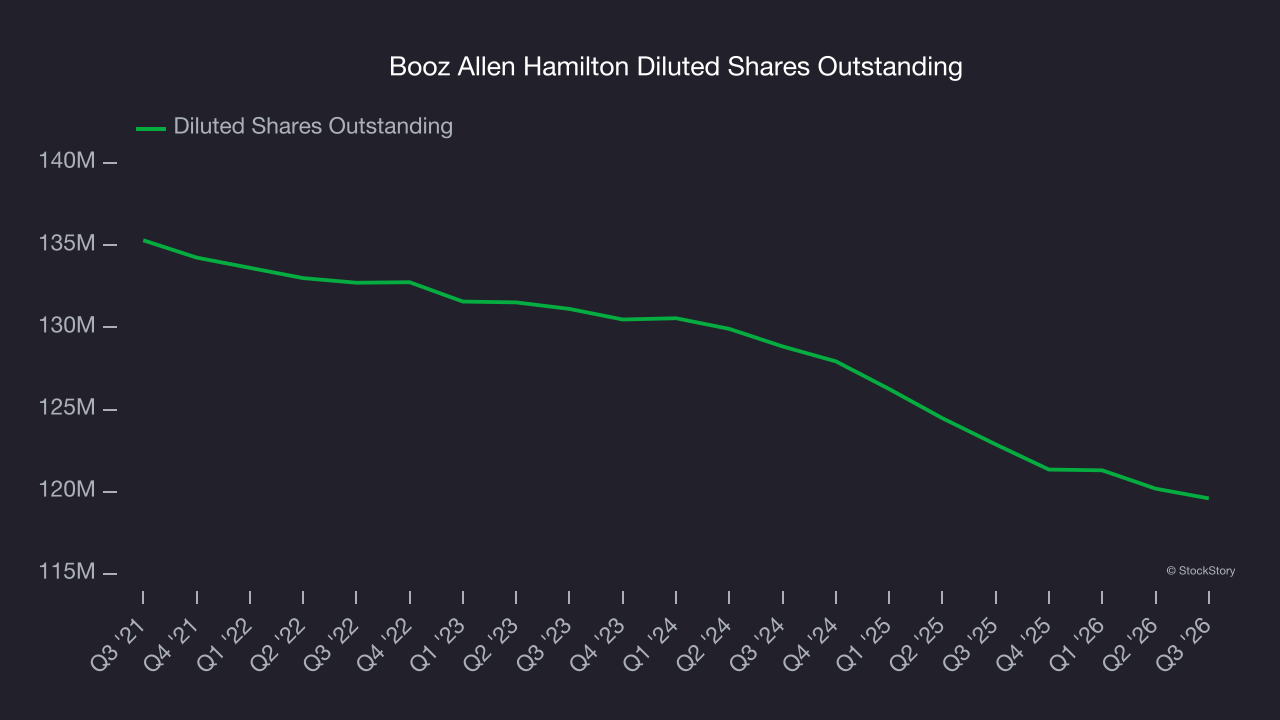
In Q3, Booz Allen Hamilton reported EPS of $1.50, up from $1.42 in the same quarter last year. This result beat analysts’ consensus estimates by 7%. Over the next 12 months, Wall Street expects Booz Allen Hamilton’s full-year EPS to shrink by 8.8% from $6.49 to $5.92 according to S&P.
Key takeaways from Booz Allen Hamilton’s Q3 results
Booz Allen Hamilton’s EPS beat analysts’ consensus estimates, but revenue fell slightly short of expectations, leaving the quarter mixed. Shares rose 3.8% to $81.70 immediately after the report.
To assess Booz Allen Hamilton at its current price, consider its valuation, business quality and what happened in the latest quarter. Read the full research report here (it’s free).