Regional banking company SouthState (NYSE: SSB) missed Wall Street’s revenue expectations in Q3 2026, with sales falling 1.9% year on year to $685.4 million. Its non-GAAP profit of $2.30 per share was 4.2% below analysts’ consensus estimates.
Is now the time to buy SouthState? Find out by accessing our full research report, it’s free.
SouthState (SSB) Q3 2026 highlights:
- Net Interest Income: $591.5 million vs analyst estimates of $590.9 million (1.4% year-on-year decline, in line)
- Net Interest Margin: 3.8% vs analyst estimates of 3.8% (in line)
- Revenue: $685.4 million vs analyst estimates of $688.9 million (1.9% year-on-year decline, 0.5% miss)
- Efficiency Ratio: 51.6% vs analyst estimates of 52.4% (76.5 basis point beat)
- Adjusted EPS: $2.30 vs analyst expectations of $2.40 (4.2% miss)
- Tangible Book Value per Share: $58.19 vs analyst estimates of $59.81 (6.8% year-on-year growth, 2.7% miss)
- Market Capitalization: $9.95 billion
"The third quarter was marked by strong balance sheet growth and a stable net interest margin," said John C. Corbett, SouthState's chief executive officer. "Loans and deposits each grew at a 9% annualized rate, with growth broad-based across our geographies and business lines, and boosted by the bankers we've added over the past year. Asset quality remains favorable, and while capital markets activity softened as treasury yields rose, the core franchise continues to perform well."
Company overview
With roots dating back to the Great Depression era of 1933, SouthState (NYSE: SSB) is a financial holding company that provides banking services, wealth management, and correspondent banking services across six southeastern states.
Sales growth
Two primary revenue streams drive bank earnings. While net interest income, which is earned by charging higher rates on loans than paid on deposits, forms the foundation, fee-based services across banking, credit, wealth management, and trading operations provide additional income. Luckily, SouthState’s revenue grew at an impressive 14.1% compounded annual growth rate over the last five years. Its growth beat the average banking company and shows its offerings resonate with customers.
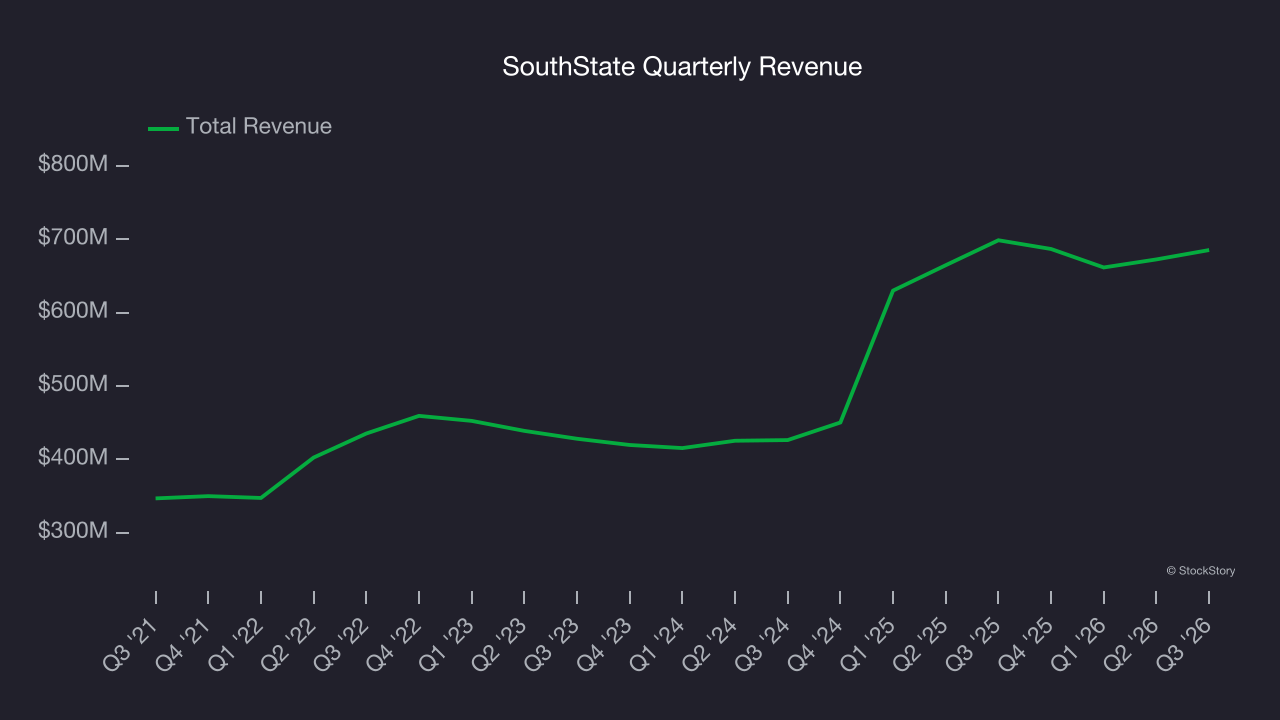
Long-term growth is the most important, but within financials, a half-decade historical view may miss recent interest rate changes and market returns. SouthState’s annualized revenue growth of 26.7% over the last two years is above its five-year trend, suggesting its demand was strong and recently accelerated. 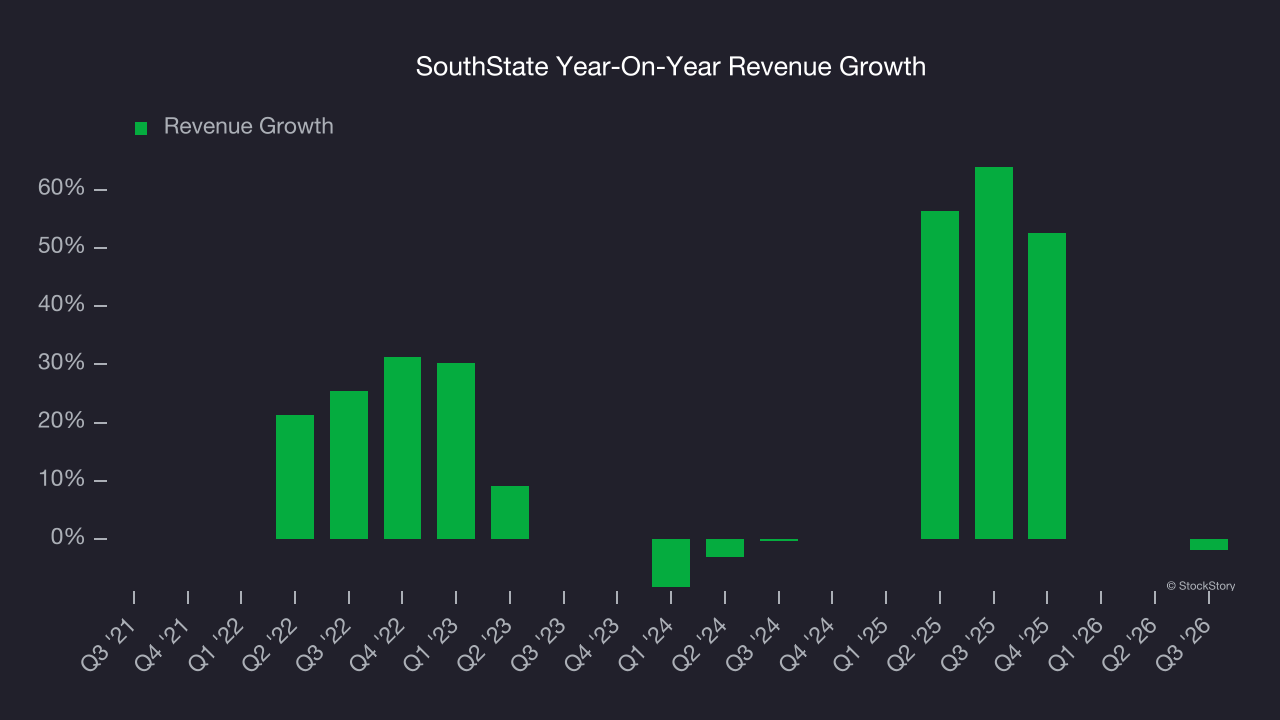 Note: Quarters not shown were determined to be outliers because they were impacted by outsized investment gains/losses that are not indicative of the recurring fundamentals of the business.
This quarter, SouthState missed Wall Street’s estimates and reported a rather uninspiring 1.9% year-on-year revenue decline, generating $685.4 million of revenue.
Net interest income made up 85.1% of the company’s total revenue during the last five years, meaning SouthState barely relies on non-interest income to drive its overall growth.
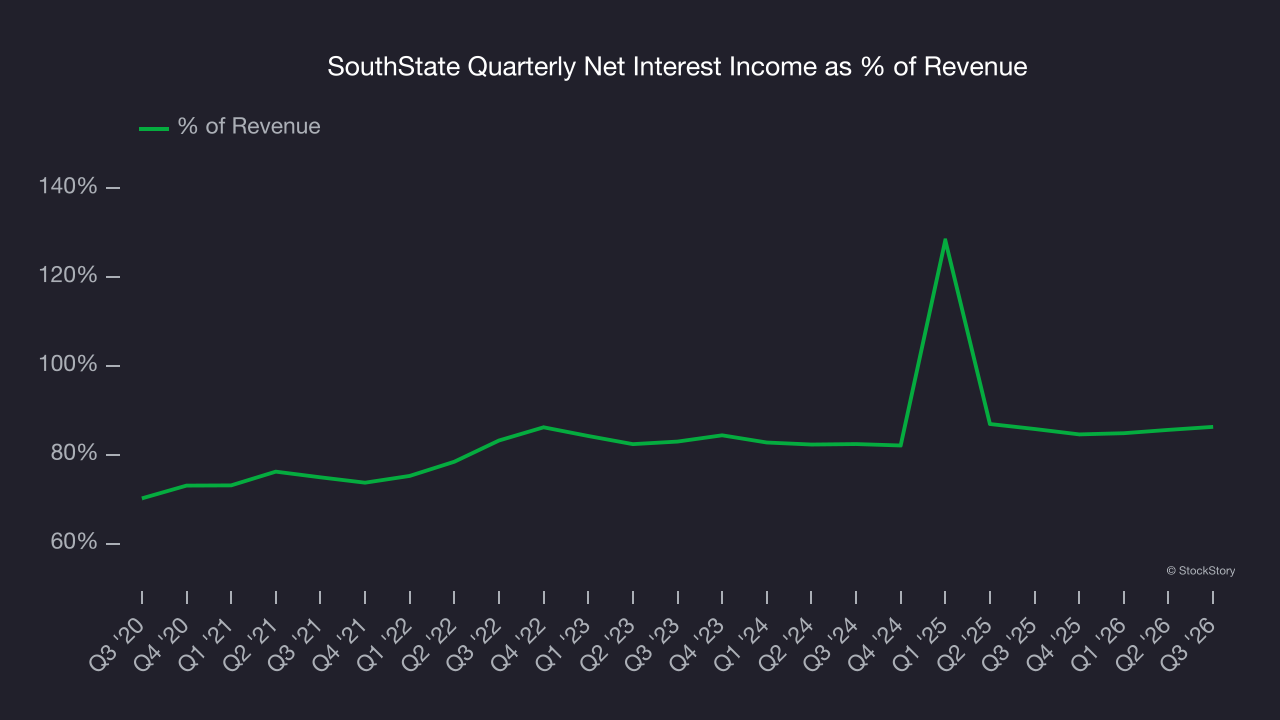
Our experience and research show the market cares primarily about a bank’s net interest income growth as non-interest income is considered a lower-quality and non-recurring revenue source.
ONE MORE THING: 3 Hidden Platforms Growing 3X Faster than Amazon, Google, and PayPal. Amazon, Google, and Meta all followed the same playbook: Dominate an ignored market. Build an unbeatable moat. Scale until you’re unstoppable.
These three platforms are running that exact playbook right now. The early investors in Amazon made fortunes. The early investors in these could do the same. Get All 3 Stocks Here for FREE.
Tangible book value per share (TBVPS)
Banks are balance sheet-driven businesses because they generate earnings primarily through borrowing and lending. They’re also valued based on their balance sheet strength and ability to compound book value (another name for shareholders’ equity) over time.
When analyzing banks, tangible book value per share (TBVPS) takes precedence over many other metrics. This measure isolates genuine per-share value by removing intangible assets of debatable liquidation worth. On the other hand, EPS is often distorted by mergers and flexible loan loss accounting. TBVPS provides clearer performance insights.
SouthState’s TBVPS grew at a decent 5.8% annual clip over the last five years. The last two years show a similar trajectory as TBVPS grew by 6.5% annually from $51.26 to $58.19 per share.
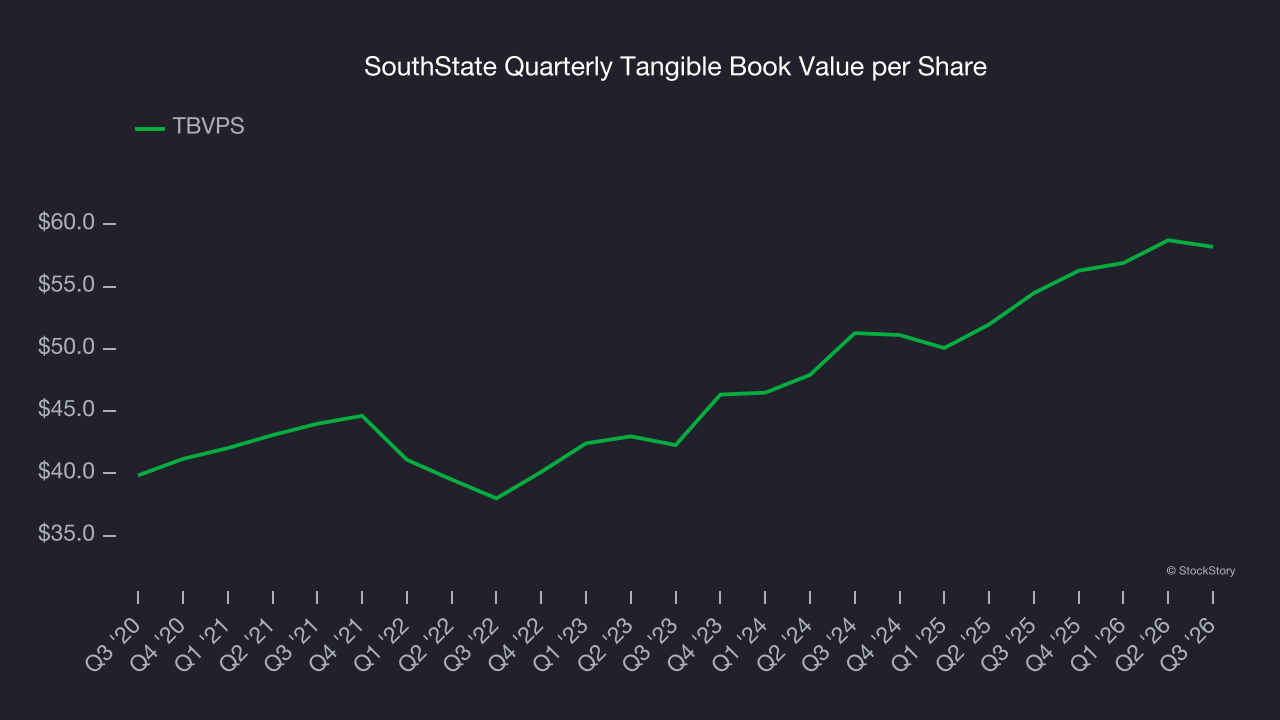
Over the next 12 months, Consensus estimates call for SouthState’s TBVPS to grow by 14% to $66.32, decent growth rate.
Key takeaways from SouthState’s Q3 results
We struggled to find many positives in these results. Its EPS missed and its tangible book value per share fell short of Wall Street’s estimates. Overall, this was a softer quarter. The stock traded down 2.8% to $99.90 immediately after reporting.
SouthState’s latest earnings report disappointed. One quarter doesn’t define a company’s quality, so let’s explore whether the stock is a buy at the current price. The latest quarter does matter, but not nearly as much as longer-term fundamentals and valuation, when deciding if the stock is a buy. We cover that in our actionable full research report which you can read here (it’s free).