Defense, intelligence, and IT solutions provider CACI International (NYSE: CACI) fell short of the markets revenue expectations in Q4 CY2025, but sales rose 5.7% year on year to $2.22 billion. On the other hand, the company’s outlook for the full year was close to analysts’ estimates with revenue guided to $9.4 billion at the midpoint. Its non-GAAP profit of $6.81 per share was 4.9% above analysts’ consensus estimates.
Is now the time to buy CACI? Find out by accessing our full research report, it’s free.
CACI (CACI) Q4 CY2025 Highlights:
- Revenue: $2.22 billion vs analyst estimates of $2.27 billion (5.7% year-on-year growth, 2.4% miss)
- Adjusted EPS: $6.81 vs analyst estimates of $6.49 (4.9% beat)
- Adjusted EBITDA: $262.6 million vs analyst estimates of $255.3 million (11.8% margin, 2.8% beat)
- The company lifted its revenue guidance for the full year to $9.4 billion at the midpoint from $9.3 billion, a 1.1% increase
- Management raised its full-year Adjusted EPS guidance to $28.59 at the midpoint, a 3.6% increase
- Operating Margin: 9.3%, in line with the same quarter last year
- Free Cash Flow Margin: 6.2%, similar to the same quarter last year
- Backlog: $32.8 billion at quarter end, up 3.1% year on year
- Market Capitalization: $13.89 billion
“Our strong second quarter results demonstrate the continued successful execution of our strategy and the value of our differentiated capabilities. With healthy free cash flow driven by solid revenue growth and strong EBITDA margin, we're delivering on our commitments to shareholders while addressing our customers' most critical mission needs,” said John Mengucci, CACI President and Chief Executive Officer.
Company Overview
Founded to commercialize SIMSCRIPT, CACI International (NYSE: CACI) offers defense, intelligence, and IT solutions to support national security and government transformation efforts.
Revenue Growth
Reviewing a company’s long-term sales performance reveals insights into its quality. Any business can experience short-term success, but top-performing ones enjoy sustained growth for years. Luckily, CACI’s sales grew at a decent 8.8% compounded annual growth rate over the last five years. Its growth was slightly above the average industrials company and shows its offerings resonate with customers.
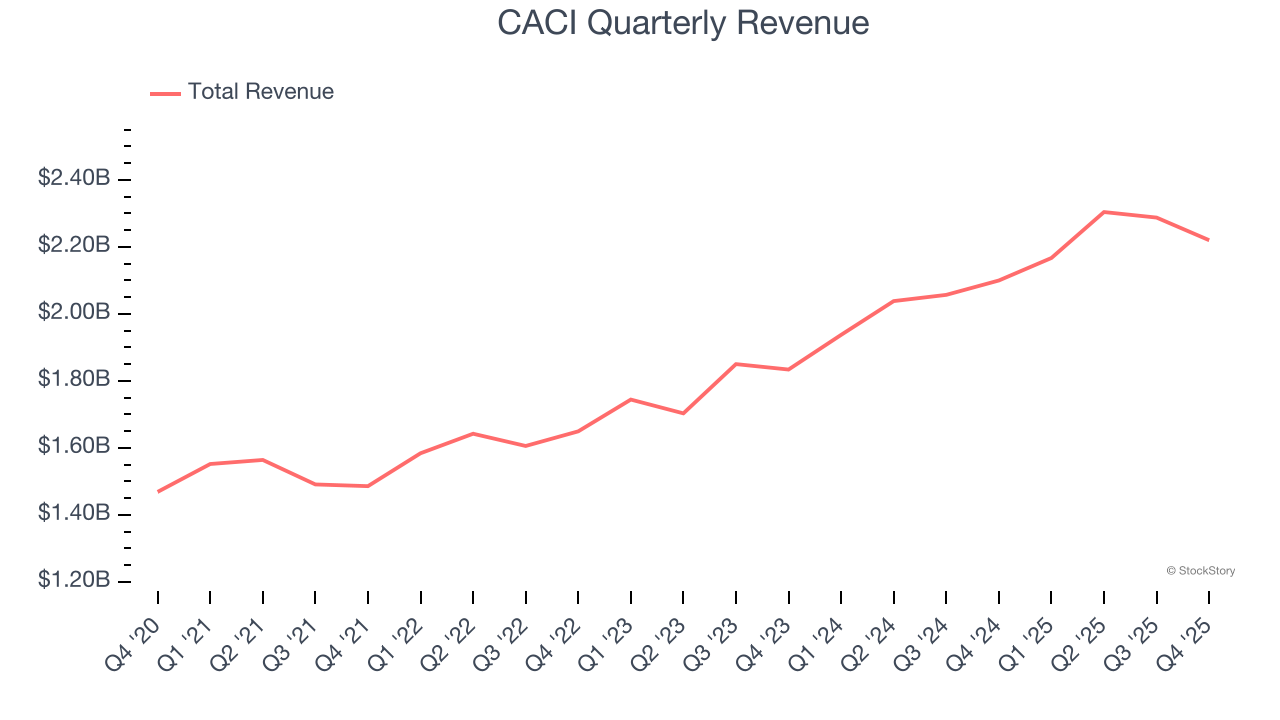
Long-term growth is the most important, but within industrials, a half-decade historical view may miss new industry trends or demand cycles. CACI’s annualized revenue growth of 12.2% over the last two years is above its five-year trend, suggesting its demand recently accelerated. 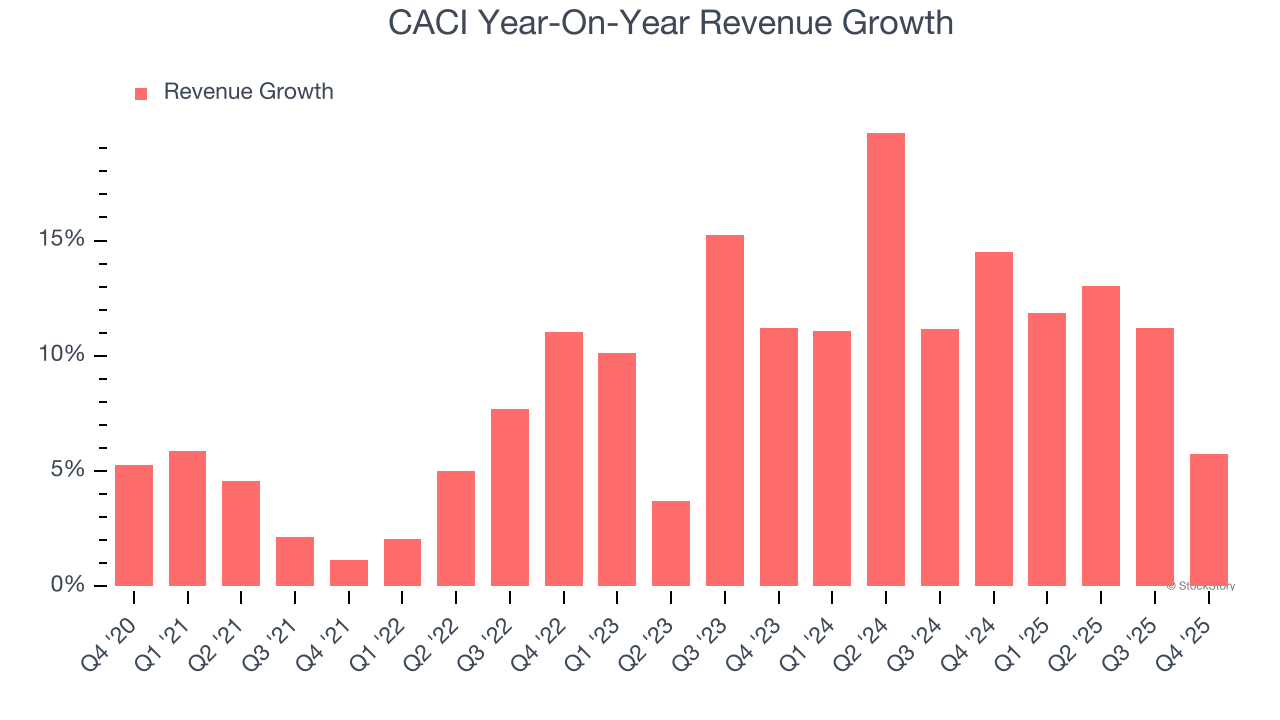
We can dig further into the company’s revenue dynamics by analyzing its backlog, or the value of its outstanding orders that have not yet been executed or delivered. CACI’s backlog reached $32.8 billion in the latest quarter and averaged 11.5% year-on-year growth over the last two years. Because this number is in line with its revenue growth, we can see the company effectively balanced its new order intake and fulfillment processes. 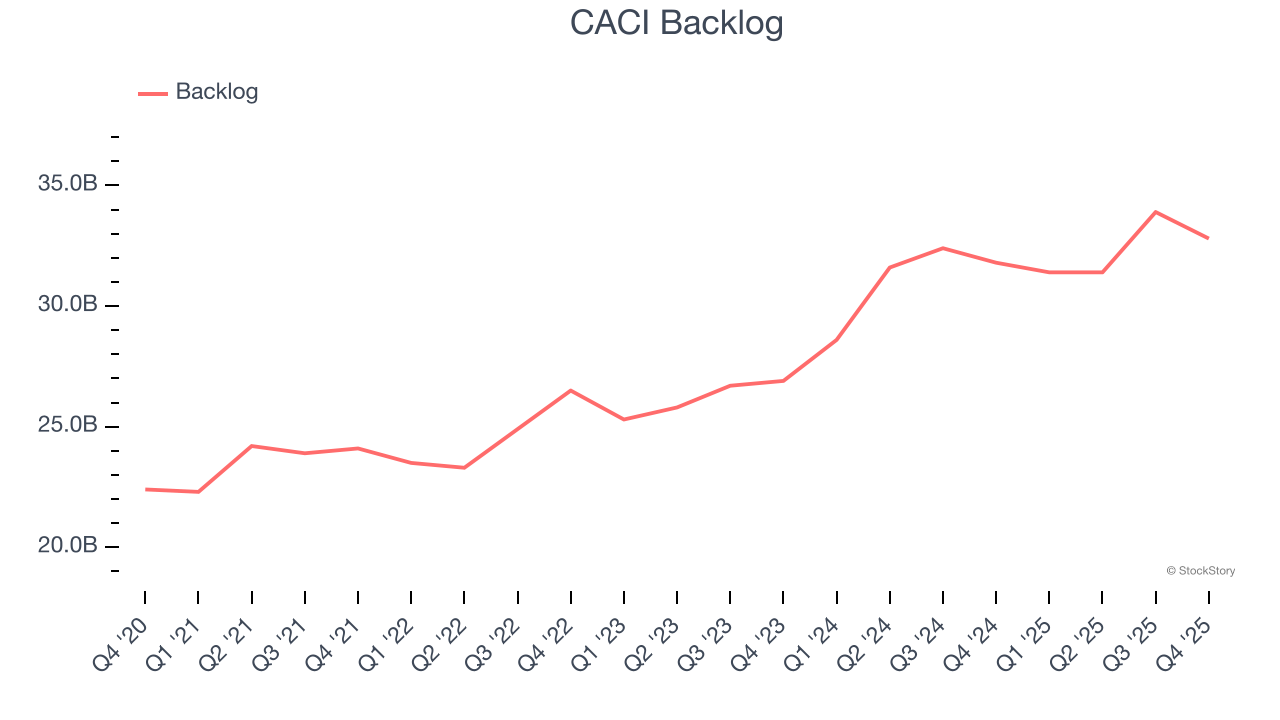
This quarter, CACI’s revenue grew by 5.7% year on year to $2.22 billion, missing Wall Street’s estimates.
Looking ahead, sell-side analysts expect revenue to grow 7.8% over the next 12 months, a deceleration versus the last two years. Despite the slowdown, this projection is above the sector average and suggests the market sees some success for its newer products and services.
Software is eating the world and there is virtually no industry left that has been untouched by it. That drives increasing demand for tools helping software developers do their jobs, whether it be monitoring critical cloud infrastructure, integrating audio and video functionality, or ensuring smooth content streaming. Click here to access a free report on our 3 favorite stocks to play this generational megatrend.
Operating Margin
CACI’s operating margin might fluctuated slightly over the last 12 months but has remained more or less the same, averaging 8.6% over the last five years. This profitability was higher than the broader industrials sector, showing it did a decent job managing its expenses.
Looking at the trend in its profitability, CACI’s operating margin might fluctuated slightly but has generally stayed the same over the last five years. This raises questions about the company’s expense base because its revenue growth should have given it leverage on its fixed costs, resulting in better economies of scale and profitability.
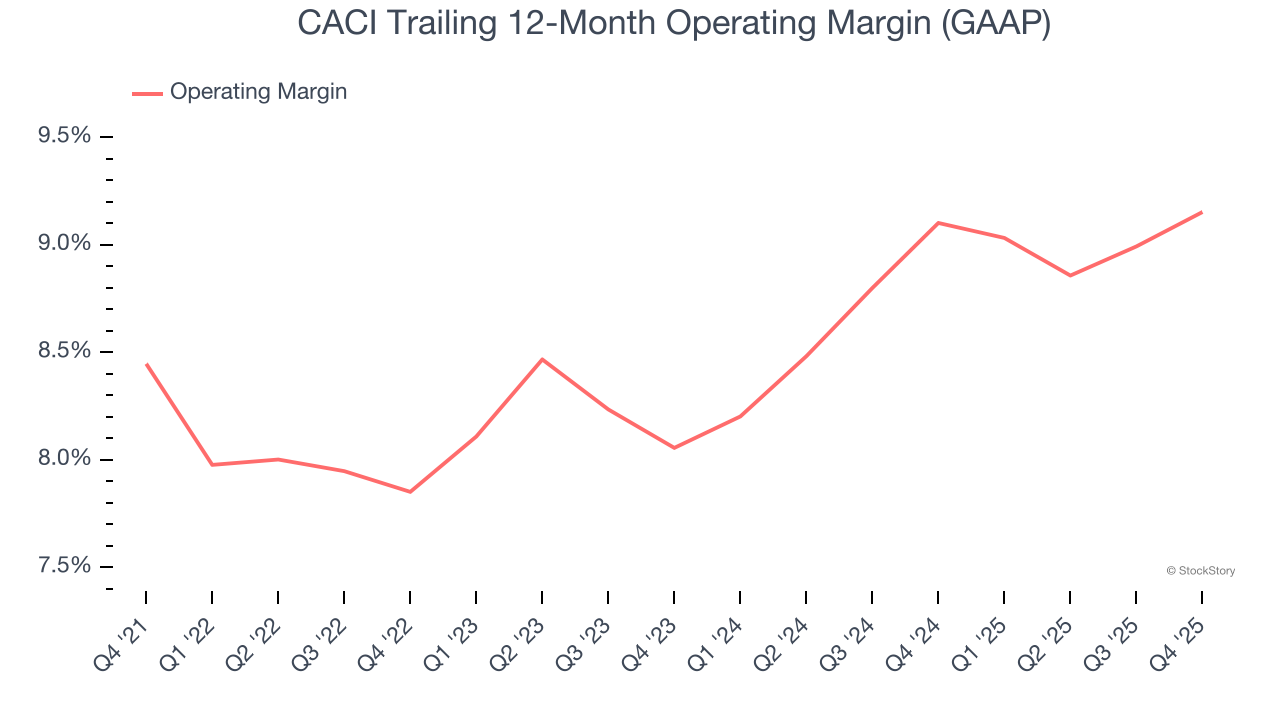
This quarter, CACI generated an operating margin profit margin of 9.3%, in line with the same quarter last year. This indicates the company’s overall cost structure has been relatively stable.
Earnings Per Share
We track the long-term change in earnings per share (EPS) for the same reason as long-term revenue growth. Compared to revenue, however, EPS highlights whether a company’s growth is profitable.
CACI’s EPS grew at a solid 11.4% compounded annual growth rate over the last five years, higher than its 8.8% annualized revenue growth. However, this alone doesn’t tell us much about its business quality because its operating margin didn’t improve.
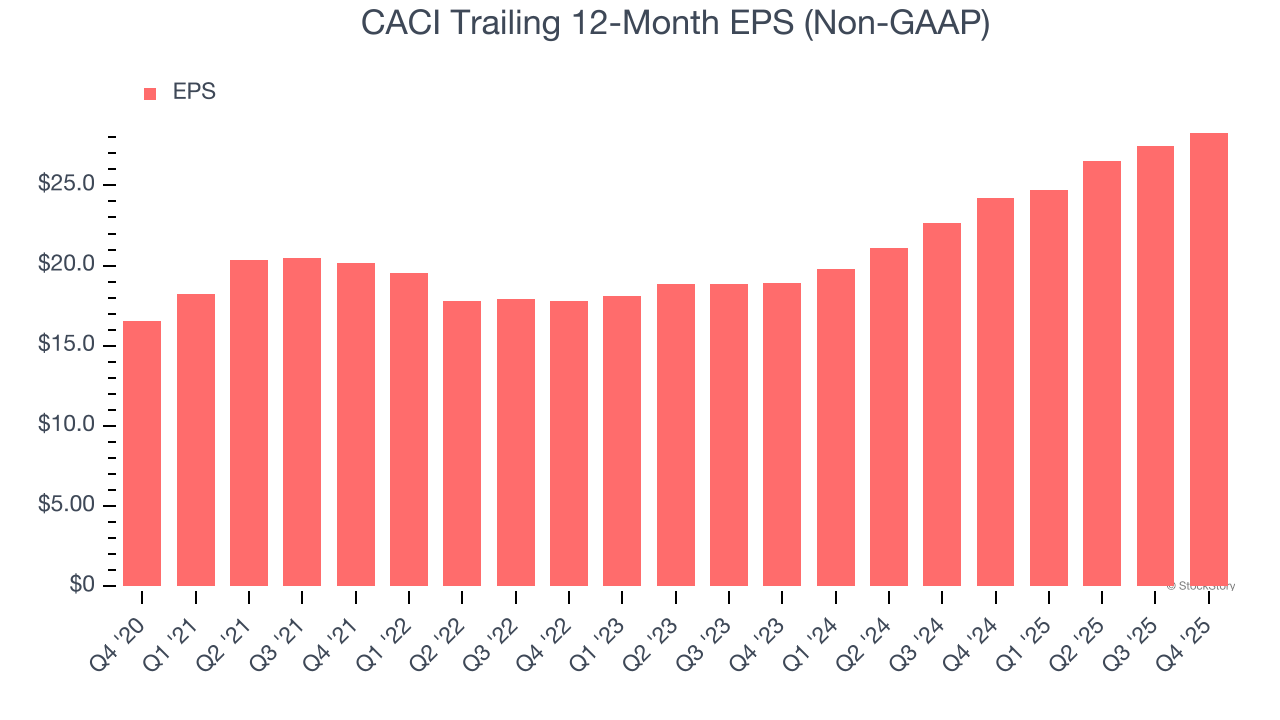
Diving into CACI’s quality of earnings can give us a better understanding of its performance. A five-year view shows that CACI has repurchased its stock, shrinking its share count by 13%. This tells us its EPS outperformed its revenue not because of increased operational efficiency but financial engineering, as buybacks boost per share earnings. 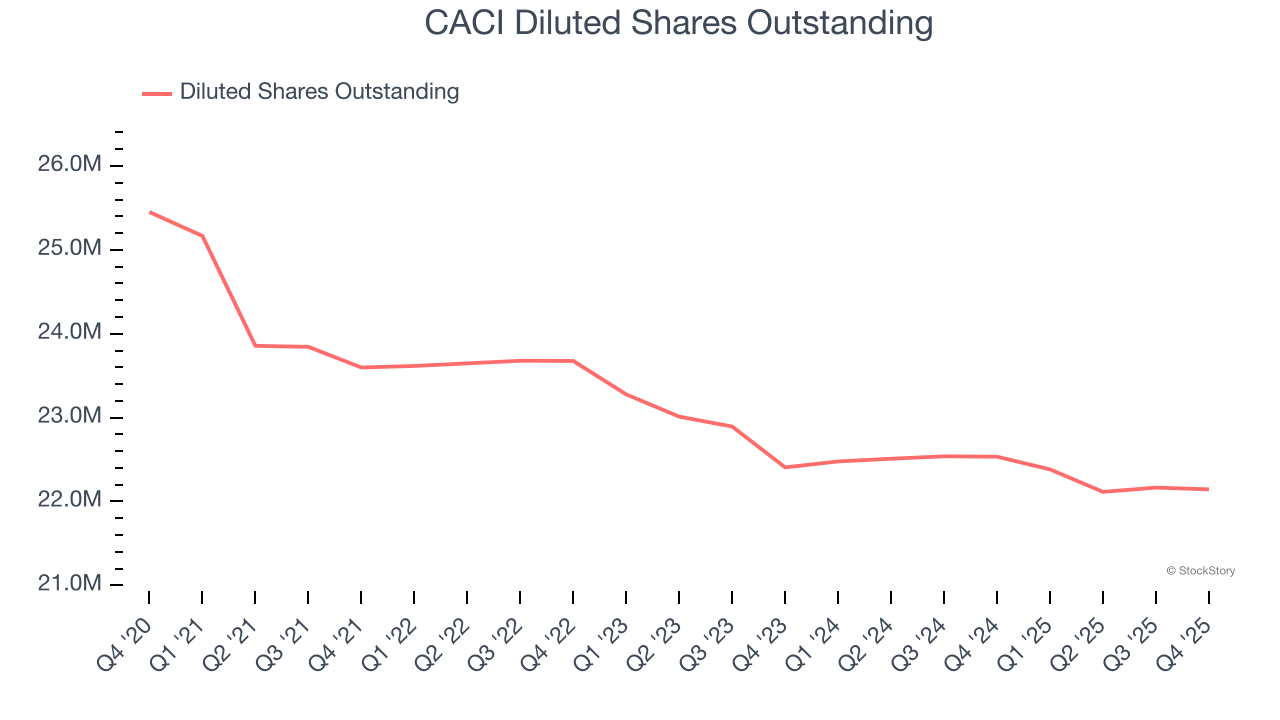
Like with revenue, we analyze EPS over a shorter period to see if we are missing a change in the business.
For CACI, its two-year annual EPS growth of 22.2% was higher than its five-year trend. We love it when earnings growth accelerates, especially when it accelerates off an already high base.
In Q4, CACI reported adjusted EPS of $6.81, up from $5.95 in the same quarter last year. This print beat analysts’ estimates by 4.9%. Over the next 12 months, Wall Street expects CACI’s full-year EPS of $28.29 to grow 4.2%.
Key Takeaways from CACI’s Q4 Results
It was good to see CACI provide full-year EPS guidance that slightly beat analysts’ expectations. We were also happy its EBITDA outperformed Wall Street’s estimates. On the other hand, its revenue missed and its backlog fell short of Wall Street’s estimates. Overall, this was a weaker quarter. The stock remained flat at $634.75 immediately following the results.
Should you buy the stock or not? If you’re making that decision, you should consider the bigger picture of valuation, business qualities, as well as the latest earnings. We cover that in our actionable full research report which you can read here (it’s free).