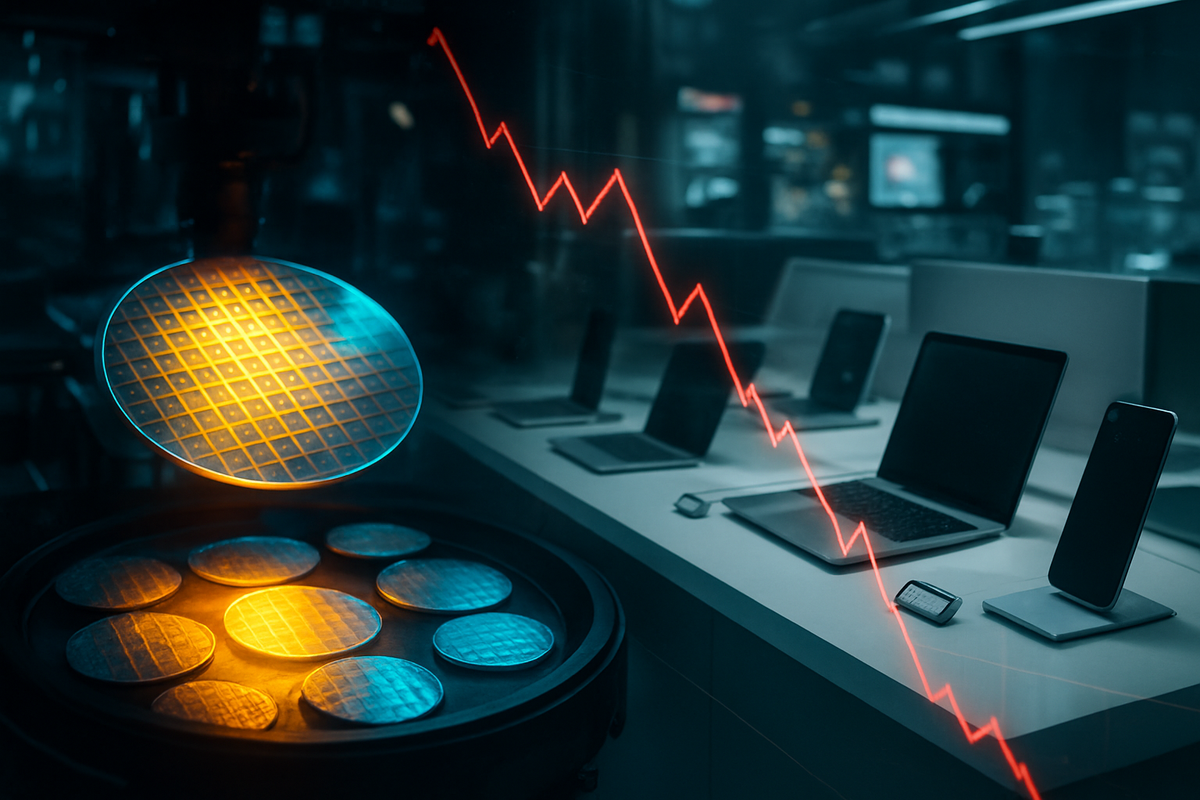
As of April 14, 2026, the global technology sector is grappling with a phenomenon industry insiders have dubbed "memflation"—a relentless surge in semiconductor prices that is now spilling over into the retail landscape. The AI-driven appetite for high-performance silicon has effectively cannibalized the supply chains for standard consumer electronics, forcing manufacturers to hike prices and leaving retailers caught in a tightening margin vise.
The situation reached a fever pitch yesterday when Goldman Sachs issued a stinging double downgrade for Best Buy Co., Inc. (NYSE: BBY), moving the stock from "Buy" to "Sell." The move serves as a stark warning to the broader market: the "Goldilocks" era of affordable consumer tech may be over, as the astronomical costs of producing modern hardware begin to erode corporate profits and stifle consumer demand across the globe.
The catalysts for this market shift are deep-seated and systemic. Throughout late 2025 and the first quarter of 2026, the world’s leading semiconductor foundries and memory makers have implemented a series of aggressive price revisions. Samsung Electronics (KRX: 005930) shocked the market in early 2026 by revising contract prices for DRAM by nearly 95% and NAND flash by 60%, citing the need to prioritize manufacturing capacity for high-bandwidth memory (HBM) required by AI data centers.
This supply-side pressure was compounded on January 1, 2026, when Taiwan Semiconductor Manufacturing Co. (NYSE: TSM) enacted a 3% to 10% price hike for its most advanced nodes. Reports indicate that a single 2nm wafer now commands a price tag of $30,000, a staggering 50% increase from previous cycles. This "input cost explosion" has filtered down the supply chain, reaching analog and power chip giants like Texas Instruments (NASDAQ: TXN), which implemented hikes of up to 85% on select components effective April 1, 2026.
Goldman Sachs analyst Kate McShane cited these "unprecedented" component costs as the primary driver for the Best Buy downgrade, slashing the price target from $76 to $59. The rationale is twofold: first, as manufacturers like HP Inc. (NYSE: HPQ) and Dell Technologies (NYSE: DELL) pass these costs to consumers, sales volumes are expected to plummet. Second, those consumers who do purchase are "trading down" to lower-margin, entry-level devices, further cannibalizing the profitability of big-box retailers.
The immediate market reaction was swift. Shares of Best Buy tumbled nearly 5% following the report, hitting a 52-week low. Meanwhile, hardware manufacturers are scrambling to adjust; Dell has already informed its commercial clients of price increases ranging from 10% to 30% for laptops and desktops, a move that would have been unthinkable just two years ago.
In this climate of escalating costs, the division between "winners" and "losers" is becoming increasingly distinct. The clear victors are the semiconductor titans with proprietary technology and dominant market share. Samsung and SK Hynix are seeing their memory revenues triple year-over-year, as they leverage the scarcity of NAND and DRAM to dictate terms to the entire electronics industry. Similarly, Intel Corporation (NASDAQ: INTC) has successfully navigated three rounds of price hikes since February, maintaining healthy margins despite the broader market's instability.
Conversely, the "losers" are the hardware OEMs and retailers who lack the pricing power to fully offset these costs. HP Inc. (NYSE: HPQ) is particularly vulnerable due to its heavy reliance on the price-sensitive consumer PC market; the company recently trimmed its 2026 earnings outlook by 30 cents per share, citing the "unprecedented" Bill of Materials (BOM) inflation. Even Apple Inc. (NASDAQ: AAPL), which traditionally boasts the industry's most resilient margins, is seeing its massive component stockpiles dwindle, leading to speculation that the upcoming M6-series MacBooks will feature significantly higher entry prices.
Retailers like Best Buy stand at the end of this inflationary whip. Unlike the manufacturers, who can partially pivot to high-margin enterprise or AI business, retailers are tied to the disposable income of the average consumer. As the cost of a mid-range laptop pushes toward the $1,500 mark, the pool of potential buyers shrinks, leaving retailers with bloated inventories of expensive hardware that may require deep discounting to move—further destroying profit margins.
This event is not merely a localized supply chain hiccup; it represents a fundamental shift in the global tech economy. The "AI Boom" has effectively created a two-tiered semiconductor market. The immense profitability of AI accelerators has incentivized foundries to shift their focus away from the "commodity" chips that power laptops, refrigerators, and smartphones. This has led to a structural supply-demand imbalance that mirrors the 1970s oil crisis, but for the digital age.
Historically, semiconductor cycles were characterized by brief periods of shortage followed by long periods of oversupply and falling prices. However, the current "memflation" trend suggests a new "higher-for-longer" price regime. Comparisons to the 2021 chip shortage are common, but the current situation is more dangerous because it is driven by a permanent shift in manufacturing priority rather than a temporary logistical bottleneck.
Furthermore, there are growing regulatory concerns. As the cost of essential technology rises, policymakers in Washington and Brussels are beginning to scrutinize whether the pricing power of the "Big Three" memory makers constitutes a market failure. While no formal antitrust actions have been launched as of April 2026, the rhetoric from the Department of Justice suggests that the "digital divide" created by these price hikes could soon become a matter of national economic security.
Looking ahead, the short-term forecast for the consumer hardware sector remains bleak. Analysts at Gartner suggest that total semiconductor revenue could exceed $1.3 trillion by the end of 2026, but they warn that this growth will come at the expense of non-AI sectors. In the coming months, expect a wave of strategic pivots from hardware manufacturers. We are likely to see a surge in "Refurbished-as-a-Service" models and longer hardware replacement cycles as consumers hold onto their devices for five or six years instead of the traditional three.
In the long term, this crisis may force a relocation of supply chains. To mitigate the costs associated with the Asian foundry monopoly, companies like Intel and GlobalFoundries (NASDAQ: GFS) may receive further government subsidies to accelerate the development of domestic "value-tier" chip production. However, these facilities will not be operational for years, meaning the high-price environment is likely here to stay through at least 2027.
The emergence of "software-defined hardware"—where the performance of a device is managed via the cloud to compensate for less powerful, cheaper physical components—could also gain traction. This would shift the profit center from the hardware itself to recurring subscription services, a transition that companies like Apple and Dell are already beginning to explore more aggressively.
The Goldman Sachs downgrade of Best Buy is more than a single stock rating; it is a "canary in the coal mine" for the 2026 economy. It signals that the costs of the AI revolution are finally being passed down to the average consumer, with potentially devastating effects on retail demand. The era of cheap, disposable electronics is being replaced by a reality where a smartphone or a laptop is a major capital investment for a household.
Investors moving forward should keep a close eye on memory contract prices and the quarterly margin reports of mid-tier hardware OEMs. If HP or Dell show further margin erosion in their next earnings calls, it will confirm that the "memflation" crisis has moved from a supply-side annoyance to a full-blown demand-side threat.
In summary, the semiconductor industry is currently the engine of the global economy, but that engine is becoming increasingly expensive to fuel. For the market to stabilize, either AI demand must cool—allowing capacity to return to consumer chips—or a new generation of low-cost manufacturing must emerge. Until then, the tech sector remains in a period of high-stakes volatility, where only those with the strongest pricing power will survive.
This content is intended for informational purposes only and is not financial advice