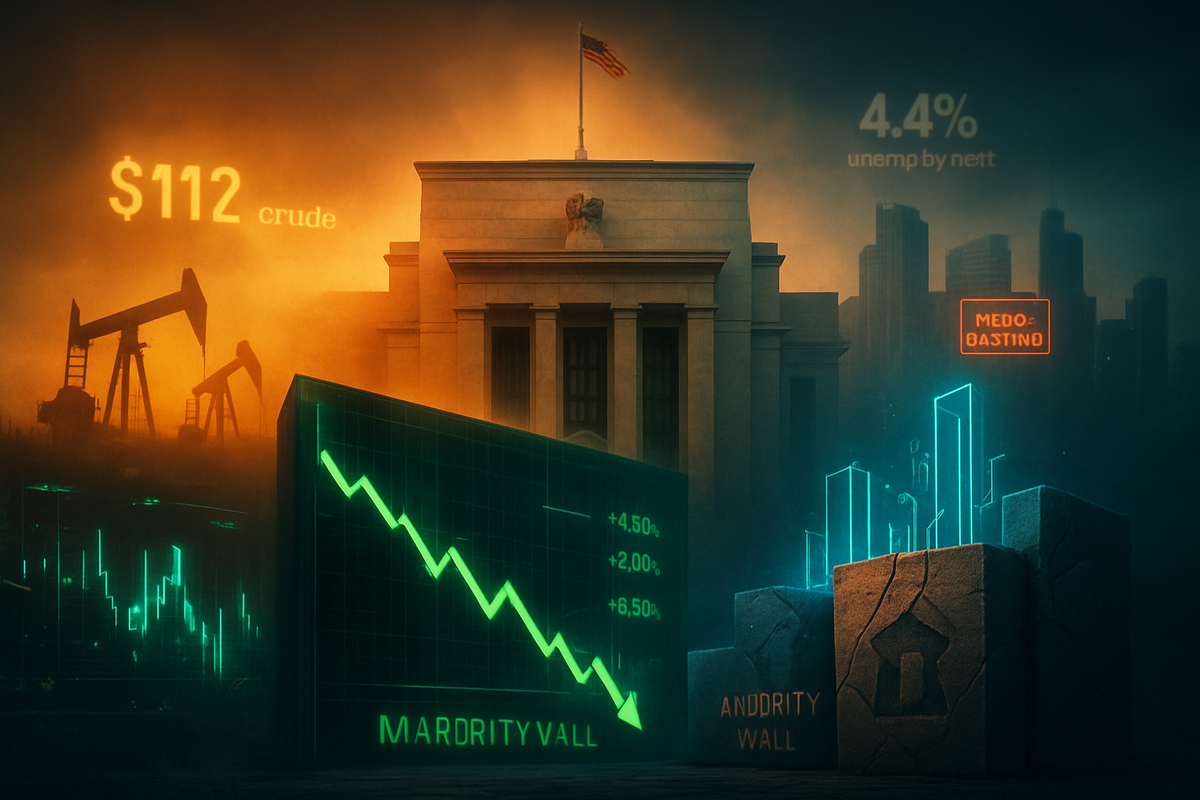
As of March 27, 2026, a profound disconnect has emerged between the Federal Reserve’s hawkish projections and the aggressive easing expectations of the financial markets. Despite a series of stubborn inflation reports and a geopolitical energy shock that has pushed Brent crude above $112 per barrel, market participants are increasingly pricing in three interest rate cuts for the remainder of 2026. This optimism persists even after the Federal Open Market Committee (FOMC) suggested a much more conservative path during its mid-March meeting, signaling a "higher for longer" regime that has kept the federal funds rate steady at 3.50%–3.75%.
The immediate implications of this standoff are felt across every asset class. While the Fed remains laser-focused on a Core PCE inflation rate that has settled at a sticky 2.7%, traders are looking past the price pressures toward a rapidly cooling labor market. With the unemployment rate recently jumping to 4.4% and the economy reporting its first major monthly job loss since the pandemic era, the market is betting that the central bank will be forced to pivot to avert a full-scale recession, regardless of whether inflation has hit the elusive 2% target.
A Divergence of Data: Inflation Heat vs. Labor Chills
The timeline leading to this pivotal moment began in early 2026, when optimistic projections for a series of rapid rate cuts were derailed by a "scorching" Producer Price Index (PPI) report in January and a sudden escalation in the Middle East conflict. The resulting spike in energy costs forced the Fed to revise its inflation forecasts upward during the March 18, 2026, FOMC meeting. The updated "dot plot" revealed that the median participant now expects only a single 25-basis-point cut this year, likely delayed until December. Fed Chair Jerome Powell emphasized that the "last mile" of the inflation fight is proving to be the most difficult, citing the energy-driven volatility as a significant headwind to price stability.
However, the market’s counter-narrative gained steam following the February jobs report, released in early March. The data revealed that the U.S. economy lost 92,000 non-farm payroll jobs—a shock to a system that had been characterized by "insatiable" hiring just a year prior. This deterioration in the labor market, combined with a 0.2% drop in real retail sales, has convinced major players like Citigroup (NYSE: C) and even some internal Fed members like Vice Chair Michelle Bowman that a more aggressive easing cycle is necessary. Bowman recently broke ranks with the hawkish consensus, stating she has "penciled in three cuts" for 2026 to support a labor market that is showing signs of structural exhaustion.
Corporate Tug-of-War: Winners and Losers in the Volatility
The shifting rate expectations have created a bifurcated landscape for public companies. In the banking sector, the "higher for longer" reality has been a double-edged sword. JPMorgan Chase & Co. (NYSE: JPM) has seen its net interest margins remain resilient, though its chief economists warn that the energy shock could eventually stifle loan demand. Meanwhile, Goldman Sachs Group Inc. (NYSE: GS) has leaned into the volatility, raising its price targets for mega-cap technology firms like NVIDIA Corp (NASDAQ: NVDA) and Microsoft Corp (NASDAQ: MSFT). Goldman analysts argue that these "AI-centric" giants are uniquely positioned to grow earnings even in a high-rate environment, as long as the market anticipates eventual relief.
Conversely, the real estate and infrastructure sectors are bearing the brunt of the Fed’s stubbornness. Real Estate Investment Trusts (REITs) like Prologis Inc. (NYSE: PLD) and American Tower Corp (NYSE: AMT) have traded near 52-week lows as the 10-year Treasury yield surged to 4.38% in late March. High borrowing costs have complicated the financing of global projects, forcing a shift from expansion to debt management. Public Storage (NYSE: PSA) attempted to navigate these waters by announcing a massive $10.5 billion acquisition of National Storage Affiliates, signaling that in a high-rate world, scale is the only defense against rising capital costs. For those facing a "maturity wall" of debt, private equity titans like Blackstone Inc. (NYSE: BX) have stepped in, offering private credit at premium yields of 8% to 12% as regional banks pull back.
Wider Significance: The End of the Ultra-Low Era
This conflict between market pricing and Fed rhetoric fits into a broader global trend of "stagflationary" anxiety. The current environment draws sharp historical comparisons to the mid-1970s, where energy shocks and sticky inflation forced central banks into a defensive posture even as the economy weakened. The market's insistence on three cuts suggests a belief that the Fed will eventually adopt a "higher inflation target" implicitly, prioritizing financial stability and employment over a strict 2% price mandate.
The ripple effects extend beyond the U.S. borders. With the "Iran War" impacting global energy supplies, central banks in Europe and Asia are watching the Fed's next move with beated breath. A failure by the Fed to cut rates could further strengthen the dollar, exporting inflation to other nations and potentially triggering a global currency crisis. Furthermore, the regulatory environment is tightening; as unemployment rises, there is renewed political pressure on the Fed to fulfill its dual mandate, potentially leading to legislative scrutiny of the bank’s independence if a recession takes hold before the November elections.
What Comes Next: The April-July Decision Window
The short-term focus for investors now turns to the upcoming April and June FOMC meetings. If the labor market continues to shed jobs at the current rate, the "Citigroup scenario" of an April cut may move from a fringe theory to a market reality. However, if Brent crude remains above $110, the Fed may find its hands tied, leading to a "hawkish hold" that could send shockwaves through growth stocks.
In the long term, companies will likely be forced to undergo strategic pivots. We are already seeing tech firms like Microsoft (NASDAQ: MSFT) investing heavily in custom AI silicon—such as their "Maia" chips—to offset the rising energy costs of their data centers. Market opportunities will likely emerge in "distressed" sectors where the 2026 debt maturity wall is highest. For investors, the ability to identify companies with the cash flow to self-fund operations rather than relying on a return to 2% interest rates will be the key to navigating the rest of the year.
Summary and Investor Outlook
The current financial landscape is defined by a high-stakes game of chicken. On one side, a Federal Reserve remains wary of an 1970s-style inflation rebound; on the other, a market that is convinced the cooling labor market will force a three-cut easing cycle. The primary takeaways are clear: inflation is no longer the only risk—unemployment and the "energy-debt nexus" have taken center stage.
As we move forward into the second quarter of 2026, investors should watch for any signs of the Fed "blinking" in its public rhetoric. If the 4.4% unemployment rate ticks higher in the next report, expect the pricing for an early summer cut to solidify, providing a potential tailwind for REITs and growth-oriented tech. However, as long as the geopolitical situation remains volatile, the risk of a "zero-cut year" remains a distinct, albeit unpopular, possibility. Caution remains the watchword for the months ahead.
This content is intended for informational purposes only and is not financial advice.