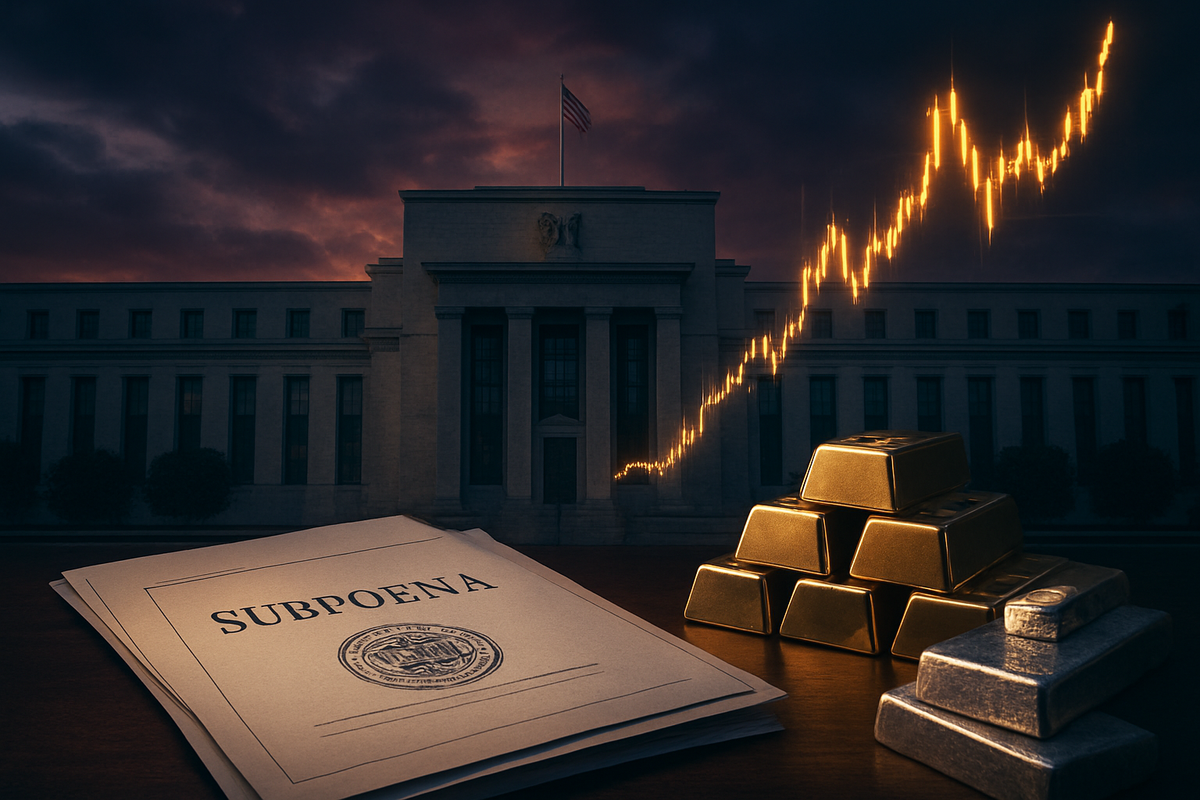
As of March 23, 2026, the foundational pillars of the American financial system are trembling. The long-standing independence of the Federal Reserve—a cornerstone of global market stability for over a century—is facing an existential threat from the executive branch. In an unprecedented move, the Department of Justice has served a series of subpoenas to high-ranking Fed officials, including Chair Jerome Powell, signaling a coordinated institutional attack designed to force the central bank into a policy of "fiscal dominance" to fund the nation's ballooning $38 trillion debt.
This calculated assault has shattered investor confidence in fiat currency, igniting a parabolic surge in "hard assets" known as the "Debasement Trade." With the executive branch pressuring for more accommodative policy to service fiscal deficits, the market's response has been swift and unforgiving. Gold hit a historic peak of $5,608 earlier in the year, and silver eclipsed the psychological $120 mark, as the world’s capital seeks sanctuary from what many see as the deliberate erosion of the U.S. dollar’s purchasing power.
The War on the Eccles Building: A Timeline of Encroachment
The current crisis did not emerge in a vacuum but is the culmination of a multi-year campaign to politicize monetary policy. Throughout 2025, the executive branch moved from rhetorical critiques to active institutional sabotage. The administration first attempted to bypass traditional checks by seeking the removal of Governor Lisa Cook and installing loyalist voices like Stephen Miran, whose public dissents in late 2025 advocated for radical rate cuts regardless of inflationary pressure. By the time the calendar turned to 2026, the conflict had escalated into a legal battleground.
In early March 2026, the Department of Justice, under the guidance of Attorney General Pam Bondi, weaponized an investigation into the $2.5 billion renovation of the Federal Reserve’s Marriner S. Eccles headquarters as a pretext for deeper scrutiny. The serving of grand jury subpoenas to Chair Jerome Powell and other members of the Board of Governors has been characterized by legal experts as a "prosecutorial ambush." The intent appears clear: to use the threat of criminal investigation to coerce the Fed into lowering interest rates, thereby cheapening the cost of government borrowing and facilitating massive fiscal spending.
Initial market reactions have been characterized by extreme volatility and a "Sell America" sentiment. While the S&P 500 has seen wild swings, the real story lies in the collapse of the "Fed Put"—the long-held belief that the central bank would act independently to stabilize the economy. With Powell’s term nearing its end in May 2026, the fear is that his successor will be a political appointee tasked not with price stability, but with debt monetization. This has led to a dramatic spike in term premiums as bondholders demand higher yields to compensate for the risk of rampant inflation and political interference.
Winners and Losers in a Fiat Crisis
The primary beneficiaries of this institutional chaos have been the producers of real assets. As the "Debasement Trade" accelerated, Newmont (NYSE: NEM) and Barrick Gold (NYSE: GOLD) saw their valuations soar, driven by massive margin expansion as the price of their primary product outpaced rising operational costs. Similarly, Freeport-McMoRan (NYSE: FCX) has become a darling of the "post-fiat" portfolio, benefiting from the dual tailwinds of a gold surge and the structural demand for copper in a re-industrializing world. ETFs such as the SPDR Gold Shares (NYSE Arca: GLD) and the iShares Silver Trust (NYSE Arca: SLV) have seen record-breaking inflows, effectively becoming the new "reserve assets" for institutional desks.
Conversely, the traditional banking sector is reeling under the weight of "duration risk" and regulatory uncertainty. JPMorgan Chase (NYSE: JPM), led by CEO Jamie Dimon, has been a vocal critic of the DOJ’s tactics, warning that the loss of Fed independence will lead to a permanent upward shift in inflation expectations. Banks with significant holdings in long-dated U.S. Treasuries are facing steep mark-to-market losses as the bond market revolts against fiscal dominance.
Consumer-facing lenders are also in the crosshairs. Citigroup (NYSE: C) and Capital One (NYSE: COF) have seen their stock prices battered as the administration accompanies its attack on the Fed with populist measures, including a proposed 10% cap on credit card interest rates. This "pincer movement"—lowering the cost of government debt while capping the revenue of private lenders—has led to a structural repricing of the entire financial sector. Goldman Sachs (NYSE: GS) has managed to navigate the turmoil by aggressively pivoting its research to support the "liquid insurance" narrative of gold, but even their analysts warn of a systemic shock if the Fed's autonomy is formally dissolved.
The Post-Globalization Repricing of Risk
The current crisis marks a definitive end to the era of globalization-driven low inflation. For decades, the Federal Reserve operated in an environment where global trade and labor arbitrage suppressed prices, allowing for a more passive monetary stance. In the post-globalization world of 2026, characterized by fragmented supply chains and strategic resource hoarding, the "Debasement Trade" is more than just a hedge; it is a structural repricing of risk. Investors are acknowledging that in a world of persistent deficits and geopolitical tension, the "risk-free rate" of U.S. Treasuries may no longer be risk-free.
This shift mirrors historical precedents where central bank independence was sacrificed at the altar of fiscal necessity. Comparisons are being drawn to the post-WWII era and the 1970s, yet the current situation is exacerbated by the sheer scale of the national debt and the speed of digital information flow. The "debasement" occurring today is not just of the currency, but of the institutional norms that have governed the Western financial order since the Bretton Woods agreement.
The regulatory implications are profound. If the Fed becomes an arm of the Treasury, the "inflation target" of 2% will likely be discarded in favor of "nominal GDP targeting," a move that would effectively institutionalize higher inflation to erode the real value of the debt. This would represent a fundamental change in the social contract between the state and its creditors, leading to a permanent shift in capital allocation toward hard commodities and away from paper assets.
What Comes Next: The Path to May 2026
The immediate focus of the market is the May 2026 expiration of Jerome Powell’s term as Fed Chair. The short-term possibility of a "constitutional crisis" at the Fed is high, as Powell has signaled he will fight the DOJ subpoenas in court to protect the institution’s records. This legal standoff could lead to a temporary vacancy at the top of the Fed or the appointment of an interim "loyalist" chair, which would likely send gold and silver to even higher levels as the "debasement" narrative reaches a fever pitch.
In the longer term, the market will have to adapt to a world where the Federal Reserve is no longer a neutral arbiter. This will require a strategic pivot for asset managers, who must move away from the traditional 60/40 portfolio toward "real asset" heavy allocations. We may see the emergence of new "private" reserve currencies or a more aggressive push into decentralized finance as participants seek to escape the gravitational pull of a politicized dollar.
Potential scenarios include a "Volcker-style" revolt from within the Fed’s professional ranks or a full-scale "bond vigilante" movement that forces the government’s hand by pushing yields to unsustainable levels. Either way, the era of "easy" monetary policy supported by institutional trust has ended, replaced by a period where the quality of an asset is measured by its distance from a printing press.
A New Economic Reality
The events of March 2026 will likely be remembered as the moment the "Great Moderation" truly died. The weaponization of the Department of Justice against the Federal Reserve has stripped away the facade of technocratic neutrality, revealing a system struggling to maintain its own weight under $38 trillion in debt. The "Debasement Trade" is not merely a market trend; it is a vote of no confidence in the governance of the world’s reserve currency.
As we move forward, investors must watch for the outcome of the DOJ’s legal challenges and the identity of the next Fed Chair. These will be the primary signals for whether the U.S. is heading toward a period of "controlled" inflation or a more chaotic fiscal collapse. The record highs in gold and silver are sirens warning that the margin for error has vanished.
In conclusion, the market is no longer pricing in just a "soft" or "hard" landing, but a fundamental change in the flight path of the American economy. The significance of this moment cannot be overstated: the independence of the central bank is the last line of defense for the value of the dollar, and that line is currently being breached.
This content is intended for informational purposes only and is not financial advice.