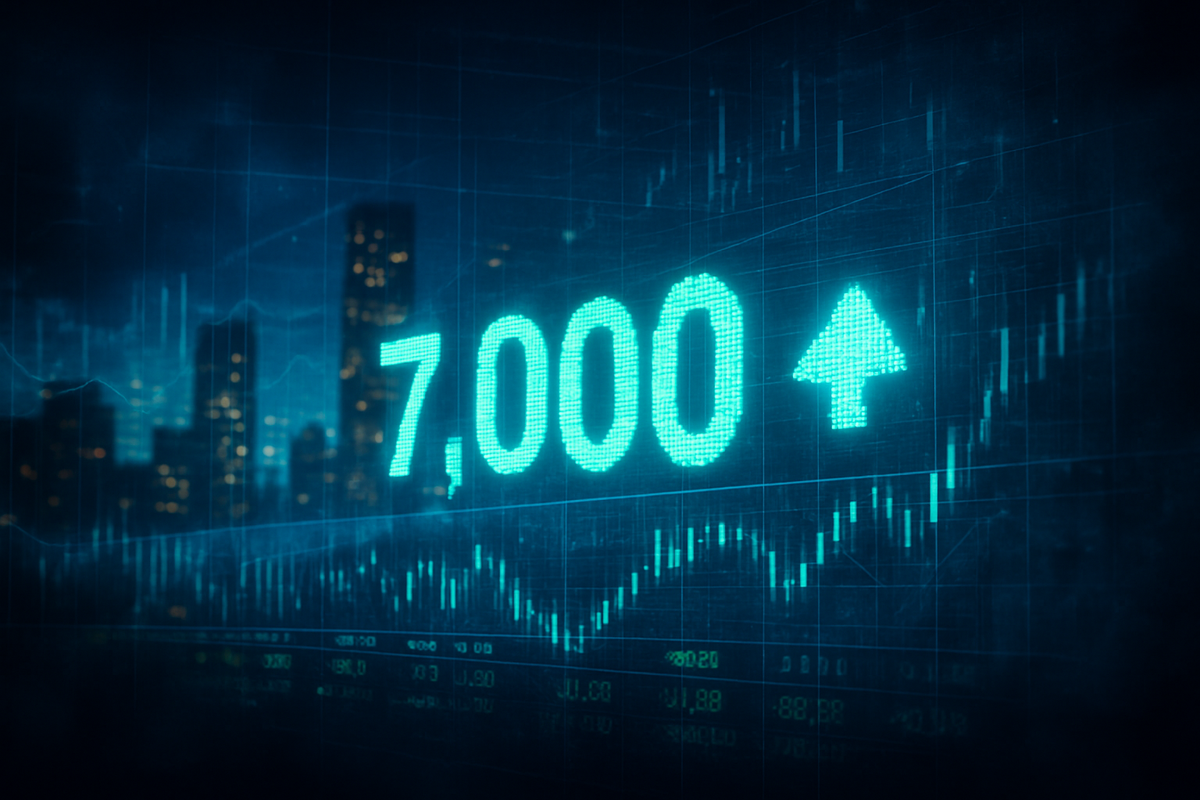
On January 28, 2026, the financial world witnessed a historic milestone as the S&P 500 Index (NYSEARCA: SPY) breached the 7,000-point threshold for the first time in history. Reaching an intraday high of 7,002.28, the index’s ascent from the 6,000-point mark took a mere 14 months, signaling a period of aggressive capital appreciation driven by the industrialization of artificial intelligence and robust corporate earnings. This psychological breakthrough marks a defining moment for the 2020s bull market, suggesting that despite a backdrop of rising geopolitical tension and domestic policy shifts, the appetite for U.S. equities remains historically resilient.
However, the journey past 7,000 has been far from a smooth climb. As of late February 2026, the market has entered a phase of "exhaustion at the summit," characterized by a tug-of-war between technical breakouts and a sudden surge in policy-driven volatility. While the milestone was a cause for celebration on trading floors, the subsequent weeks have seen the index retreat to roughly 6,876.19 as investors grapple with new global tariffs and a leadership transition at the Federal Reserve. This duality—record-breaking momentum met with sharp policy pivots—defines the current market regime, leaving investors to wonder if 7,000 is a new floor or a formidable ceiling for the year ahead.
The Road to 7,000: A Technical and Fundamental Surge
The push toward 7,000 was largely catalyzed by a "perfect storm" of fundamental drivers that crystallized in early January 2026. The primary engine was the Q4 2025 earnings season, where titans like NVIDIA Corporation (NASDAQ: NVDA), Microsoft Corp (NASDAQ: MSFT), and Meta Platforms Inc (NASDAQ: META) exceeded even the most bullish expectations. Unlike the "hype cycles" of previous years, these companies demonstrated tangible margin expansion attributed to widespread AI implementation. NVIDIA, in particular, remained the bellwether of this movement, as its next-generation Blackwell-2 chips saw unprecedented demand from both sovereign nations and enterprise data centers.
The timeline of the breach was swift. Following a Santa Claus rally that pushed the index near 6,800 in December 2025, the January effect was amplified by the "One Big Beautiful Bill Act," a fiscal stimulus package that buoyed consumer sentiment and retail participation. By mid-January, momentum indicators like the Relative Strength Index (RSI) began flashing overbought signals, yet the index continued to grind higher. On Wednesday, January 28, the market finally touched 7,002.28 in morning trading. While the S&P 500 failed to close above the level that day—ending at 6,999.71—the barrier had effectively been broken, triggering a wave of algorithmic buying.
Initial reactions were polarized. Institutional desks at firms like Goldman Sachs and Morgan Stanley noted that while the 7,000 level was "a testament to American corporate ingenuity," the valuation multiples—trading at roughly 21.5 times forward earnings—left little room for error. The initial euphoria was quickly tempered by the realization that such a rapid ascent often precedes a period of "mean reversion," leading to the technical consolidation seen throughout February.
Winners and Losers: The Great Rotation
The achievement of 7,000 coincided with a significant shift in market leadership, often referred to by analysts as the "Great Rotation." While the "Magnificent 7" drove the initial leg of the rally, the first two months of 2026 saw a pivot toward "old economy" sectors. The Invesco S&P 500 Equal Weight ETF (NYSEARCA: RSP) began to outperform the traditional market-cap-weighted index in February, as investors sought value in energy and industrials. Companies like Caterpillar Inc (NYSE: CAT) and Exxon Mobil Corp (NYSE: XOM) benefited from this rotation, as their dividends and more reasonable P/E ratios became attractive havens against high-flying tech valuations.
On the losing side of the recent volatility are major retailers and importers who have been caught in the crosshairs of new trade policies. Following the February 21 announcement of a new 15% global tariff, shares of Walmart Inc (NYSE: WMT) and Target Corporation (NYSE: TGT) faced selling pressure. These companies, which rely heavily on global supply chains, are now forced to navigate the potential for increased input costs and a "tariff tug-of-war" that could dampen consumer spending.
Furthermore, the banking sector has seen a mixed bag of results. While the nomination of Kevin Warsh as the next Federal Reserve Chair was initially viewed as pro-growth, the uncertainty surrounding his independence from the executive branch has caused a spike in the VIX, which climbed to 21.01 by mid-February. Financial giants such as JPMorgan Chase & Co. (NYSE: JPM) have had to recalibrate their interest rate outlooks, shifting from a clear path of cuts to a more cautious, data-dependent stance as the "Warsh-led Fed" prepares to take the helm.
Policy Shifts and Historical Precedents
The current market environment draws striking parallels to the late 1990s and the post-2016 period, where technological breakthroughs met aggressive trade stances. Historically, the move from 6,000 to 7,000 in just 14 months is among the fastest 1,000-point climbs in the S&P 500's history. This speed reflects a market that is increasingly "front-running" productivity gains from AI, much like the internet boom of the 1990s. However, unlike the dot-com era, the companies at the top today are highly profitable, providing a more stable floor for the index.
The wider significance of hitting 7,000 lies in what it says about the "neutral" state of the economy. The market seems to be pricing in a "no landing" scenario where growth remains robust despite higher-for-longer interest rates. Yet, the 15% global tariff introduced in February represents a significant ripple effect that could disrupt this narrative. If trade tensions escalate into a full-scale global trade war, the historical precedent suggests a "stagflationary" risk—lower growth coupled with higher inflation—which would be a nightmare scenario for an index priced for perfection at 7,000.
Regulatory scrutiny also looms large. As AI companies become the "infrastructure" of the global economy, the S&P 500's heavy concentration in tech makes it vulnerable to antitrust actions. The "One Big Beautiful Bill Act" provided the fiscal fuel for the rally, but the ensuing debt levels and the political transition at the Federal Reserve suggest that the policy environment is shifting from a tailwind to a potential headwind.
Looking Ahead: The Battle for 7,000
In the short term, the S&P 500 appears to be trapped in a range between 6,780 and 7,050. Technical analysts are watching the 6,800 level closely; a sustained break below this support could signal a deeper correction toward the 200-day moving average. Conversely, if the market can digest the tariff news and see a stabilization in the 10-year Treasury yield, a "second leg" of the rally could target 7,200 by mid-year.
Strategic pivots will be required for investors who have been overweight in mega-cap tech. The emergence of AI-driven efficiency in non-tech sectors—such as healthcare and logistics—presents a new opportunity. Companies that can demonstrate margin expansion through AI adoption without the extreme valuations of the chipmakers may become the new darlings of 2026. However, the challenge will be navigating the "mini-black swan" events, such as the ongoing diplomatic friction over Greenland and military operations in Venezuela, which have proven they can trigger rapid "risk-off" rotations.
Summary and Investor Outlook
The S&P 500’s journey to 7,000 is a landmark achievement that underscores the enduring power of the U.S. economy and its lead in the global technology race. It represents a 16.6% gain from the 6,000 level in record time, fueled by fiscal stimulus and a fundamental shift in how corporations operate in the age of AI. However, the "policy-driven volatility" of February 2026 serves as a stark reminder that milestones are often accompanied by growing pains.
Moving forward, the market’s ability to hold the 7,000 level will depend on two factors: the resilience of corporate earnings in the face of new tariffs and the clarity of the Federal Reserve’s path under new leadership. Investors should watch for the upcoming Q1 2026 earnings previews in March to see if the AI productivity gains are offsetting the increased costs of a protectionist trade environment. While 7,000 is a number for the history books, the real story of 2026 will be how the market adapts to a more complex, volatile, and politically charged economic landscape.
This content is intended for informational purposes only and is not financial advice.